Showing posts with label Discord. Show all posts

Monday, 2 June 2025

Aurora Horizon on Discord: after action report

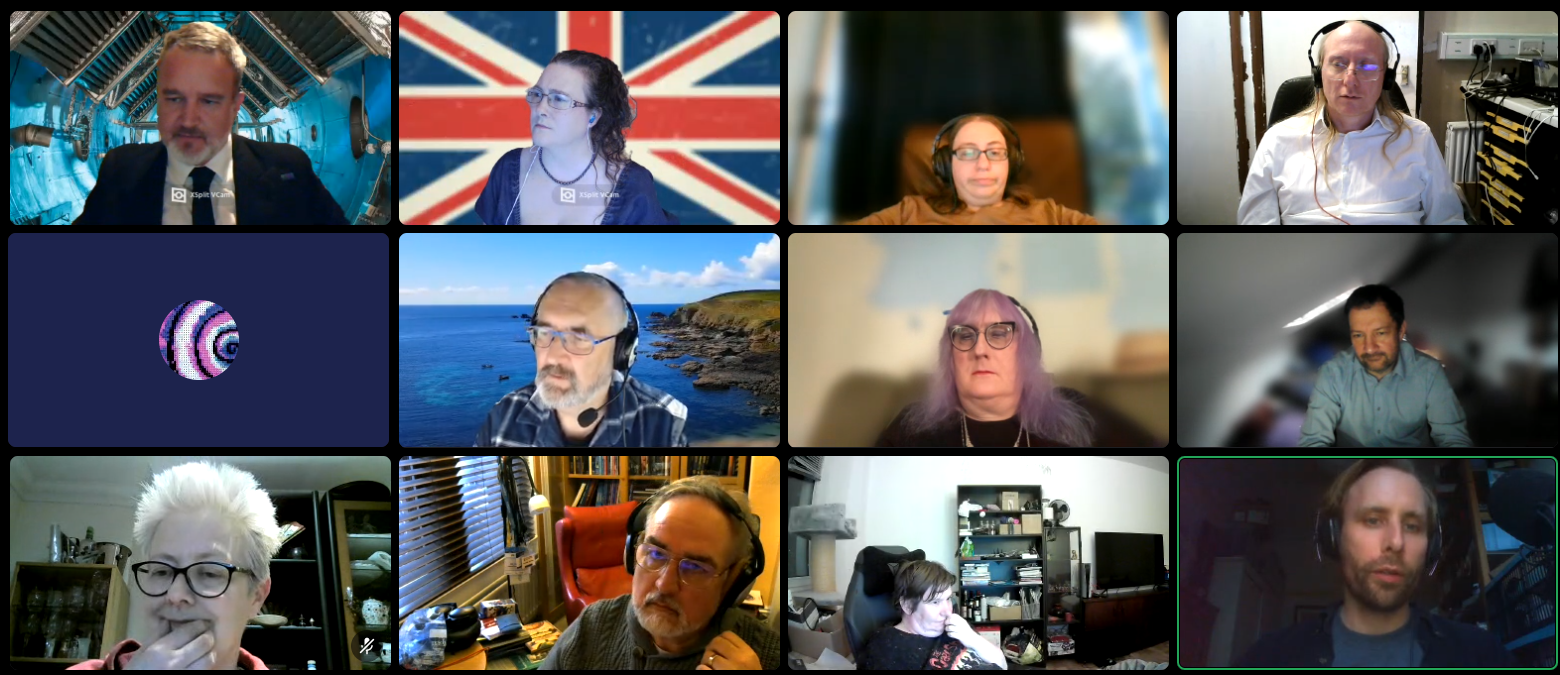
Last week, Aurora Horizon had its world premiere, held on Discord with thirteen players worldwide. (Well, mostly UK-based, but with one player in the US and another based in, well, I don’t know.)

(Aurora Horizon is part 6 of a long-running first-contact series of freeforms that I’ve been writing. You can read more about the design process here.)

Playing on Discord

TL;DR – it was a success!

As ever, though, I had a few things to think about and reflect on.

Before the game

YAMM: I decided to try a new programme, YAMM (Yet Another Mail Merge), to send out character sheets and background info. That turned something I find to be a bit of a drudge into a learning exercise, making it much more interesting for me.

YAMM is a Chrome extension that lets you use mailmerge in Gmail. This is how I used it:

First, I created shareable folders in Google Drive for each character. Into those I put their character sheets and other information.

Second, I set up a Google sheet with columns for email address, first name, character, and a link to the 

Third, I drafted an email in the correct format, with curly brackets denoting the fields from the Google sheet. (I’m skipping the bit where I got the format wrong and had to send it twice…)

Fourth, I used YAMM to turn all that into personalised emails. (This is easy – just pick YAMM from a menu in Google Sheets.)

The free version of YAMM lets you send 20 emails per day, which was more than enough for me.

YAMM also saved me from remembering to bcc my emails, which I occasionally forget to do.

Recruiting players: I have a list of about twenty players who have played the earlier games on Discord, so I try and fill my game from them before looking further afield. What I should have done was use a Doodle poll to choose the date, but instead I picked a couple of dates far enough ahead that I thought wouldn’t cause problems. I then swapped to a Doodle poll when the dates I had chosen were causing problems…

When I had thirteen players, I stopped the poll, announced the date and asked everyone to fill in the casting form. And interestingly, people who I didn’t think could make the date (based on the poll) completed the form, and I ended up with a short waiting list.

I had a player drop (the game wasn’t for her), but I filled it quickly.

And unfortunately, I had a player who wanted to play but had forgotten to complete the casting questionnaire, which felt awful when she got in touch/

Player queries: A couple of days before the game, I could tell the players were reading their character sheets as I started getting queries. (Which was helpful for me, as I’d put the game to one side for a few weeks and was already getting rusty.)

I’m always happy to field queries, although some suggestions I pushed back on where I felt they were deviating from what I was after.

The game involves a mission to investigate an alien spacecraft on Callisto, but when the game starts, the players’ ship (the Aurora Horizon) has suffered some damage. This forces them to curtail their stay drastically, and they must prioritise what they want to achieve. So the game has difficult decisions, and I felt that some of the initial queries were attempts to try to circumvent those decisions.

If this were a tabletop game, I might have said yes (because I generally like to reward player initiative), but in this case, I said no because I knew it would affect at least some of the other players.

Errors and glitches

And as always, the players picked up a few errors and glitches. There are always errors, no matter how hard I try. I’ve learned not to take it personally, but accept that players will always spot something my tired eyes have missed.

If the error was spotted soon enough, I would change the shared documents. But as the game got closer, I just updated the master documents and made a note to adjust things during the game if needed.

On the day

Aurora Horizon was due to start at 7:30 pm, but I was online from 7 pm (and had told everyone that). Several people joined just after 7, and we chatted and caught up. At about 7:25 pm, I chased the last two, and we started at 7:30 pm.

I carried out a short briefing, and then we started play.

Starting positions: In hindsight, I should have given everyone a starting position where they spend a few minutes roleplaying in small groups. That seems to be particularly important when playing on Discord.

Instead, everyone moved to the galley and started talking.

(I’ve now changed that and created four starting positions, each with three characters. The last character, the computer, can start wherever they want.)

But I must remember this for the next game: Start the game with everyone in small groups.

The game unfolds

The first hour for me was relatively relaxing. I just listened to everyone roleplaying and answering the occasional query.

Then we had the first EVA period.

This was always going to be a challenge, as I had to give each away team their own briefing (which I posted to them via the Discord chat). This took a bit longer than I expected (and I made mistakes as the Discord interface was clunkier than I thought). And then, once I had given everyone their documents, I had to answer queries.

This would have been easy if we had been playing a tabletop rpg (as I had considered earlier), and easier if we were face-to-face (as the briefings would all be printed out and ready to go), but Discord just slowed everything down.

In a sense, I was trying to run four different tabletop rpgs at once. I do like a challenge, and I don’t think it was awful, but I don’t think I’ll be repeating the experience in a hurry!

(It’ll be easier in person, I tell myself!)

I’d scheduled the EVA period to take 15 minutes. That was always optimistic, but I don’t know if that was the challenges of Discord, or lots of discussion, but the first EVA period took over an hour, and we ended up not having time for a proper second EVA period.

We overran a little, and from the discussion afterwards, players were saying they could have continued roleplaying for another hour. But it was a school night, and I was conscious that some people needed to be up early the next morning.

As usual, not everything came out, and as usual, the game went in directions I hadn’t anticipated, but overall I was happy with how it went.

Highlights

A few highlights:

  • Rich as CORA 9000, who used the HAL image as his Discord avatar and spoke in a robotic manner throughout the game.
  • Tom playing Dr Halvorsen, who creeped out all the other players by playing the ship’s medic completely straight-faced and yet somehow managing to be sinister. 
  • Alex’s sacrifice! Well, two sacrifices. I don’t want to say more, but I’m really pleased with the direction Alex took Lt Osborne.
  • Elyssia, Daniel and Tony renaming their Discord names so that they would always be grouped on the Discord screens.
  • Nathan as Commander Archer trying to keep a grip on everything.
  • Chatting afterwards. I didn’t need to rush away, and chatted with some of the players after the game for about half an hour. I think there was a little frothing going on, which is one sign that they enjoyed themselves.

(I probably have more highlights, but those are the ones that come to be right now.)

Overall

So overall, the game was a success. I have a fair bit of feedback to incorporate before running it at Consequences, but I’m on with that.

As always with post-game amendments, I have to decide whether to address the bits of plot that didn’t emerge. Did that happen because we ran out of time, or were my clues too subtle? Or was it just how the game ran that time? It’s hard to say, so I’m not planning on making too many changes.

As for Episode #7, I have some vague ideas. But I’m not thinking about that too hard just yet.

Tuesday, 30 May 2023

Messages from Callisto: How did it play?

Messages from Callisto is the fourth part of my series of linked freeforms involving aliens. I ran it earlier this month, online, using Discord. Last time I talked about its design; this time, I’m reflecting on how it ran.

Scheduling

My first challenge was choosing a date for the game. I created a Doodle poll with some dates and emailed everyone who had played before (and was still interested in playing), and while I got the most popular date, I still couldn’t fill the game.

(Now that games are being run face-to-face, online games may be less popular. I’m not sure why – I enjoy running and playing them online. They’re not as good as face-to-face, but they’re better than not playing…)

Anyway, with about a week to go, I still hadn’t filled the game (and I didn’t want to run it with fewer players), so I pushed it back three weeks and filled all the places. (Happily, I got two new players – one new to freeforming.)

First contact with the players

Once I sent out characters, I started getting questions.

One player complained about their character, and I realised I hadn’t read their casting form response correctly. So I radically changed their character to suit what they were looking for – and I’m glad I did so; I think the character is much better for doing that.

I also received questions about science and the specific NASA timeline that made me realise I should have set it three years later. Not that it would have made any difference to the plots, but ‘realistically’, the flight time from Earth to Jupiter is about six years, leaving no time for the development and construction of the probe itself. So in the rewrite, I’m moving it to 1993.

On the day

The day didn’t start well as I had a player drop, and I spent a while finding a replacement. Thankfully Julie stepped into the breach.

As for Messages from Callisto itself, well, maybe there were too many meetings. I had five topics for discussion, but perhaps they didn’t all need to be meetings. And while I had identified those who needed to attend each, it turned out that everyone wanted to hear what was going on.

And despite scheduling the meetings to last only ten minutes, inevitably, they overran. So there was less one-to-one roleplaying than I had hoped for, and not everyone had time to talk to those they wanted to talk to.

But apart from that (and a few players said they liked the meetings), the game went well. The time passed quickly, and we had good decisions (and dilemmas) to manage.

As I now do with all the games I run, I asked for feedback and stories. I got a great response, prepared an epilogue for everyone, and shared some of the stories.

Future changes

I’m hoping to run the game face-to-face at Consequences in November, so I need to take on the feedback from this run.

The main changes I need to make are around the meetings (as discussed above) and the decisions.

One player noted that while making decisions was good, the decisions themselves were made by only a subset of the group. He wondered if decisions could be delegated to subcommittees so more players are involved.

So I may do that – or I may give each player a vote, even if their character wouldn’t necessarily have one. That steps outside the usual “you are your character” style of play that typifies freeforming, but I will try to word it so it’s not too jarring.

However, a more challenging change concerns Children of the Stars, the previous game. I’m also running Children of the Stars at Consequences, and if the players make different decisions, that will affect Messages from Callisto

I’ve got ideas for how I manage this, but that’s a bigger topic I will probably cover in another post.

Overall

Overall, I’m pleased with how Messages from Callisto survived contact with the players. From the feedback I received, most of them enjoyed themselves (nobody seemed to have a terrible time), and I have good feedback I can use to improve the game for next time.

Wednesday, 25 May 2022

Kumospace for freeform larps

Recently I ran our Reunion with Death murder mystery freeform larp online using Kumospace. I called for players from the uk-freeforms mailing list and Facebook page and the Remote Larps Facebook group. I got nine players, including four people I’d not met before.

So, Kumospace.

Kumospace is a spacial chat—a virtual space where people can form groups for conversations. As a user, you are presented with a floorplan and you move towards someone to talk to them. Then, when you are close to them, you can chat.

Kumospace is (currently) free for up to 30 participants, so it’s ideal for gaming.

Kumospace for larping

So how was Kumospace for larping? Well, it was pretty good. I created a simple floor representing a hotel function space. I had different chairs, a piano playing in the corner, and some (virtual) drinks and snacks.

The game in full flow - I've got the map open which shows the whole floor

I also created a separate out-of-character floor where everyone met at the start so we could get used to the interface.

The video and sound worked well for almost everyone—one player struggled with video and sound, but we don’t know why that was.

Video itself can be a little small (especially if you are used to Discord). You can create a pop-out which shows a larger video if that helps (but still smaller than you get on Discord).

The virtual space gave a real physical sense of space—much more so than different channels in Discord. Other characters were definitely “over there” rather than “in that channel” which added to the ambience.

Changing layout

I found changing the layout is straightforward—it’s all drag and drop. Several templates can easily be modified, which saves some work. Creating a standard hotel/workspace/bar/convention setting is easy; if you want something more outrĂ©, that will be harder.

You can add images from the web to customise to your virtual space. (I didn’t need to do that.)

Some objects are (slightly) interactive—such as a tray of drinks that adds a drink icon to your avatar if you click on it. The glass or cup slowly empties, representing you drinking it. However, it would be nice if there were more game-y icons—so things where you could add some descriptive text.

I didn’t use rooms in Kumospace, as they introduced the feature only a few days before I was due to run Reunion with Death and I didn’t have time to figure them out. Rooms work slightly differently—in a room, everyone can hear everyone else. So that means you need not be close to someone to hear them properly, which would have been better for the debrief when everyone was crowded on top of each other.

What sort of larp?

Kumospace best suits conversational freeforms/larps. Games with items and money and complicated abilities won’t work so well. Of the recent larps I’ve played, Brest or Bust and Smoke and Mirrors (both at Peaky 2022) would have been fine on Kumospace.

As Reunion with Death was designed to be run online, it worked fine with Kumospace. The only complication is abilities, but none require the GM and the players managed them themselves.

I don’t think I could have run a more complex freeform with Kumospace. For my recent SF games (The Roswell Incident and All Flesh is Grass I used Discord with LARPPorterBot; I’m not sure how I would have done that with Kumospace.


It would be great to have a standalone app to manage items/abilities/contingencies that we could use alongside Kumospace or Zoom. Maybe one day.

Feedback from players

I asked for some feedback from the players on using Kumospace. Here are some of their thoughts:

  • I didn’t think I’d like it, but I was wrong. I was impressed!
  • Kumospace was the perfect online platform for this. Having the visuals of moving made for a wayyyy more natural experience of joining and leaving conversations—much more like real life—compared with the breakout rooms in Discord, where you are either ‘in’ or ‘out’ and nothing in between.
  • One thing worth flagging before start of play is that people might be able to hear everyone in a crowd if some people are outside the range, so piling up is a good idea. (NB—rooms, which I didn’t use, can overcome this.)
  • I struggled with Kumospace—you would think they’d show you the rooms you had invitations for.  (Once I got into it, it was great.)
  • Pleasantly surprised. I’d like to see it work in a way where players’ icons bounce off one another, rather than superimposing on each other.
  • I liked it. The flexibility of moving around in a room (instead of changing between channels) made the game more dynamic.
  • The video pictures of the other players were rather small, so you couldn’t see their faces as easily as on a regular video chat.
  • I liked wandering around and finding separate spaces for a private chat. It seemed nice to have the visual “room” compared to Discord. However, in practice it ate up wifi and I found it slow to respond. I couldn’t hear or be heard until I was top of other avatars, so it got in the way of roleplaying for me.
  • I suspect Kumospace changes the dynamics of games, resulting in more group interaction than two-person interaction. Not sure if this is a good thing or not.

On that last point, I remember observing that we typically had three groups of players at any one time. It was usually two small groups (two or three players together), and everyone else (so four or five players). So the players did bunch up—but I also see this in live games and on Discord.

Feedback as a GM

I found running the game was quiet)—although that may have been as much to do with Reunion with Death as Kumospace.

For Reunion with Death’s various announcements, I copied them from the pdf and pasted them into the global chat. I then made a short announcement to everyone (using the host’s broadcast function) telling them that the announcement was there—I didn’t read it out. That meant that players could look at the announcements at their leisure. (Unfortunately, you can’t post images to the chat.)

Towards the end of the game, I found it hard to read the room to judge when to stop the game. While I used the timetable that comes with Reunion with Death, I’d normally monitor the room towards the end of the game to work out when to bring the game to an end. However, this was much harder (also hard on Discord), so I used the game timetable.

Overall?

Kumospace was my first experience with spacial chat. It works for larps—especially simple larps without complicated mechanics. I intend to use it again—and I’d like to try it as a player.


Wednesday, 27 October 2021

The Highgate Club - online using Discord

In January 2021 I ran The Highgate Club, a freeform I co-wrote back in 2010 at Peaky. I’m fond of The Highgate Club—It’s a place where the people of hidden London (vampires, werewolves, sorcerers, immortals and more) gather. There are various plots involving Atlantis, a volcanic island up for auction, the return of King Arthur, Russian cyborgs, the last of the elves, and more.

Discord

I updated The Highgate Club a couple of years ago and Covid happened before I could run it in person. Given the success I’d had with other freeforms online, I thought I’d try it out using Discord.

The item bot

The Highgate Club uses items. A lot. Happily, one of my freeform pals was developing a Discord bot to manage items, and they got it ready in time for me to try. A week before we were due to run the game I had a crash course in installing Discord bots, and we tested it beforehand—it was a success and hopefully development will continue.

During play, I inadvertently installed it in the wrong channel, which I don’t think caused me any problems, but next time I’ll know better. We also found that the locations weren’t working properly, so we had to manually sort them out.

If the bot hadn’t worked, our fallback was for one of the GMs (probably Alan, my co-GM) to be dedicated to managing a huge spreadsheet.

Problem #1: Discord

While overall I think the game was a success, it wasn’t without a few issues. The first was that one player failed to join. We carried on without her, but it was frustrating. We’re not sure what happened—she struggled with Discord despite rebooting her laptop. (One thing we didn’t try was to check whether she could have used Discord on another device, or using it through a browser rather than the app. Or through a phone.)

I don’t know if the problem was her setup, or issues with her local internet connection. We had 16 people present, but nobody else had any difficulties.

Problem #2: The Decision

During the game there’s a joining ceremony and two characters apply join the club. Unfortunately, one of them was refused entry, and this upset her. I sympathised with her (I couldn’t quite see where the decision not to allow her entry had come from) and she carried on playing, albeit her game was spoiled as a result.

Mechanically, it didn’t make that much difference (as she wasn’t barred from the club) but it obviously affected her game emotionally. I’ve since tweaked the writing to make it less likely that either character will be blocked from being accepted.

As a side effect, I noted that it also affected me as well. It upsets me when players aren’t enjoying playing my games—I want everyone to have a good time. And I may have been more sensitive than usual, as it turns out I had Covid.

Problem #3: Covid

A few days after the game, I tested positive for Covid. While I didn’t have any of the classic symptoms I had been feeling below par—I thought I was fighting off a nasty cold—in hindsight I realised that I was suffering from Covid the weekend of the game.

Covid also affected my mood.

Normally after a game, I’m quick to write up my notes and reflect on how the game went. While I did sort out typos to sort out some of the smaller issues, I didn’t feel like reflecting on the session. It’s taken me over a month to write this up.

And my view of The Highgate Club was soured as a result.


Minor niggles

We had a few minor niggles.

Late starters: A couple of the players misread when the game was due, and thought it was the following day. So we started about 30 minutes late while we got in touch and waited for them. It didn’t occur to me to send reminders in advance, but maybe that was also Covid.

Discord rooms: I set up a few small (2 or 3 person) channels on Discord for people to have quiet conversations. Unfortunately, that made it hard for some people to get hold of others, as they were often in those rooms with other people and there was no way of getting them out. (Not everyone was paying attention to direct messages, which didn’t help.)

In future, I will have more channels but set the minimum number at four to make it easier for players to talk to each other.

Reading the room: From a GM’s perspective, watching the game being played is a lot less satisfactory on Discord than in person. It’s hard to “read the room” online, and I had little sense of how the game was going.

As a player, I find it distracting when you’re conversing with another player and a GM suddenly appears. All they’re doing is listening in, but it’s still distracting. So I tried not to do that—but that meant not seeing as much of the game as I would otherwise have.

Make it longer: A casualty of not reading the room is not knowing when to stop the game. I had originally planned to run from about 7:30 to 10pm, but we started late (as described above) and at 10:30pm I was flagging. I called the end of the game at 10:30, but I know that players were still busy and had I been able to read the room I would have let it carry on for a bit.

I think that’s an inevitable consequence of online play, but for The Highgate Club at least, I’ve added another 30 minutes to the run-time.

Once more with feeling

So my memory of The Highgate Club is tinged with Covid. It's probably time for me to run it again, but ideally face-to-face rather than Discord.