Showing posts with label Liminal. Show all posts

Sunday, 20 July 2025

The Department for Irregular Services – design notes

Three years ago, I had an idea for a Liminal crew assigned to Historic England, and responsible for dealing with Hidden World situations associated with scheduled ancient monuments and other historical buildings.

I wrote this up for the blog (here), and it sat in the back of my mind for a while.

Then, about a year ago, the temptation of mixing historical sites (which I love visiting) with modern horror/fantasy rpg grew too much, and inspired by Neil Gow’s Case Files Patreon, I decided to expand the article into an unofficial supplement for Liminal

Expanding the department

So I needed to develop the Department for Irregular Services (DfIS). Here’s the full team, NPCs and PCs:

  • Bernard McTavish, who leads the DfIS. (NPC)
  • Hester Babbage, the wheelchair-bound archivist. (NPC)
  • Cecil Philip Mayhew, a dead academic archaeologist “living” in a ghost realm.
  • Dr Cassandra Blackwood, occult history specialist (PC)
  • Titus Stone, expert in paranormal engineering and protective wards. (PC)
  • Grey Calderwell, the DfIS’s fae expert (PC)
  • Erik Grimsson, cryptozoology specialist. (PC)
  • DI Yasmin Burton, P-Division’s liaison officer (PC)

In my head, the youngest characters are in their fifties – the oldest are past retirement. (McTavish is 71.) Of course, players can play them at whatever age they want, but I like to think of the DfIS as a bunch of old folk.

Tools of the Trade

I decided that the DfIS probably has a store of occult artefacts – including a hand of glory, blessed weapons and other mysterious devices of limited use. My favourites are probably the Nails of Wem:

Nails of Wem: 17 bronze Roman nails were discovered with the famous Wem Hoard collection of coins and silver. To anyone with The Sight, the nails were clearly occult – and the DfIS took possession of them. When hammered into a doorway, a single nail will prevent the passing of any fae. The DfIS have only 11 nails left. 

One of the things I’ve tried to do is suggest that the world is wider and stranger than just the things that directly affect play. So I’ve dropped in hints and suggestions that can be expanded upon if a GM wishes. (For example, what happened to the other six nails?)

The investigations

I created three investigations – one of which was an update of an investigation I’d published previously.

The Hairy Hands involved the famous Dartmoor legend – they’re back! I wrote this after visiting Dartmoor and realising that we had been driving along the famous “hairy hands” road.

Hardknott Roman Fort Ghost Realm consists of a ghost realm new to the DfIS. This is the investigation I had already published, so it just needed updating to suit the department.

The Wherewell Cockatrice is a longer investigation that ends with the PCs face-to-face with a cockatrice, which I decided was a fae creature.

I ran my online group through these adventures, and we took about ten sessions to work our way through them all, which was about right. I’m not sure I’d use any as a convention one-shot, so that's maybe something I should work on.

The ghost realms

I figure the DfIS has records of dozens of ghost realms, and I thought it would be good to describe some. 

So I conclude with a description of four ghost realms: Machrie Moor stone circles, Rushton Triangular Lodge, South Stack Lighthouse, and Bilton Viaduct. (I’ve visited all of these, which probably gives you a sense of what I do on my holidays…)

One thing that I found I needed to pay attention to was making sure that the ghost realms aren’t too easy to get into. I like to assume that the world of Liminal is pretty much like our own, and since people aren’t being regularly swallowed by ghost realms (if it happened often it would be news and we would know about it), I made the ghost realms tricky to access (requiring specific times or activities to be performed).

AI input

Given the current furore surrounding AI art, I decided not to use AI for character portraits. Instead, I found suitable public domain and Creative Commons-licensed artwork.

However, I did use ChatGPT for brainstorming, so I acknowledged that.

Approval from Mr Liminal

Once I had everything formatted, I sent the pdf to Paul Mitchener to ask for permission to publish it, which he kindly granted me.

Purchasing The Department for Irregular Services

You can purchase The Department for Irregular Services from itch.io or DriveThruRPG.

Monday, 21 October 2024

Furnace 2024

A couple of weekends ago I attended Furnace, the RPG convention in Sheffield. As usual (previous reports here), I ran one game and played in three others.

Furnace is a lovely, friendly convention and would be the highlight of my gaming calendar if it wasn’t for all the other lovely events I go to.

Anyway, here’s what I played and ran.

Kids on Bikes

Fergus ran Swallows and Elder Things, an investigative scenario for Kids on Bikes where we played WW2 refugees sent to the country to stay with our uncle. (We were effectively Enid Blyton’s Famous Five – including a dog. I played Bea, nine years old and the youngest.) We uncovered dark secrets of an expedition to the Antarctic where our uncle had brought back something he shouldn’t. And thanks to some bad rolls, we all died in the climax to the ancient creature we really shouldn’t have reawakened…

Lots of lovely details (tongue sandwiches, ribbons, throwing sticks for Tommy the dog) – and everyone leaned into their characters. In fact, we had so much fun roleplaying kids that the scenario overran the slot a little – but it didn’t matter. Neither did the TPK ending.

DramaSystem (ie Hillfolk)

After lunch, I ran Success too Soon, a game for DramaSystem (ie, Hillfolk). My four players played members of a successful pop band who had reached the end of their first tour. We created the characters as usual in DramaSystem, and then their manager told them their record company wanted them to sign the next contract tonight, which kicked the game off.

While the band argued about what to do with the contract, I raised the stakes by introducing a parent who wanted to remortgage the house (and was relying on their income), and a music journalist looking for a scoop. We ended up with the band fracturing and one member going their own way.

This was the first time I had run this playset and it seemed to go well. As ever when I’m running a DramaSystem game, I felt drained at the end of it – I find it a very intense game.

Anyway, I’ve now put the playbooks on Itch.

Liminal

Elaine ran The Forgotten Station, a Liminal investigation into an old book which led us to a forgotten underground station and a dangerous magical ritual. I played Morgan, one of the Hidden, those who are easily overlooked (and inspired, I think, by Neverwhere).

As always, Liminal was a lot of fun. Lots of inventive London magic by our geomancer, and plenty of in-character chat, which I always like to see. We ended with a climactic battle against the forces of darkness (we won) and finished pretty much on the dot.

Mouse Guard

For my last game of Furnace, Guy ran Mouse Guard, where we had to track down a grain peddler who was suspected of being a spy. We faced terrible hazards including rain and a mink. I played Lillye, an enthusiastic guard mouse. (It’s fun being given an enthusiastic character – you just volunteer for everything!)

This was my first time with Mouse Guard. I had the book a while ago (a rare raffle win from a previous Furnace – it’s not the sort of thing I would normally buy), but I never got it to the table because it didn’t really make sense. And although it made some sense when Guy ran it, I felt the lack of system mastery when it came to the challenges – we were nearly defeated by the rain, and in the final battle, when two of us went up against a mink, we lost. I’m not regretting getting rid of Mouse Guard, but I’d like to play it again.

As for our adventure, we had a nice time, although it would have been nice to have a bit more time for some character stuff - we were all done a couple of hours or so.

Until next year

And that was Furnace 2024 for me.

There are other conventions at The Garrison (see them all here), but they are all too close to other gaming weekends, so I give them a pass.

Next on my calendar is Consequences, the freeforming convention in November.


Tuesday, 10 October 2023

Furnace 2023

It’s October and that means I’ve been to Furnace, the RPG convention in Sheffield held over two days (five sessions of gaming). I ran one game and played in three. This is how they went.

Dragonbane

First up was a Dragonbane scenario, The Village of the Day Before, ably run by Graham. I played grumpy mallard, Makander of Halfbay.

The scenario had a videogame feel about it – there was a problem to solve, which we had to solve by doing things in the right order. Fail (or run out of time), and everyone dies and the scenario resets. Fortunately, Graham didn’t make us go through everything for every reset – that would have been tiresome. We ended up with a tricky battle against a demon in which I (as the party tank) led the assault and almost died.

As a system, Dragonbane was new to me. It was extremely easy to pick up, which I was grateful for, and probably made it good for conventions.

It would have been nice to have fifteen minutes of session zero at the start to get the characters to bond with each other and create links to the scenario. As it was, we were an “adventuring party”, and we were going to the village because it might have some treasure. I know those are RPG tropes, but I’ve never been convinced by them.

DramaSystem

After lunch, I ran Hazelwood Abbey, which is Downton Abbey for Hillfolk/DramaSystem. My five players were Elina (Eldest Daughter), Lynn (The Heir), Dee (The Earl), Paul (The Spare) and Becky (The Youngest Daughter). 

Most players were new to the game, so I ran through the system, and we dived in. Everyone leaned into their characters and the situation. We had a lovely dramatic game with illegitimate children, money problems, a dodgy Heir and more.

This time, I found I needed some GM scenes to keep up the pressure on the main plot established at the start. (That wasn’t something I needed when I ran Hillfolk at Continuum.) So halfway through the game, I inserted a “GM” card into the deck I was using to call scenes; when it was my turn, I played whichever minor character I needed to play to keep things on track.

We wrapped up after about 2.5 hours with a satisfactory climax. It felt like an intense session, and I was grateful for a slightly longer break after the game. 

I will do a couple of things differently next time as The Heir and Spare need adjusting. The Heir decided that they were a distant relative, which put The Spare in an odd position. We sort of fudged it, but I’ve adjusted The Heir’s playbook to say that if The Spare is in the game, then the Heir should be a family member (ie an older brother). I think that would have been clearer.

I’ll make the playbooks available shortly.

Saturday evening

I never play slot 3 at Furnace; instead, I head home to see the family. So I re-read the Hillfolk rules. Having run it twice now, I’m already questioning some rules. I don’t know if that’s the difference between campaign and one-shot play, or whether I’m missing something, but it’s something I will reflect on as I run more Hillfolk/DramaSystem.

Unknown Armies

On Sunday morning, I played in Elaine’s Unknown Armies game – another system new to me. Elaine ran Jailbreak, a classic Unknown Armies one-shot featuring escaped convicts and an isolated farmhouse. I played Uder, the loving husband, and I’m not going to say more than that for fear of spoiling an excellent scenario. (And that’s a shame because I had a lovely scene with Elina, playing my lovely wife, which I won’t mention because it was sooooo spoilery.)

Jailbreak gets a thumbs up from me for using characters tailored for the adventure – it wouldn’t be as effective with a random set of pre-gens.

A couple of the players had played it before but couldn’t remember the details. Playing the scenario a second time isn’t a problem if you are deliberately antagonistic and help drive the action, which is what happened this time.

I didn’t get the hang of the rules – particularly the Madness Meter. But I think I made only one or two rolls, so it didn’t matter.

I expected the game to end up bloodier than it did – no characters died. Maybe we’re all getting more reasonable as we get older.

Liminal

And finally, a Liminal investigation run by Neil set in and around Newcastle (and written to accompany the forthcoming Novocastria book). With its vampires and werewolves, it’s easy to head towards horror in Liminal, but instead, Scream! If you want to die faster? focussed on genuine Newcastle folklore involving a traditional fair (The Hoppings) with its “danger night” and even an old curse). 

We played members of the Worshipful Company of Investigators – I was posh boy Simon D’Oliviera, a clued-in mortal. (And if that sounds familiar, it’s because the characters were taken from Pax Londinium – the Crew was sent on a mission outside London to the Grim North.) I’m not sure I played Simon particularly well – but I rolled dice, followed the clues, danced, was ineffectual in combat and enjoyed exploring liminal Newcastle.

One character was a London geomancer. Outside of London, you’d think their powers would be limited, but Neil had a great way to connect them to Newcastle through the gift of a magic Newcastle United shirt. (Geomancy is a tricky power if you run a game set in many locations – this was a neat solution.) 

Overall

So, three great games played, and I enjoyed running Hazelwood Abbey. Best of all was catching up with old friends, some of whom I hadn’t seen in years.

Maybe next year I’ll make one of the other Garrison conventions?


Wednesday, 4 January 2023

Other London: Desk 17 - status report

 I’m heading rapidly towards the finishing line for my Other London: Desk 17 RPG. 

Other London: Desk 17 is a modern urban horror RPG, where the PCs work for Desk 17, an obscure part of London’s Met that investigates magical crimes. So yes, it’s a bit Liminal and a bit Rivers of London, but also neither of those.


Assuming all goes to plan, the book will be 6x9 and around 80 pages long. There will be a bit of background, details on character creation, some pregens, lots of factions and NPCs, and a short investigation. Further adventures will follow. I’m using Fate Accelerated, which simplifies the system side.

I’m deep in layout at the moment. I have Affinity, but I’m struggling to use it on my laptop (it keeps crashing – I don’t know if that’s a conflict or if I have insufficient memory). So for the time being I’ve reverted to laying out the book in MS Word. That means I can’t upload it to DriveThruRPG, but I should be able to use Lulu. Either way, the pdf will come first – with luck by the end of the month.

NPC portraits

Artwork has been a challenge. Other London has been a labour of love. I’m not expecting much of a return, which rules out paying for artwork. But I like having artwork for NPCs, and Other London has a lot of NPCs.

So I’ve embraced AI art – in particular, Artflow.ai. Artflow lets me create portraits for everyone. They’re not perfect and can look samey, but I rationalised that by thinking that every artist has their own style – this is just artflow’s. 


One thing I like about artflow’s portrait creator is that you can tweak the results – turn the head, age them, and change their expression. The results can be a bit odd sometimes, but I’ve quickly been able to create portraits for all the major NPCs.

Other artwork

For other artwork, I’ve taken free-to-use images from Pexels and massaged them a little in paint.net.

Pregens

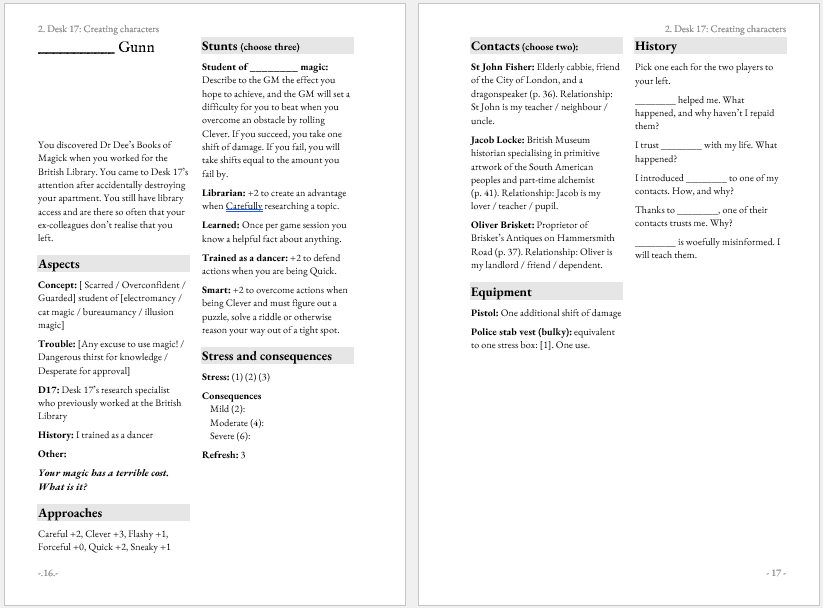
However, I have a dilemma for the pregens. I’ve created five pre-generated characters – they’re the ones I use at conventions when I run a Desk 17 one-shot. I’ve created them so they’re customisable – much like a PbtA playbook. So each character has options for their aspects, and they can choose different NPCs as their contacts.

And I want the players to choose their gender. But that means I can’t give them character portraits.

Current pregen design (character sheet design isn't my strong suit!)

I’m aware, however, that they would look better with portraits. But they wouldn’t be so useful at the table.

So I’m torn. I need to decide before too long.


Monday, 12 December 2022

MR James ghost story RPG scenario design

As I continue to listen to MR James’ ghost stories (see last post), my thoughts inevitably turn to how I would do this in a roleplaying game. And the short answer is, it’s not easy.

So what do I want from an MR James-inspired game?

A sense of unease

A sense of unease. Details. A sense of measured pace. A creepy backstory. Long-dead occultists whose reach extends into the present. No real closure. Things that should not have been done. Bleak endings.

Taken at Calke Abbey

MR James’ ghost stories lack the terror and horror stages that Ash Law talks about in The Trajectory of Fear. There’s unease and dread, but that never (or perhaps only rarely) becomes terror or even horror.

While that works for MR James, how on earth do I wrap it all up into an enjoyable RPG adventure? Compromises will have to be made.

Casting the Runes

Casting the Runes is Paul StJohn Mackintosh’s GUMSHOE-powered game of occult investigation, set in the world of M. R James’ ghost stories. The Design Mechanism publishes Casting the Runes, and you can download a preview here.

I don’t own Casting the Runes (and I’ve never played a GUMSHOE game), but from what I can tell, Casting the Runes is Call of Cthulhu (or, rather, Trail of Cthulhu) with ghosts replacing tentacles. So there are investigators, monster stats, combat rules, magic rules and so on. 

My main problem with Casting the Runes is that it doesn’t model the MR James stories. Monsters aren’t fought – they are mysterious and otherworldly. Magic isn’t used – except by the bad guys. That’s not what I’m looking for.

While researching this, I tried to find free scenarios for Casting the Runes (just in case I was mistaken). I found The Bone Mill and A Reckoning Come October (both by Dosmania) on itch.io. Instead of a traditional investigation, the two scenarios use a structure that I didn’t find easy to grok. But from what I can see, the scenarios appear to be traditional investigations.

What I’ve done so far

I’ve already used A Warning to the Curious as the basis for Operation Curious Warning, a D-Day mission for Achtung! Cthulhu. That’s about as far from MR James as you can get. In the scenario, Section M is charged with investigating and neutralising the legend of three ancient crowns said to protect the French coast from foreign invasion.

Unfortunately, whoever disturbs the crowns suffers a ghastly fate – so the PC who destroys the crown (allowing D-Day to be a success for the Allies) is doomed. 

While I’m pleased with the scenario, it’s much more pulp action than Jamsiean unease.

The only time I think I’ve got the Jamsiean aspects right is after the crown has been destroyed: that PC’s doom is foreshadowed by having a shadowy figure getting closer behind them. (“Sorry, Sir, I thought there was someone behind you.”) 

But given that the PCs are in the middle of a commando raid on a French chateau, any subtlety is lost in the cordite and action.

What I’m planning

My current plan is to base something around Count Magnus. Something has been accidentally awakened, and the long-dead count is stirring. 

I’m considering setting it at Calke Abbey, the National Trust property in Derbyshire. Calke Abbey passed to the National Trust in 1985, and much of it is in the same shabby condition as when it was handed over.

Taken at Calke Abbey

It is tempting to set the adventure in 1985 and involve members of the Department for Irregular Services (the Liminal crew I wrote about recently). They would be called in to check over the property before any work begins to make Calke Abbey visitor-ready, which would start our scenario.

And while that’s tempting, the scenario doesn’t feel quite the right fit for Liminal. I won’t get the bleak, supernatural feeling I’m hoping for with Liminal.

Instead, I think I need Cthulhu Dark.

I’ve written about Cthulhu Dark before – it’s elegantly simple and suits bleak one-shots. I suspect it’s what I’m looking for.

I haven’t made my mind up yet. While I suspect Cthulhu Dark would be ideal, I also want an excuse to give the Department for Irregular Services an outing.

I expect I’ll try them both.


Monday, 21 November 2022

Liminal: the Department for Irregular Services

I had an idea for a Liminal crew while I was on holiday – the Department for Irregular Services.

Silbury Hill, not far from the DfIS office. Please do 
NOT to climb the monument as it disturbs the spirits there.

Ancient monuments can be a draw for liminal beings. So, to both protect those beings and the general public (not to mention employees), the Office of Works set up the Department for Irregular Services (DfIS) in 1703. The department is now part of Historic England.

The DfIS deal with boggarts, ghost realms, fae, trolls and more. A Footpath Closed sign might indicate a footpath in need of repair, or it might be to avoid disturbing a sleeping troll.

Currently led by Bernard McTavish, the group is a team of six, based out of a haunted office in Marlborough, Wiltshire.

The team are now all getting on a bit – the youngest is 53. Most of the team have Lore and The Sight – both are essential in their kind of work.

Crew goal: Deal with liminal hazards (creatures, realms, etc) affecting Britain’s historical monuments. Protect monuments, employees and the public from liminal hazards – and vice versa.

Assets

Base of operations: An old office in Marlborough. Haunted.

Occult library:  Managed by Hester Babbage, the wheelchair-bound archivist.

Support: The crew are English Heritage employees.

Transport: Two pickup trucks with Highway Maintenance markings.

Hangers-on: Associates and contacts in English Heritage, National Trust, Cadw, Historic Scotland and elsewhere.

Cases

I’m not sure what I’m doing with the Department for Irregular Services yet, but I’m thinking about it. Maybe something for Furnace. 

(And while I’m waiting, they can sort out the Hardknott Roman Fort ghost realm and make the site safe for visitors.)

Fountains Abbey at dusk. The carving of the green man has
been known to sing, but sadly not while the DfIS has been on site.

Wednesday, 12 October 2022

Furnace 2022

Last weekend found me in Sheffield for Furnace 2022. 


Furnace runs over a weekend – three games on Saturday and two on Sunday. It takes me about an hour to get there, so I don’t play the Saturday evening game (slot 5).

One of the nice things about Furnace is putting faces to names that I see on The Tavern. Anyway, on with my games.

Slot 1 Saturday morning: The Raven Stone (AD&D, GM: Simon)

A proper, old-school game of AD&D. We had six of us trying to figure out what was causing the dead to rise (the eponymous Raven Stone) and then putting it back where it belonged.

We nearly had a player-induced TPK when our mage decided to kill a room of kobolds by drop-kicking bottles of ‘nitroglycerine’ at them. We cleared the kobolds, yes, but sadly (or, deservedly) our mage perished in the inferno.

Although I’ve been roleplaying since 1981, this was my first proper game of AD&D. I never played it back in the day (it was Traveller and Call of Cthulhu for me), and I rarely play D&D now. I found the system confusing – it lacks a modern consistency (sometimes you need to roll high, sometimes low). Luckily Simon had all the modifiers in his head, and I just needed to roll the dice.

Slot 2 Saturday afternoon: The Haunting of Abbeyham Priory (They Came From Beyond the Grave! GM: Tom)

This was delightful fun with lots of hammy fun with five of us investigating a mystery in the style of a 70s Hammer Horror movie. 

The system was simple (although we had the usual business of finding that the skills don’t quite work for the situation you want) and I really liked the quips – each character has several catchphrases that give them extra dice when they say them. So we did that often, and the system rewarded us with more dice.

A great, light-hearted con game – although I can’t imagine playing this as a campaign.

Slot 4 Sunday morning: Perfect Organism (ALIEN, GM: me)

My turn to run something. I had a few preflight nerves, but I always get that with a scenario I’ve not run before. I had one player drop, which was fine - the other three were awesome and really leaned into the conflict and agendas I’d created.

The scenario worked well (phew!), and I didn’t even kill any of the characters (although there weren’t many NPCs left alive by the end.) 

Some lovely moments: All the character banter, particularly the ICC lawyer and the W-Y executive. The players gamely ignoring what they knew and playing their characters. One player throwing an NPC into the path of an attacking facehugger. Kathar Station blowing up.

Slot 5 Sunday afternoon: Mischief Night (Liminal, GM: Sue)

Four P-Division agents tracking down some missing cream for a Halloween-themed adventure. Very irreverent, with some great banter around the table and trips into Northampton’s medieval tunnels and a creepy fairy realm.

I really like four-player games – it gives me space to develop a relationship with the other players and their characters, which I don’t find so easy with higher player counts. However, I appreciate the difficulty at conventions as it means you need more GMs.

Furnace 2023

I’m already looking forward to Furnace 2023 – but next for me is Retford freeforming in November and then Airecon in March.


Wednesday, 9 December 2020

Loose ends: a Liminal mini-campaign (and some thoughts on Liminal)

I didn’t mean to run a Liminal mini-campaign. My original plan was to run Prodigal Son and The Haunting, to a) try running someone else’s adventure, and b) to try my hand at Liminal.

But the players were enjoying their characters and had questions about their backstories and I didn’t want to run more one-shots without exploring that. I also wanted to draw it all to a close (because I don’t like extended campaigns).

So this is what I did. (Click here if you’d like to see the Trello board we used. I’ve moved some of the GM-facing bits over that the players didn’t see—I originally had them on a separate board and only copied them over when I needed to.)

Loose ends

We had a fair number of loose ends after Prodigal Son and The Haunting. These included:

  • What was Charles Gardner up to?
  • What was Ariadne doing with the knife?
  • Where was Mark Northcott?
  • What was going to happen with Sir Tatton Northcott’s library?

And that’s not including the questions in the character backstories:

  • Who were Ygraine’s parents?
  • What had Naomi’s mentor done? And where was he?
  • Who had destroyed Stephen’s pack in the Lake District?

Focussing on the characters

So rather than give the characters cases to solve, I created problems for the characters to deal with while I worked out a narrative that linked their backgrounds together. Here’s what I decided:

  • Naomi: Naomi’s mentor (Dr Belnap) was secretly a member of the Shrivelled Rose (mentioned in passing on Liminal p.210), seeking their own twisted vision of human perfection.
  • Ygraine: Ygraine’s parents were a high-ranking politician’s wife and a Fae of Queen of Hyde Park’s Court. However, her mother had actually been taken by the Winter King and was trapped in his realm.
  • Stephen: Stephen’s pack had been killed by Dr Belnap (assisted by Charles Gardner and a crazy vampire called Suzy Shrike) and then experimented on as part of the Shrivelled Rose’s plans.
  • Aaron: The vampire that set Aaron on his dark journey and into the Liminal world was Suzy Shrike (Charles Gardner’s associate).

Problems problems

Some of the problems the players faced:

  • The ambitious vampire Ariadne (from Prodigal Son) approached Stephen with information about the murder of his pack. In exchange, Ariadne wanted Stephen to show her how the knife of Lethe works…
  • Sir Tatton Northcott left his library (and a peculiar cabinet) to Naomi in his will. However, the Council of Merlin approached Naomi and suggested that it would be good for her if she gave them the library instead. But the players don’t trust the council…
  • Having experienced two ghost realms (in Prodigal Son and The Haunting), the Crew decide to hide the library in another ghost realm in Leeds. They find a potential realm near the City Varieties music hall, but how to get into it?
  •  Becoming trapped in a ghost realm at Hardknott Fort and rescuing innocent bystanders from the winged horrors hidden within. (I wrote this up as an encounter here.)

My preparation for each session was to create a list of events and moments that I thought might happen, or that I might introduce to complicate things. I tracked these using a checklist in Trello (on my GM board), which I found worked really well. (At the end of each session I asked the players what they might want to follow up on, which gave me something to plan.)

At the end of one session the players asked if I knew what they would do. I told them I had no idea—but that I had created a situation (populated with people, things and events), and then I simply reacted to their actions. While I had an overall direction in mind for the things I knew they were interested in, I had no sense what they would do from scene to scene.

Colourful characters and unpleasant artefacts

I created numerous NPCs for the PCs to interact with. These included:

  • Holly Greenwood—Fae owner of a crystal shop opposite City Varieties in the centre of Leeds.
  • Tiberius—an immortal Roman legionary (“I don’t know why I’m so old; I just haven’t died yet.”) and living in the Lake District.
  • Karen White—fearless reporter on the trail of our heroes.
  • Jurgen Heim—dark wizard, er I mean evil wizard of the Shrivelled Rose.
  • Ethel Beardsley—the nun with a gun.
  • Hannah Smith—PhD student who took a shine to one of our heroes.
  • Suzy Shrike—the crazy vampire who sleeps in a coffin of dirt.
  • Dr Cartilage—Edinburgh’s ineffectual Council of Merlin representative.
  • Creepy kids—in the fae world (these had no stats or anything—just a photo of the Midwich Cuckoos and the description “creepy kids” on their Trello card).
  • A lazy, video-game-playing and junk-food eating (and ensorcelled) fae lord.

Not all of my NPCs entered play, but that’s okay as I’m sure they will appear in another game one day.

I’ve been creating weird and unpleasant artefacts for Tales of Terror for years, so it was inevitable that some would find their way into Liminal.


I did these with cards on the Trello board, with a description and a photo. The players had access to the Trello, and they also added details or photos, which was great.

The players seemed to enjoy running around the “real” world. We used Google Maps when scouting locations, including City Varieties in Leeds, Hardknott Roman Fort, Holyrood Park in Edinburgh. That’s one of the things I like about a modern-day game—the detail is limitless.

Wrapping it up

The mini-campaign ended up in a fae domain that the Shrivelled Rose had corrupted. The main access was in the garage of an industrial unit, which the Crew sneaked into (excellent usage of the False Face glamour trait—Liminal’s version of Polyjuice potion).

The domain itself I modelled on Cragside, the National Trust property in Rothwell. The house was occupied by the fae lord of the realm (a lazy chap corrupted by the dark wizards from the Shrivelled Rose), while the stable block contained the laboratories—and a nursery away in the woods.

Final encounters

With their base in the fae realm exposed by the Crew, the Shrivelled Rose decided to make a hasty retreat. The Crew released the fae lord from his ensorcellment, freed his court from their tooth-egg prison, and stopped the Shrivelled Rose from escaping.

We satisfyingly conclude most of the character arcs:

  • Stephen avenged the death of his pack by killing both Dr Belnap and Charles Gardner.
  • Naomi cleared her name with the Council of Merlin by exposing her mentor’s crimes.
  • Aaron faced Suzy Shrike and is accepted into P Division.

And Ygraine? Ygraine learned that her mother was one of the Winter King’s brides, and set off in search of answers…

About Liminal

As for Liminal itself, I never found myself completely comfortable with the rules and too often I wished that I was using Fate Accelerated instead. Often I made something up whenever we hit a grey area, and we seemed to hit those regularly. It’s not that Liminal is complicated, but it is just complex enough that we spent more time consulting the rules than I prefer.

I still prefer a looser ruleset that I can handwave, and when it came to creating winged horrors that attacked the PCs in a ghost realm at Hardknott Fort, I ignored traits and abilities and simply decided on the effects I wanted.

Liminal’s core concept

There’s something that bugs me about Liminal’s core concept though. In Liminal the PCs investigate mysteries. The difference between Liminal and other investigative roleplaying games is that the player characters are “liminals”, someone between both the Hidden World and the real world. (Liminal’s core concept is not explained until page 63 which describes what the PCs do in the game.)

Liminal comes with a good selection of character concepts (gutter mage, eldritch scholar, changeling, and so on) and the four pregenerated characters described above.

However.

All the pregens are misfits, fitting neither in the ordinary nor the Hidden World. They all have different reasons for that and they encapsulate the concept of being “liminal”. But many of the character concepts feel like they’re all firmly part of the Hidden World: Warden, Dhampir, Face, and Man in Black.

So what are the differences between those in the Hidden World, those in the modern world and the liminals in between? And should there be consequences for going too far one way or the other?

Suggestions for Liminal’s second edition

I know it’s early to be thinking about a second edition, but these are the things I would like to see in Liminal 2.0.

Core concept: Put the core concept at the front of the book! Liminal is a British urban fantasy rpg in which the players solve mysteries—this needs to be one of the first things you read (and not on page 63). I would also like to understand what the differences are between the modern world, the Hidden World, and those in between.

Character generation: Currently, Liminal character generation is mostly mechanical: focus, skills, traits. I would like to see links and bonds between the characters. Even the bare minimum of how did you learn about the Hidden World? and how did you join the Crew? would be a start. But I’d go further and include questions that bond the Crew together.

Crews: Crews are important in Liminal, and although we followed the process, we struggled with our Crew’s goal and purpose. The process system should spit out well-designed crews with compelling goals and purpose, so I think it needs looking at. And maybe a section on downtime would be worth including.

Factions: I would like to see each faction having goals and objectives (or maybe just rumours of these) to give them direction and bring them into conflict with each other. At the moment, they’re fairly static. How do they feel about the other factions?

Layout: While Liminal’s art is stupendous, the other elements of graphic design aren’t as powerful. The font is a little small and the lines are too long—which means it’s not easy to read (particularly for someone like myself in their fifties). Either have a gap between paragraphs or a first-line indent, not both. And the tables on page 33 and 41 could be more appealing. And I’ve mentioned stat blocks previously.

Skills and examples: More examples of things like social challenges (for example, intimidating and persuading) would help. We found that Lore was, without doubt, the most important skill—because it’s used both for casting magic and for general knowledge about the Hidden World, it gave the magic-using characters too much spotlight. Perhaps Lore needs splitting in two: Lore (knowing about the Hidden World) and Magic (using magic)?

A more thorough proofread: I found quite a few typos and inconsistencies. Is it Melee or Melee Combat? Hidden World or hidden world? Liminal could do with a more thorough proofread.

Enough Liminal for now

And that’s probably it for Liminal from me for a while. It’s been a fun thirteen sessions, but time to give something else a try.


Friday, 13 November 2020

Other People’s Adventures: The Haunting

Episode 2 in my experience of running other people’s adventures—this time Paul Mitchener’s The Haunting for Liminal which follows on from Prodigal Son. The Haunting didn’t need quite as much work as Prodigal Son, and I had fewer issues with the text. Some points though:

  • The Ghost Spirit has the wrong trait (insubstantial instead of immaterial).
  • It’s not clear, but I decided that P Division have asked for the police to keep bystanders away from Thornhill Hall.
  • Where is Mark? At the end of the previous adventure, Mark Northcott is presumably reunited with his father. (This happened when I ran Prodigal Son.) I decided that Mark had left the house again and his whereabouts was currently unknown.
  • The players may want to talk to witnesses or the press—I had a witness and reporter in my back pocket in case they were needed. (We used the reporter.)
  • The social challenge to persuade the guardian spirit not to attack could be clearer—it’s an opposed roll, but using which skills? And at what level? (I said that it was a level 10 roll using Charm—but only by someone who can see the spirit.)

Countdown clock: I created a short countdown clock for the adventure:

  1. Sir Tatton Northcott dies. Letter is delivered to Naomi. (This is where the players come in.)
  2. Ghosts escape, the Thornhill Hall appears ghostly at night, there is an attack by a ghost. Police block access to the manor.
  3. The newspaper publishes a report of the ghost attack “Mystery Assault at Thornhill Hall”
  4. Charles Gardner sneaks into the ghost realm. Ghosts try attacking him, but Gardner sees them off and they keep him at bay.
  5. Gardner finishes draining the energy - releasing the ghosts into the wider world.
  6. P Division arrive, late as usual.

(I’m not sure if Gardner would be able to see off the ghosts in a fair fight, but I want Gardner to be tougher than the ghosts.)

On Geomantic Hauntings by Bishop Ferrar: I turned this into a handout (well, a Trello card) with the key information about draining geomantic energy taken from the text. That means the players can refer to it without me having to read it out. (There are a couple of other places where handouts might be useful—such as the press reports about the house appearing on the hill each night. This is the sort of thing that I think a published adventure should provide as a matter of course.)


Other Factions: And what of the other factions?

  • P Division: Aware of the site, but are limited by what they can do and they arrive too late.
  • The Council of Merlin: Aren’t interested in Thornhill, but I had one of them contact Naomi to secure the Northcott library for the council, using this as a bribe to help her reinstate her good name.
  • The fae, werewolves and vampires: Uninterested in Thornhill (but they’d probably like access to the Northcott library).
  • The press: Stories about the haunted house may attract cranks of all shapes and sizes from the ordinary world—so I had some ideas for those in my back pocket.

NPC stat blocks: Following Prodigal Son I changed the stat blocks as I found providing the different challenge levels slightly less intuitive than simply turning them into a modifier. So the Guardian Spirit became:

  • Initiative modifier: +2 (Awareness)
  • Attack modifier (melee only): +3 Poltergeist must spend 1 Will to act
  • Attack modifier (Terror): +4, use Conviction for defence
  • Defence modifier (melee/ranged): +3/+0 (magical or blessed weapons only - other weapons cannot harm it)

In practice I add the modifier to 8 to get the challenge level—when defending a melee attack, the PCs need to roll 11.

I did this to make it easier in the event that I have NPCs and foes battling each other: decide who is going to make the roll, then apply all the modifiers (attack and defence) to that single roll. 

How did it play: It took about two hours, and was pretty straightforward. I introduced a reporter character who followed the players into the ghost realm and I think caused them more problems than anything else. While there wasn’t much physical combat, there was a fair bit of magical combat this time and the players ended up very low on Will. Overall, a success.

Thoughts on running other people’s adventures

After running Prodigal Son and The Haunting, I have a few thoughts on running other people’s adventures:

  • Running someone else’s adventure isn’t necessarily less effort than running your own. It does mean that you don’t need to generate a core story—but you do need to make it your own.
  • Don’t forget that there’s no wrong way to play! (It can be harder to go off-piste when running a published adventure, particularly if you’re not that familiar with the setting.)
  • If you’re preparing a published adventure, please really think about how it will be used in play. Solid blocks of text aren’t easy to skim while you’re running the game—bullet points, highlights, boxed text and handouts (with key player-facing info) are preferable. Both Prodigal Son and The Haunting could have been better thought out for actual use.

I plan to run more adventures, and I'm interested to see what I learn.

Sunday, 4 October 2020

Skills, RPGs and me

Liminal is a change for me: it has a skills list.

Since I re-started roleplaying in 2012 or so, I’ve been running very simple games: Fate Accelerated, Cthulhu Dark, and Monster of the Week. None use skills, and characters can do whatever is narratively appropriate.

So I’ve been running Liminal recently (see here for more on this) and I’ve often struggled to run it. What often happens is this:

  • Player: “I puff my chest out and suggest to the reporter that he shouldn’t be here.”
  • Me: “Okay, sounds like you’re trying to intimidate him. Make a roll”
  • Player: “What skill do I use?”
  • Me: “Erm, hang on…”

And then we all consult the rulebook and work out which skill we should use. And sometimes it’s not clear, so we have to make something up.

I find the simpler games much easier to GM:

  • Player: “I puff my chest out and suggest to the reporter that he shouldn’t be here.”
  • Me (Fate Accelerated): “Okay, that sounds like you’re being intimidating. That’s probably Forceful.” Make a roll…
  • Me (Cthulhu Dark): “Sure, roll 1D6.”
  • Me (Monster of the Week): “Sure, roll Manipulate Someone”

With a skill-based game I find I am spending too much time looking at the rules trying to work out how to interpret the player’s actions. I don’t have to look anything up in the other games.

Some of that is system mastery—but only some of it. While I’ve been playing and running Fate Accelerated for years now, as I have only run Cthulhu Dark once and Monster of the Week twice and I have no problem with them. Liminal is a more complex system and requires more system mastery. 

Isn’t it ironic?

It doesn’t escape my notice the irony in all of this: my first RPG was Traveller, followed by Call of Cthulhu and then GURPS. All skills-based systems, and all now more complicated than I can manage.

I’ve had a Traveller adventure sketched out for ages now, and one thing that is holding me back is whether to use the old Traveller rules (I have 1982’s The Traveller Book, but none of the modern iterations) or run it with Fate Accelerated. Using Traveller rules feels like hard work, while using Fate Accelerated feels like cheating. (But I suspect I would run a better game using Fate Accelerated.)

Looking forward

 As well as that potential Traveller scenario, I also want to run Alien and Fate of Cthulhu. Again, they’re skills-based systems (Fate of Cthulhu uses Fate Condensed, a halfway point between Fate Core and Fate Accelerated.)

I will be interested to see if I have the same problems with them.


Monday, 28 September 2020

Running Prodigal Son

And 3.5 hours later, we’re done running Prodigal Son. Sir Tatton is reunited with his son, Ariadne has the Knife of Lethe (yikes!) and our heroes took out two vampires.

Here’s how it went. Look out, spoilers ahead!

(Note, this is the third of three posts. Start here.)

First session

The session started at Northcott House in Sledmere where Sir Tatton asked the PCs to find his son and retrieve his books. There was a slight stumble when we discussed why the PCs would agree, but Sir Tatton was prepared to pay and we agreed that that was how it normally worked.

At the abandoned farmhouse (second scene) the PCs killed the two vampires (in two combat rounds—an enraged werewolf is really tough), rescued Omar and found the missing books, and directions to Castle Market in Sheffield.

In fighting the vampires, the difference between the fighters and non-fighters quickly became apparent. While Ygraine created the illusion of a sunbeam to distract the vampires, Naomi found herself sidelined. In future I will take a leaf from Fate’s book and allow characters to “create an advantage” (distracted, blinded by sunlight) that can be a +2 bonus by one of the combat specialists.

We ended the first session with the vampires dead.

Second and final session 

We started second session with a brief recap, and then the players questioned Omar and headed to Castle Market. (I had hoped they would return to their base in between as I had an encounter with a representative from the Council of Merlin planned to make this and the following scenario seem more interwoven, but it was not to be.)

At Castle Market the players met persuaded the two Jaeger watchers to show them around the site, and Ygraine created a distraction so they could sneak into the ghost realm.

In the ghost realm they confronted Mark, who handed over the knife for help in exiting the realm. As they returned to Castle Market, they encountered Ariadne and her brood (who had taken out the two Jaeger watchers).

Mark (minus the knife) launched himself at Ariadne, while the others face the vampires. Ariadne beats Mark, and the PCs trade the knife for Mark. Ariadne accepts, and lets the PCs leave. Mark is broken, and the PCs return him to Northcott Hall and Sir Tatton’s gratitude.

How was it running someone else’s adventure?

I’d thought about Prodigal Son so much (much longer than the 3.5 hours we spent playing it!) that I’d internalised it and running it wasn’t too hard. I found I had to create a lot of the detail (the names of the stolen books, how the knife worked, how you access the ghost realm). I don’t mind doing that, but I might have resented it if I’d paid for the scenario.

The situation at Castle Market could be clearer in Prodigal Son. I’m pleased I put the Jaeger watchers in as site security, as otherwise the PCs would have just gone straight to the ghost realm and bypassed them.

I had to think on my feet in the ghost realm. I was trying to decide how to play it—I knew Ariadne and her brood had to make an appearance. I was tempted to bring her into the ghost realm, but I was hoping she would survive the scenario as a potential future foe. (I hadn’t expected her to walk away with the knife—that was a nice surprise.)

I enjoyed running Prodigal Son. I would have written it differently, but I liked having a scenario that I could adapt and flesh out. It will be interesting to run a scenario that doesn’t require so much work.

And how was Liminal?

I found Liminal fiddly, but that may be my unfamiliarity with it. It’s crunchier than I am used to—my favourite system is Fate Accelerated and Liminal is much more granular. There are a few mistakes (a few errors made it through proofreading), and the writing could be clearer.

I’m not a fan of having both dice modifiers and Challenge Levels. If it were up to me, I’d have a constant Challenge Level of 8+, and then everything else is a modifier. (Page 199 explains how to set different Challenge Levels when climbing down the wall of a house—but it’s as easy to assign modifiers as it is to change the Challenge Level.)

The changes I made to the stat block (see this previous post) worked well, and really sped combat up as it saved everyone from having to work out what to roll during combat. However, it didn’t work so well when I had two NPCs fighting each other, so I've made tweaks.

I wasn’t familiar enough with Liminal to want to run a big combat with it, so I hand-waved the big fight with Ariadne and her brood. Luckily the players didn’t mind and were happy for me to take a more narrative approach (particularly one where they didn’t all die). Re-reading the rules, I’m not sure Liminal manages such battles well—there are rules for ordinary mobs, but a mob of seven vampires is somewhat different.

I’d like to see examples of social challenges in the rules. While a social challenge is an opposed skill test, it’s not clear which skills are used on either side. On at least two occasions I wished Liminal had a Persuade skill. It has lots of other social skills (Charm, Conviction, Empathy, High Society, Rhetoric, Streetwise and Taunt) but not Persuade.

Player feedback

Player feedback was good. They were invested in their characters, and they want to continue. They enjoyed playing a game set in Yorkshire (and one player knows Thornhill well).

Most players had a copy of Liminal, and two had played it before. I took a collaborative approach to running the game, asking them to look things up when I was busy.

What next?

I ended with the start of the next scenario (The Haunting), with a letter from Sir Tatton delivered to Naomi. However, that’s in the future and we will do some character stuff first. The PC’s drives are all from the book, and a lot of questions need answering (such as exactly why was Naomi’s master thrown out of the Council of Merlin?). So I asked the players to think about what they want for their characters.

I also want to bring in a few factions—so P Division will be interested in the bodies in the abandoned farmhouse, the Council of Merlin are already interested in Sir Tatton’s library, and Omar (the rescued werewolf) will join the Jaeger Family.

Plus I need to decide what to do about Ariadne and Mark Northcott…


Tuesday, 22 September 2020

Session Zero: Liminal Characters

Last time I talked about Prodigal Son and the changes I made to it. This time I’m talking about Session Zero and getting ready to play. I recruited my players Liam, Thomas, Alex, and Daniel from GoPlayLeeds (which hasn’t met this year due to lockdown).

Although I was using the four pre-generated characters from the Liminal rulebook, we spent 45 minutes in Session Zero getting to know them.

For me, the most important bit of an RPG character isn’t their statistics, skills or attributes—it’s the relationships with the other characters and the world. Like most RPGs, Liminal doesn’t cover this well so this is what I did.

Crew questions

The “Crew” is one of the most important parts of Liminal. The Crew is Liminal’s equivalent of the adventure party. It’s the group that ties the PCs together. 

Liminal is a game of solving cases (at least, that’s what the published scenarios so far would have you believe). And so the PCs need a good reason to be motivated to investigate and solve those cases, and that’s where the Crew comes in. The Crew’s reason for existence is to allow the PCs to solve cases.

A Crew can be many things—such as an investigation business, a group with a powerful enemy who have banded together for protection, or group allied to a faction who provides support in exchange for services. (I do think Liminal’s section on creating a Crew could be stronger, but that’s a subject for another day.)

I wanted the players to have some ownership in the crew, so I use this to frame a discussion:

Crew Concept: Who you are and your reason for taking on cases and engaging with the world.

  • An investigation business.
  • A group with a powerful enemy who have banded together for protection.
  • A group allied to a faction or powerful individual who provides support in exchange for services.

Crew questions: Why does the Crew investigate cases? How do clients get in touch? Who formed the Crew? Is it an established Crew, or formed with the PCs? Is being part of the Crew full-time? Does the Crew have a reputation?

We had an interesting discussion about the Crew. Was it the day job, or is it on top of the day job? We decided that each player could decide. We liked the idea that the Crew could provide deniable services, and that it would have a patron.

The group chose several assets, including a base below the Impact! Art Brigade art collective in Leeds.

Character questions

We then moved to the character questions:

  • How did you join the Crew?
  • Which faction to you admire, and why?
  • Which faction worries you, and why?
  • With which faction do you have a positive relationship, and why?
  • With which faction do you have a negative relationship, and why?

The question about admiring and fearing factions revealed interesting views that the PCs had—and a common admiration of the Queen of Hyde Park. I’m sure she’ll be pleased.

Contacts

Finally, I asked each to choose a contact from the list below (or they could invent their own) and determine their relationship and how trustworthy they are. I almost always do this in my games as I find it so useful as a GM: it gives me a ready supply of NPCs linked to the players that I can use to create drama and provide information.

  • Michael Fraser, young magician being groomed for greatness by the Council of Merlin. (Academic Wizard)
  • Mina Cotton, not the frail old lady she appears, but a formidable fae knight loyal to the Queen of Hyde Park. (Knight)
  • The Deacon, leader of a fae criminal game, loyal to the Winter King. (Clued-up criminal)
  • Meera Stone, untrained wizard who married into the Jaeger family. (Gutter mage)
  • Lynden Grant, bodyguard to the Order of St Bede (Bodyguard)
  • John Cooper, P-Division liaison officer (Investigator)
  • Jet, pavement artist and street urchin with links to The Mercury Collegium (Changeling)

What is your relationship to them?

  • Childhood friend
  • Lover
  • Immediate family - spouse, parent, sibling or child
  • Distant family - uncle or aunt, grandparent
  • Flatmate
  • Colleague
  • Team player
  • Schoolmate / university friend
  • Mentor or teacher
  • Rescuer
  • You share an interest
  • You shared an experience

How strong is your relationship? 

  • I trust them with my life
  • I can rely on them in a time of trouble
  • I owe them a favour
  • I find them unreliable at best

We ended up with a friend, a couple of mentors and an unreliable lover. One of them already appeared in our opening session, and I’m looking forward to working the rest into the story.

Session Zero Feedback

Player feedback was that they appreciated the chance to explore their characters before diving straight into the case. The challenge I have is to make sure I keep drawing on the Session Zero material we go along—I know I have to work at that.

Next time: running Prodigal Son.


Wednesday, 16 September 2020

Running other people’s adventures: Prodigal Son (Liminal)

This is the first in what may be a series of my thoughts in running other people’s adventures. As I've mentioned, it’s not something I normally do as I prefer to run my own. So this is a departure for me, and I’m probably overthinking it.

(As this has ended up being three posts long, I'm definitely overthinking it...)

This time it’s Liminal’s Prodigal Son, written by Sheffield’s own Dr Mitch (and Liminal author).

Spoilers ahead!

Making it my own

Prodigal Son is a short, three or four scene case for Liminal. The Crew are given a case, fight vampires, and enter a ghost realm. There’s more to it than that, but that’s the broad outline.

In terms of running the adventure, I need to make it my own. So I printed it out and went through it, making notes as I did. And as I did, I realised that I had a handful of questions I needed to resolve so the case made sense.

I am sure I could have asked the good Dr Mitch for his thoughts on these, but I’m sure he’s got better things to do than answer my pedantic questions. More important, answering the questions myself gives me some ownership. It means I will internalise it more, making it easier for me to run.

So, I have questions…

Why doesn’t Sir Tatton realise who took his books?

Sir Tatton has noticed that some books have gone missing from his library—but his guardian spirit didn’t react to the thief and it would react to anyone other than a family member. As the players will immediately put two and two together (because they’re playing an RPG if for no other reason) and work out that Mark Northcott took them, it makes sense for Sir Tatton to know that as well.

So when I ran it, Sir Tatton knows that his son took books from his library (he doesn’t know how many). Prodigal’s Son doesn’t name the books, but the players will probably ask, so I made them up: A History of Sheffield Castle, Wolf Legends, and Bronze Age Myths.

The books aren’t mentioned again, but I dropped them in the ruined farmhouse that the Heirs of Osbehrt use for their base. If the vampires wipe everyone out, then they’ll take the books back to Ariadne (but if that happens then it means the investigation is already over). If they don’t then they’ll end up in the hands of the players—which is as it should be.

What was the deal between the Mark and Ariadne?

Before the case begins, werewolf Mark Northcott has made a deal with vampire Ariadne. His gang (the Heirs of Osbehrt) are being pressured by the Jaeger family to join them, and they want to remain independent. So Mark makes a deal with Ariadne to put the Jaeger family “in their place”. (I imagine this is done by Ariadne killing the Jaeger Face that has been negotiating with the Heirs—that saves me inventing a character…)

But what does Ariadne get from the deal? The case notes don’t say, so here’s what I decided:

  • In return for protection, Northcott offered Ariadne a powerful ancient knife he knew he could get.
  • Northcott had no intention of giving Ariadne the knife (the Knife of Lethe). Instead he intends to use to raise the Wolf’s Head, which he can use to see off both Ariadne and the Jaeger family.
  • When Ariadne realises that she has been tricked (she has access to Diviners), she attacks the Heirs, trying to find Northcott and the knife.

What are the watchers doing and do the watchers know about the ghost realm?

Jaeger watchers

Prodigal Son isn’t clear what the two Jaeger watchers are doing in Sheffield. They’re watching… but how? Are they in a car, just hanging around, or do they have some kind of cover? Do they run a nearby newsagent? I made them security guards for the derelict site, which adds to their nerves (they are nervous because they know Ariadne and her gang are around) because they can’t just leave.

And do they know about the ghost realm? While the adventure suggests no, I decided that one of them does.

(And I renamed one of them—Sean Daley is also the name of Sir Tatton’s butler in The Haunting and if all goes well I’ll run that next.)

What happens if Mark Northcott raises the Wolf’s Head?

And what of the Wolf’s Head, the mythical werewolf outlaw gang that Mark Northcott is trying to raise? What happens if he succeeds? What does that look like? Prodigal Son is silent, but it feels like an own goal not to summon the Wolf’s Head, so…

Knife of Lethe: If the wielder of the knife kills another being, then they draw the spirit of the Wolf’s Head into them. This costs 2 Will and happens automatically unless they don’t have enough Will. 

This gives them +2 Melee, +2 damage and +4 Endurance. However, it also drains 2 Will.

A wielder may do this multiple times, providing they have enough Will. Each time they kill, the spirit of the Wolf’s Head gets stronger and they get more powerful. The effect lasts until the following sunset—at which point the wielder drops unconscious for 48 hours. (And given this may fall into the players’ hands, there’s probably some awful long-term effect if the knife is used often.)

What is Ariadne’s plan

I decided I needed a countdown clock for Prodigal’s Son—events that will take place whether the players are present or not. It all hinges around Ariadne…

  1. Ariadne’s vampires attack the Heirs, but Mark is no longer there. (At this point the PCs enter and thwart their final attack.)
  2. Ariadne tracks Mark to Castle Market in Sheffield.
  3. Ariadne kills one of the Jaeger watchers and tortures the other to learn about the ghost realm.
  4. Ariadne and her gang enter the ghost realm.
  5. Ariadne and Mark fight—Mark wins, using the knife to kill one of Ariadne’s vampires and summons the Wolf’s Head into himself. He becomes the legendary Wolf’s Head and destroys Ariadne. As he continues to kill the vampires he becomes more and more powerful—but loses more and more Will. By the end of the fight he has no Will left, and eventually passes out.
  6. With no Will remaining, Mark fades and becomes a ghost in the ghost realm himself...

Why are Mark’s stats so high?

Finally, for someone who has been in a ghost realm, Mark’s stats need adjusting so I dropped his Will to 6 (from 12). I also found his drive, vengeance at all costs, confusing as I wasn’t sure who he wanted vengeance on. The Jaegers? Ariadne? So I changed it to Summon the Wolf's Head and make the Heirs of Osbehrt great which is clearer in terms of gameplay and his objective for the scene.

Can I make fights more interesting?

Recently I talked about using scenario design to make the fights better. As Prodigal Son has several potential fights, I considered how I might make those more interesting.

The vampiresProdigal Son’s first battle is with some vampires picking on a young werewolf. That’s their objective—if outmatched they will flee and report back to their boss, Ariadne. (And if they can’t flee, they will surrender.)

Ariadne and her brood: Ariadne plans to be a player in the Hidden World, and will not risk her life foolishly. Her brood isn’t indispensable either—so she will retreat and regroup if things don’t go her way. (She may not even attack if the odds aren’t in her favour.)

Mark Northcott: Sadly, Mark has gone crazy and is driven by his lust for power. He wants to summon the Wolf’s Head. He will fight to the death.

Next: Session Zero

Even for a one-shot I like to do some Session Zero stuff, and I’ll cover that next time.


Sunday, 16 August 2020

Liminal stat blocks

Recently I wrote that I don’t run published adventures, and I promised myself I would run some before the year is out. I backed Paul Mitchener’s Liminal on Kickstarter in 2018, and I now have a small handful of scenarios to run with it.

I’ve started with Prodigal Son, and follow on with The Haunting (featuring some of the same characters) if that’s a success. However, I’m finding Liminal’s stat blocks a bit frustrating.

Vampire stat blocks

The first encounter is a battle with two vampires, and their stat block looks like this:

So first off, there are two vampires. So we should have Vamp #1 and Vamp #2. At the very least, the stat block for Endurance should be repeated (as that’s the only bit that’s going to count).

Second, how tough are these vampires? What’s the unmodified Challenge Roll to hit a vampire in melee? Or shoot one? Or dodge their attack? And is the Brawny damage bonus already included (I assume yes, but it’s not clear).

I appreciate that once you’ve mastered the system then it’s obvious, but for anyone learning the game (and this is an introductory scenario) then it’s a nightmare. So here’s what I’ve added to make the stat blocks easier to use:

  • Initiative modifier: +4 (Awareness and Quick Reflexes)
  • CL to beat vampires in melee: 13 (Base 8 + Melee 3 + Quick Reflexes)
  • CL to beat vampires in ranged combat: 13 (Base 8 + Athletics 3 + Quick Reflexes)
  • CL to avoid taking melee damage from vampires: 11 (Base 8 + Melee)

These two vampires are tough! Unless the PCs have a powerful werewolf with them (such as Stephen Dunstan, one of the pregenerated characters) I can see a lot of Will being spent in that encounter to take the two vampires out.

My revised this stat block looks like:

Two Vampires

  • Drive: Thirst for blood
  • Physical Skills: Athletics 3, Awareness 2, Melee Combat 3
  • Mental Skills: Education 2
  • Social Skills: Rhetoric 1, Taunt 3
  • Traits
    • Brawny (+2 damage, +2 athletics for feats of strength)
    • Night Sight
    • Rapid Healing (Weakness: Silver)
    • Quick Reflexes (+2 initiative, +2 to any defence, spend 1 Will to make an extra action before anyone else)
  • Limitations:
    • Weakened by Sunlight (-1 to all rolls)
    • Vulnerability (Garlic, Mirrors—extra 2 damage, requires 2 Will to face)
    • Obliged (to Ariadne, see below)
  • Endurance
    • Vampire #1: 11
    • Vampire #2: 11
  • Will:
    • Vampire #1: 8
    • Vampire #2: 8
  • Damage (inc all bonuses): d6+3 (natural weapons or silver knife)
  • Initiative modifier: +4 (Awareness and Quick Reflexes)
  • CL to beat vampires in melee: 13 (Base 8 + Melee 3 + Quick Reflexes)
  • CL to beat vampires in ranged combat: 13 (Base 8 + Athletics 3 + Quick Reflexes)
  • CL to avoid taking melee damage from vampires: 11 (Base 8 + Melee)

As well as adding the extra sections, I’ve also provided brief mechanical effects of the traits and limitations so I don’t have to look everything up in the heat of the moment.

PC stat blocks

Similarly, PC stat blocks look like this:

This is Stephen Dunstan, Liminal’s pregen werewolf.

It’s not clear from this (unless you’re an expert) how tough Stephen really is. He’s a werewolf, but is he tough enough to take on the two vampires above?

So I’ve added this:

  • Initiative modifier: +2
  • Attack modifiers: +3 (+2 if in Rage, +2 if in wolf form) Melee / +0 Ranged
  • Defence modifiers: +3 (+2 if in Rage, +2 if in wolf form) Melee / +2 Ranged
  • Damage modifier: +2 (+2 Rage)

I’ve not expanded on the mechanical impacts of traits and limitations, but that’s because I will include their full description on the character sheets.

(Stephen will need to go into wolf form (and Rage) to have any chance against the two vampires. If he does that then he will only need to roll 6+ to hit them and 4+ to block their attacks.)

Summary

So those two changes make the vampire NPCs much easier for me to run, and hopefully will make the PC easier for the character to run.

Update: Following a successful run of Prodigal Son I changed the stat blocks as I found providing the different challenge levels slightly less intuitive than simply turning them into a modifier. That changes the vampires to:
  • Attack modifier (melee only): +3 (Melee 3)
  • Defence modifier (melee): +5 (Melee 3 + Quick Reflexes)
  • Defence modifier (ranged): +5 (Athletics 3 + Quick Reflexes)
This is also simpler when you have NPCs or monsters attacking each other—it’s easier to see who has the advantage.