Showing posts with label boardgames. Show all posts

Monday, 17 April 2023

Solo roleplaying

I enjoy solo board games but don’t enjoy solo roleplaying games. What’s going on?

(Quick aside. I’m not criticising anyone who enjoys solo RPGs. This is me gazing at my navel and trying to work out why they don’t work for me.)

Saving the world in Thunderbirds

Solo RPGs

I have little experience with solo RPGs, but that’s because I don’t enjoy them. The two I’ve played to any extent are Thousand Year Old Vampire and Starforged. (And even then, I had a guide to Starforged.)

I’m also not a massive fan of the “lonely fun” some games come with. For example, I don’t want to build spaceships or subsectors or star systems in Traveller. And I don’t enjoy creating stat blocks while preparing RPG adventures. (I’m a big fan of Fate Accelerated’s simplified approach to NPC stat blocks.)

(I admire the mechanics of solo RPGs. Both Thousand Year Old Vampire and Starforged seem good at what they do. They just aren’t pressing the right buttons for me.)

Fighting Fantasy gamebooks

What about Fighting Fantasy gamebooks, such as The Warlock of Firetop Mountain and its successors? Well, while I enjoyed The Warlock of Firetop Mountain when it came out, I tired of the later books.

A few years ago, I found some in a charity shop and revisited them, but I found them as frustrating as I remember. I was annoyed at the lack of clues – sometimes, the means to success was finding something completely at random. I also didn’t enjoy the fights – typically, I would ignore them and assume I won.

I also skimmed the text to get to the decisions – the bit l liked.

The only gamebook I honestly enjoyed was Dave Morris & Jamie Thomson’s Can you Brexit? I found this monster of a book (865 paragraphs) both educational and entertaining, and I played it all through (I even managed to reverse Brexit!). Can you Brexit? has an advantage over the fantasy fighting gamebooks – it’s meaningful, which maybe made a difference.

(So does this mean I would like “interactive fiction” more, as the bookish/less-gamey hobby calls itself? Apparently not – I’ve tried a couple and found they have the same problem as gamebooks – I skim them to get to the decisions. I think the problem is me.)

Solo board games

On the other hand, I’ve played many cooperative board games, including The Lord of the Rings, D-Day Dice, Pandemic, Thunderbirds, Space Hulk: Death Angel, Escape: The Curse of the Temple, and Ghost Stories. In addition, I often play competitive games with an “AI” such as Wingspan.

So why do I like solo board games but not solo RPGs or (with rare exceptions) fighting fantasy gamebooks?

Plot and role-playing

In an older post (Why I roleplay), I explained that when I roleplay, I like three things:

  • Plot: I like games with a plot and a purpose. I’m not a fan of sandbox games.
  • Characters must be important: Characters tied into whatever is going on. Session zero is important.
  • Players talking to each other in character: I love it when the players talk to each other as their characters. They need not be speaking as their characters but simply interacting as their character with each other.

The solo RPGs I’ve played seem to be sandboxes. As I recall, Starforged felt like one. We went places, and we explored. And Thousand Year Old Vampire was similar – it was about existing as a vampire rather than being involved in a grand plan. But, on the other hand, a solo board game isn’t a sandbox – there’s a definite problem (storming the beaches on D-Day, saving the village from Chinese ghosts) to solve (and win).

Characters may or may not be important to what’s going on in a solo RPG. As I recall, the characters from Starforged were rolled randomly – they could have been anybody. On the other hand, in Pandemic, your character is someone from the CDC, fighting infectious diseases.

Of course, neither solo RPGs nor boardgames solve the problem of someone to talk to…

I like solo board gaming because I like solving the puzzle and winning, but I find it interesting that they tick more of my roleplaying boxes than solo RPGs do.

But I’ve not explored solo RPGs in depth, so perhaps the game for me is somewhere out there somewhere…


Monday, 20 March 2023

Are games expensive?

Games seem expensive to me. 

While I was at AireCon, I was tempted by Gloom of Kilforth. But it was £60, which felt like a lot of money.

But is it?

A typical game, a box of cardboard and plastic, say Carcassone, costs £37 (RRP – you can get it cheaper if you shop around). The Traveller Core Rulebook (2022) is £45 from Mongoose. Is that a lot?

It seems like a lot.

I remember when Carcassonne first came out – it was less than £20 in 2000. It might have been less than £15. Because I’m old, that’s the price I feel it “should” be.

(I think the Traveller boxed set was £5.95 back in 1981 when I first encountered it.)

Alas, everything seems more expensive. Apart from CDs.

Last night's game of Everdell

So let’s think about this differently.

How much should I pay for entertainment?

Before I consider games, what about other forms of entertainment?

Movies: I don’t go to as many movies as I used to, but a typical movie ticket is perhaps £12 for a 90-120 minute movie. (I’m not counting all the adverts and crap beforehand.) So maybe £8 per hour.

Concerts: I don’t go to many concerts either, but the last big one I went to (Rush) was £65 per ticket for a three-hour show. So £20 per hour.

A meal out: A meal out is maybe £20 per head. Most meals don’t stretch for longer than an hour, so that would be £20 per hour. (I realise that eating out is different – I’d have to eat anyway, and eating out saves on preparation and cleaning up.)

A night out with friends in a pub: I don’t drink much – maybe three drinks and some crisps or nuts. Say £16 for two hours?

(In these terms, novels are superb value.)

So while eating out and big concerts may be expensive, in 2023, £8 per hour seems about right for entertainment.

Boardgames

So how about boardgames? Some examples:

D-Day Dice (second edition). I think I paid about £110 on Kickstarter in 2019 (with most of the expansions). According to BoardGameGeek (BGG), I have played it 48 times (so far – all solo). BGG reckons it takes 45 minutes to play, which sounds about right. I can’t remember if those 48 times included my losses – which usually occur about 15-20 minutes in. So let’s say 30 minutes overall (or 24 hours of gaming time). £105 / (48 x 0.5) = £4.38 an hour. Except that doesn’t include the time discussing it on BGG and doing things like writing a strategy guide to Omaha beach.

OGRE Designer’s Edition was $192 on Kickstarter (ouch!). Plus, I backed the two OGREzines, at another $3 each, so that’s $198 in total. (I’ll keep this calculation in $$$ as I can’t be bothered to convert it.) I’ve played OGRE 56 times; according to BGG, it takes 45 minutes. However, I usually play solo, so I think 20 mins is more accurate as the basic game doesn’t take me long to play. So that means 18.6 hours, or $10.61 per hour.

While I have some regrets about backing OGRE on Kickstarter, this calculation has made me realise that I’ve already got my money’s worth. It’s getting close to my (arbitrary) £8/hr target. (However, given how unportable OGRE Designer Edition is, most of my plays have been with the $3 black-and-white microgame version my pledge came with. So I could have had as much fun if I’d only paid $3! I try not to think about that.)

So OGRE is about the same value as going to the cinema. But only because I haven’t played it more. 

Everdell is my latest game, a birthday present from Mrs H. We’ve played it six times so far, taking about an hour each time. (I’ve not played it much – even though it has a solo version – because I don’t want to get too good at it. Mrs H gets frustrated if I know a game too well, so I’m deliberately holding off.)

I think we paid £60 for Everdell, and £60 for six hours is £10 per hour. But they were all three-player games, making it £3.33 per person hour. Already a bargain.

Escape: The Curse of the Temple is my most played game, according to BGG. I’ve played it 189 times, so surely it’s the best value ever? Well, maybe not. I have all the expansions (and mini-expansions – I think), and according to Kickstarter, I paid $133 for everything. However, Escape is a timed real-time game that takes only ten minutes to play. I estimate two-thirds of my games have been solo, so maybe 40 hours of playing time which works out at $3.30 per player hour. Not bad, but Everdell is already catching up with only six plays.

Some others – I’ve played all of these a fair bit:

  • London (second edition): 27p per person hour.
  • Villagers: 50p per person hour.
  • Wingspan: £3.60 per person hour.
  • Oceans: £1 per person hour.
  • Carcassonne: No idea, but probably less than 10p per person hour. I’ve had it since it came out in 2001, plus I have some expansions. I’ve recorded 61 plays since 2011 on BGG, but I wouldn’t be surprised if it were at least twice that.

So for me, whether a game is good value depends on whether or not I play it. But if £8 per player hour is my target, it doesn’t take long for most boardgames to become good value for money. And the more I play them, the better value they become.

(And as long as I enjoy them, that’s the important thing.)

Resale value

None of these calculations includes the value left in the game, for example. Taking OGRE for a moment, assuming I could sell it for (say) $60, then the price per hour drops to $7.40. (I have some out-of-print games now worth more than I paid for them. They’re in a different class, of course.)

Are Freeform Games expensive?

So this brings me to Freeform Games. Are our games too expensive?

At first glance, they might be – Death on the Gambia takes about 2.5-3 hours to play and costs $29.99. That’s expensive, on the face of it.

Except that Death on the Gambia is for 8-11 people. That means it provides between 20 and 33 hours of person fun, making it cost between $1.50 and $0.93 per person hour. (And I haven’t included the host or extra characters you could include.)

Not so bad when you look at it like that.

Are roleplaying games expensive?

The Dee Sanction: This was a bargain. I think it cost me about £10 (including shipping), and I ran a 14-session campaign for two players. Each session was about two hours (let’s say 90 minutes, as we always did a lot of chatting) or about 63 hours of playing time. That’s a wonderful 15p per person-hour. (And that ignores the time I spent writing about it on my blog or the fact that I’ve earned more than £10 selling an adventure, Abaddon’s Puppet, for The Dee Sanction.)

Liminal: Another bargain. Liminal cost me about £40. I ran a 13-session campaign for four players, each lasting two hours. (Again, let’s say 90 mins of playing time.) So that’s 130 person-hours or 30p per person. Fabulous.

ALIEN: I’ve spent a fair bit on ALIEN over the last couple of years, maybe £150? It seems like I’ve spent a lot, and I don’t feel like I’ve had a good return for all that money. But when I check my notes, I see I’ve run fifteen sessions for 2-5 players, which works out to about 130 person-hours of play. So that’s £1.15 per player hour – and suddenly, ALIEN seems like good value.

But compare that with Traveller (2022 edition), Monsterhearts 2nd, Hillfolk, Good Society and more. All of which I’ve bought, none of which have made it to the table. Of course, buying RPGs just to read is a big part of the hobby, but I find that harder to judge whether that’s good value. (I keep them because I want to run them. If I didn’t want to run them, I’d probably get rid of them.)

So should I have bought Gloom of Kilforth?

Maybe yes. I might be playing it instead of typing this now if I had. If I paid £60, then eight person-hours of playing Gloom of Kilforth would mean I have reached my target “hourly rate”. If I played with Megan, that would probably be only three plays (assuming each game lasts 90 minutes or so).

So, are games expensive?

Of course, it’s not always about the money. But even if it were solely about the money, given the hours of entertainment they provide, games aren’t expensive. Some are a real bargain.

Unless they sit on the shelf, unplayed. In which case, unless I love them or they have some other value, I should cut my losses and get rid of them.


Wednesday, 15 March 2023

AireCon 2023

So last weekend was AireCon 2023 in Harrogate. This year it was even bigger, which meant it was in the larger halls. I was there for three days. On the Friday, I ran two roleplaying games; on the Saturday I popped in to play games and catch up with friends; and on the Sunday, I was there with family. (Previous AireCon reports here.)

At the entrance to AireCon with Megan on Sunday

Friday

Friday was exciting because of all the snow that had arrived overnight. It didn’t last long but caused some travel chaos. I caught the bus, so I just had to contend with some slippery pavements, which I navigated with care.

I ran Perfect Organism (for ALIEN) and The Bone Swallower (for Fate Accelerated) and had time to wander around.

Perfect Organism (game files here)

Perfect Organism is my ALIEN cinematic set in a W-Y station in orbit above LV-426. The USCMC are investigating the loss of the Sulaco (from Aliens), and, well, things don’t go according to plan… Perfect Organism sold out before AireCon, so I knew I had five players. This would be my first time running it with all five players – my previous runs each had three. I was interested to see how the additional characters changed the scenario. I had expected everything to take longer, but to my surprise, we took less time than before.

This time, the players never made it out of orbit. That’s because one of the new characters shut down any suggestion that the PCs head down to LV-426 itself. Had they gone down to LV-426 (as earlier groups had), the game would have lasted longer.

It didn’t matter – the players seemed to have a blast. They leaned into their conflicting agendas – for much of the time I just sat back and watched them.

My favourite moments were the number of excuses the lead scientist had for keeping the investigators from looking at anything too deeply. She was so inventive – “There’s always a reason,” said one of the others.

Me and most of my Perfect Organism crew

Finishing earlier than expected gave me time to chat with Graham (the organiser and someone I know from Furnace), grab some lunch and a pint of beer, and buy Ivan Brett’s two books, The Floor is Lava and Bored? Games!

The Bone Swallower (more info here)

The Bone Swallower is the adventure in my Other London: Desk 17 setting book for Fate Accelerated. Again I had five players. (I’m normally wary about running games for five players, as I find it difficult to ensure everyone has enough spotlight time. But from what I can tell, I think I got it right at AireCon in both games this year. Although I may not be the best person to judge.)

My players knew of Fate, even if they hadn’t played it before. Except for one – for whom this was their first time roleplaying! While they were hesitant at times, they soon got stuck in and played along with the rest of them.

Five players is a bit much for an investigative scenario (it can feel like the players are going in mob-handed at times), but we split the party when we needed to, and their investigation took a different route to previous runs.

(It also changed one scene dramatically. Previously, there’s one scene where I’ve seen players be a little tentative. This time, convinced they had found the suspect, they went in hard and fast and quickly overpowered the bad guys.)

My favourite bit was tracking where the missing Iona had gone – using an eyewitness and traffic cameras to find the van. Nobody’s tried that before, so I was thinking on my feet.

Again, it felt like a successful session, and I felt pleased.

With my Friday duties finished, I headed back to the bus station.

Over tea, after telling Mrs H about the convention, we played Licence Plate Sentences from The Floor is Lava (but we grabbed some random letters as we were in the kitchen rather than in the car). Mrs H is so much better at it than I am!

Saturday

Overnight, I dreamt that Taylor Swift had written a song about an unpopular D&D setting she really liked. I think it was pretty good – but I can’t remember anything now. Mrs H suggested it meant I had had a good time yesterday, which was hard to argue with (although I don’t play D&D…)

Anyway, I hadn’t originally planned to be at AireCon on Saturday. However, the snow prevented the planned visit from the in-laws, so I was free to brave the bus into Harrogate again and I was there by about 11.

Saturday was a day of catching up with old friends and playing boardgames.

Games played:

Star Wars: The Deckbuilding Game: A Star Wars-themed Star Realms, with a few twists. Maybe if I didn’t have so many Star Realms cards, I would be interested in it.

Letters from Whitechapel: I played this twice, a hidden movement game along the lines of Scotland Yard where one player tries to avoid capture by the others. Three of us hadn’t played before, but we picked it up pretty quickly. I was an investigator in the first game, and we caught Jack (the villain) before he murdered his second victim. As that was over fairly quickly, we played a second game, and this time I was Jack. I won on the last turn, but goodness, it was stressful! I was exhausted at the end. (One of the other players, who’d played before, said it was one of the best games of Letters that he’d played.)

I found this game by spotting a lightsabre – the system AireCon uses that lets players know that people are looking for more players. It’s a great system – and along with the area where you can linger if you’re looking to play a game means nobody should be looking for a game for long.

King of Tokyo: I entered the AireCon King of Tokyo tournament at the last minute. (I was nearby as it Cwas setting up.) I was knocked out in the first round – the winner of our table obviously loved the game and was a worthy winner.

Other moments of note included chatting with gaming pals and telling Ivan Brett (author of The Floor is Lava and Bored? Games!) about Freeform Games. I cursed myself for not having a business card with me…

Sunday

Over breakfast, we played the gloriously silly Brian? Brian! From The Floor is Lava

Anyway, Sunday was family day for me. I had deliberately avoided the demo and playtest areas so far as I knew I would likely spend time there today with my family (my daughter Megan, brother Phil and nephew Jack). And that’s what happened.

Megan at the AireCon sign

We had a lovely time – games played included:

7 Wonders: An Asmodee demo (some cards removed, I think). I knew how to play, but it was new to the others. However, they all liked it, and Jack won. I like 7 Wonders, but I don’t own it because it needs 3-7 players, and I won’t get it to the table often enough. (Lots of my friends have it, though, so I get to play it when I see them.)

My shelfie: Build a point-scoring bookshelf. I won this. It was okay, but nothing to write home about.

Silly selfie while playing My Shelfie

In the footsteps of Darwin:
I played this with Megan and came last. Megan was pleased to beat me. Gorgeously illustrated tableau-building game. Not too heavy. A game I’d happily play, but not one I need for my collection.

Taco Cat Goat Cheese Pizza: I was terrible at this – a crazy loud snap variant. Jack won, and I definitely lost. Megan wanted a copy as she knew her friends would enjoy it. Unfortunately, the copy she bought was the FIFA version, which she wouldn’t have chosen had she realised. So she’s going to tailor it.

Cobra Paw: Roll dice and take the matching dominoes. I thought I’d be rubbish because Megan’s so good at pattern-spotting (she thrashes me at Dobble and Panic Lab and Set). But Phil won, and I came second. Not too bad for the old folk.

Scout: Phil was looking for a game to play at restaurants, and after asking around, we tried Scout, an intriguing trick-taking game. It fitted the bill, so he picked up a copy. (I often put Timeline or Red 7 or No Thanks or some dice for Perudo in my pocket for those situations.)

It was then time for us to head back, so that’s what we did.

Loot

I was fairly restrained at AireCon—my loot is shown below.

Airecon loot - small by many standards

I’m very happy with the books and counters, and Megan is happy with Taco Cat Goat Cheese Pizza (despite the FIFA branding). The freebies are fine:

  • The extra card for Dixit reminded me to get it to the table more often.
  • I’ll give the Ticket to Ride promo cards to someone who has TtR: Europe.
  • Megan and I played with the Dobble, Time’s Up and Cortex cards when we got home. Dobble was fine—she beat me as usual (we have a set), and she’s taken the cards as a portable set to play with her friends. She also beat me at Cortex (which neither of us liked). Time’s Up might have been fun (like Articulate but with some twists), but we only had the two of us, and there were too many pop culture people that neither of us knew.
  • The King of Tokyo character was a freebie for playing in the tournament, and Megan has taken that for a friend who has the game.

Gloom of Kilforth tempted me—but I need to do some research first. Megan was more interested in the upcoming version, Call of Kilforth (pirates!), so I may get that when it comes out.

I was also tempted by Earth Rising, a new cooperative game about making the world a better place (fighting poverty, solving climate change, reversing biodiversity loss and so on). It’s a great message, and the game seemed interesting. Maybe if there had been a copy to buy, I would have walked away with it. But only maybe – I don’t know how much overlap there is with the upcoming Daybreak (which focuses on climate change).

I was also tempted by the journalling RPG Be Like A Crow, which looked beautiful. But I already have (and don’t play) Thousand Year Old Vampire and I don’t suppose Be Like A Crow would be different, and I don’t need more games on my shelf to sit unplayed.

(Isn’t it interesting that the games that tempted me are all solo or cooperative? I think that’s because I know I can get them to the table. If I buy a multiplayer game, I’m relying on it appealing to my family.)

AireCon 2023 - final thoughts

Overall, I had a wonderful time. Megan was sorry she could only go on the Sunday – next year, she wants to go on Saturday and Sunday.

I thought the new halls were good. While the smaller halls are much nicer (the large halls are rather industrial - not that anyone notices when they have their heads down, studying the board), AireCon never felt overcrowded, even with the obvious increase in attendees.

AireCon 2023's industrial vibe

And although I would love to do AireCon every weekend, as an introvert, I did find it exhausting. Time to recharge the batteries!

Monday, 30 January 2023

The Illuminati computer game

I wasn’t expecting to enjoy playing Illuminati again. But I am.

Some history

I first played Illuminati, Steve Jackson’s card game of group-based world domination, in the 1980s. It was of its time – slow, fiddly, but with a deep streak of humour.

In 1994, Illuminati was reborn as INWO (Illuminati: New World Order), a collectable card game following the CCG craze that Magic: the Gathering started. INWO was like Illuminati dialled up to 11 – more groups, lots of crazy plots and bizarre combos.

INWO card game

Over the next few years, INWO spawned two expansions, Assassins and SubGenius, but we haven’t seen a new card in decades.

“I can’t help but wonder if it would be easier ACTUALLY to take control of the world?”

INWO was both more streamlined (action tokens replacing income) and more complicated (secrecy, immunity, resources, places, personalities, instant attacks…). It rewarded deep mastery, and I loved it. 

But it was also frustrating. The rulebook isn’t short, and as each group had its own ability, exceptions and special cases were inevitable. (As the compiler of an unofficial FAQ, the UFAQ, I was very aware of all the complications. Teaching INWO was a nightmare.)

(The quote above is from one of my friends.)

Variants

In 2010 or so, I dusted off my cards and pulled together some variants (rules and cards). I created a wiki to capture them all. (I don’t know why I didn’t do this on BoardGameGeek. I should upload them.)

I created a variant with very different rules that satisfied my issues with INWO. I’ve played it once or twice, but given the lack of fellow INWO players to hand, I haven’t played it (or regular INWO) in over a decade.

The deep freeze – and Kickstarter

So, to sum up, I was over-invested. But after about 2012, I put away my cards and variants and stopped thinking about INWO. Instead, I played other games. Simpler games. Games that were easier to teach. Games that weren’t so geeky. Games with a modern design and less waiting between turns.

And I didn’t think about INWO for years. Not until I learned of a Kickstarter for an Illuminati video game. I signed up for the basic tier – I wanted to support the game, but I didn’t like their business model as I didn’t want to buy all my cards again. (We’ll see…)

Illuminati – the computer game

In early 2023, the Illuminati computer game was released on Steam – and I’m enjoying it. It’s still being developed, so it’s rough around the edges. Gameplay combines classic Illuminati and INWO, with some plot cards and INWO’s colourful design (much of it updated). Over time, more of INWO is planned to be incorporated – but not too much, I hope. (Some things aren’t worth including.)

I’ve played several two-player games against the AI. I now win regularly. I have yet to play a game against a human opponent.

Gameplay

The Illuminati computer game is a cross between Illuminati and INWO. You have your own deck of plots and groups (as per INWO), but there’s also an uncontrolled area (as per Illuminati). There’s no deckbuilding (yet?), so everything is random, much like Illuminati.

There are no automatic takeovers, apart from one at the start of the game, so you are making attacks to control almost every turn. The plots are a cut-down sample from INWO: Mostly +10s, power boosters, reloads and alignment changers.

Illuminati computer game

The other big change is the power structure, which is laid out as a pyramid with your Illuminati at the top. All groups are played the right way up – this change works for the computer version.

The good

Things I like:

  • The new groups and art are great. As ever, the groups are biased towards the USA, but that’s inevitable. The random decks and uncontrolled area are a lot of fun, and you see lots of groups that would never see play in INWO.
  • Only one automatic takeover – at the start of the game. This took me a moment to figure out, as I had expected INWO’s auto-takeover every turn. But I think I prefer this way of playing – there are more attacks, and the game is more interactive as a result. (INWO often resulted in players playing defensively.)
  • Attacks fail on a 12. This is a huge change – in INWO, attacks failed on an 11 or 12. As attacks were relatively rare (you could grow your power base with your automatic takeovers), this made luck a huge factor. An unlucky roll could lose the game for you. Reducing the chance of failure from 1 in 12 to 1 in 36 is a big deal – I like it.
  • I like the new pyramid structure, with all the groups facing up. (However, I am confused by the underlying logic. The computer tells you where is free in your power structure, but it’s not always clear why those slots are free.)
  • Reloads are simpler – restore an action to a group of a specific alignment that doesn’t have one. There’s no discarding or action token requirement, unlike INWO. I prefer this simpler, cleaner approach.
  • Similarly, the power boosters are simpler. Instead of increasing power to 6 (as INWO), they increase it by +3.
  • The in-game tutorial is good. I muddled through a couple of games without it, but I wished I’d started with the tutorial.
  • I like the combination of a neutral zone and a private dossier.
  • Illuminati plays quickly – it takes 15 or 20 mins to play a game against the AI. I think there would be too much hanging around with more than three.
  • I like the clarity of play. INWO could get very muddled, with every group having a unique ability and the interactions creating analysis paralysis. This is much simpler. Having said that, I’d like to see some of INWO’s craziness, but probably not all of it. (More on that below.)

The not so good

Illuminati isn’t perfect, however. It’s an early release, and updates are released all the time. So this list is likely to be out of date fairly quickly.

  • The graphical display isn’t great. Once you have lots of groups, you must pan around to see your power structure. 
  • The interface isn’t great, and it’s not always clear where to click. Once you get used to it, it’s fine. But initially, it’s awkward and doesn’t give a good first impression.
  • Documentation is non-existent. It would be nice to read how Secrecy and Immunity work (are they the same as the original?).
  • Where groups can be placed is confusing. It’s not a big issue (as the game highlights all available slots), but I can’t figure out the underlying logic. For example, even when your Illuminati’s control arrows are all used up, you can still use it to attack to control (with the group going elsewhere in the power structure). I like this, but it's not how I remember INWO.

Going forward

While the game plays well at the moment, adding complexity from INWO may make things worse:

Cancellers: Cancelling was a real pain in INWO. Cancelling slowed everything down – not just because cancelling an action stopped it, but also because you needed to factor in the likelihood of your opponents cancelling your actions in your planning. And that added to the analysis paralysis.

Do we really want to have to click “Do you want to cancel?” for every action?

For me, I wouldn’t include any cancellers. Instead, I’d change the Nuclear Power Companies’ ability to remove a group’s action. Secrets Man Was Not Meant To Know could do the same. Hoax could remove an already-played power/alignment changer.

New World Orders in combat: Playing an NWO in combat was always frustrating as everything needed adding up again. It’s much simpler with the computer doing all the adding up, but I suspect it would be better if NWOs had to be played outside of an attack.

At any time: In INWO, many cards can be played during your opponent’s turns. This included power boosters and alignment changers, which can be played only on your own turn in the computer version. I think I prefer this limitation – the complexity of playing cards during opponents’ turns may slow the game down significantly. So I hope those cards will be minimised.

Things I’m looking forward to:

  • Some funky group abilities that aren’t just attack bonuses. (Brazil, Fraternal Orders, IRS, NPCs (but see above), Pentagon, Phone Phreaks, and so on.)
  • Resources, instant attacks, NWOs and other elements from INWO.
  • Deckbuilding. As much as I like the random decks, I’m looking forward to deckbuilding.
  • More AI Illuminati – the AI plays the Network at the moment.
  • Stuff that only a computer can do – there’s talk of a campaign game where you start in the 1980s and continue through to the 1990s and 2020s. That sounds fun.

Would I recommend?

So would I recommend the Illuminati computer game? Well, I’m very happy playing it and I’m looking forward to seeing how it develops further. If you’re a fan of INWO or Illuminati, I think you’d be happy. But I’m not sure I’d pick it up if I weren’t into either of them. Not yet, at least.


Monday, 18 July 2022

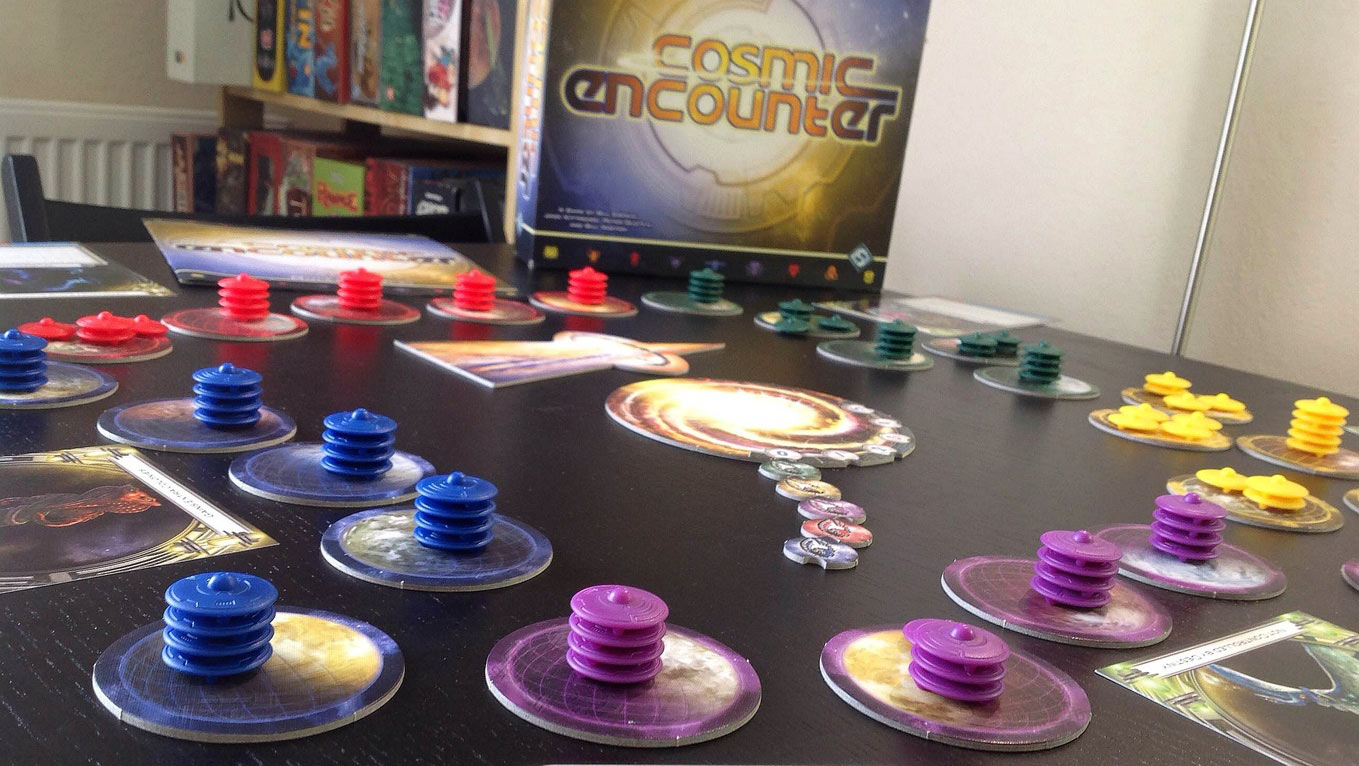
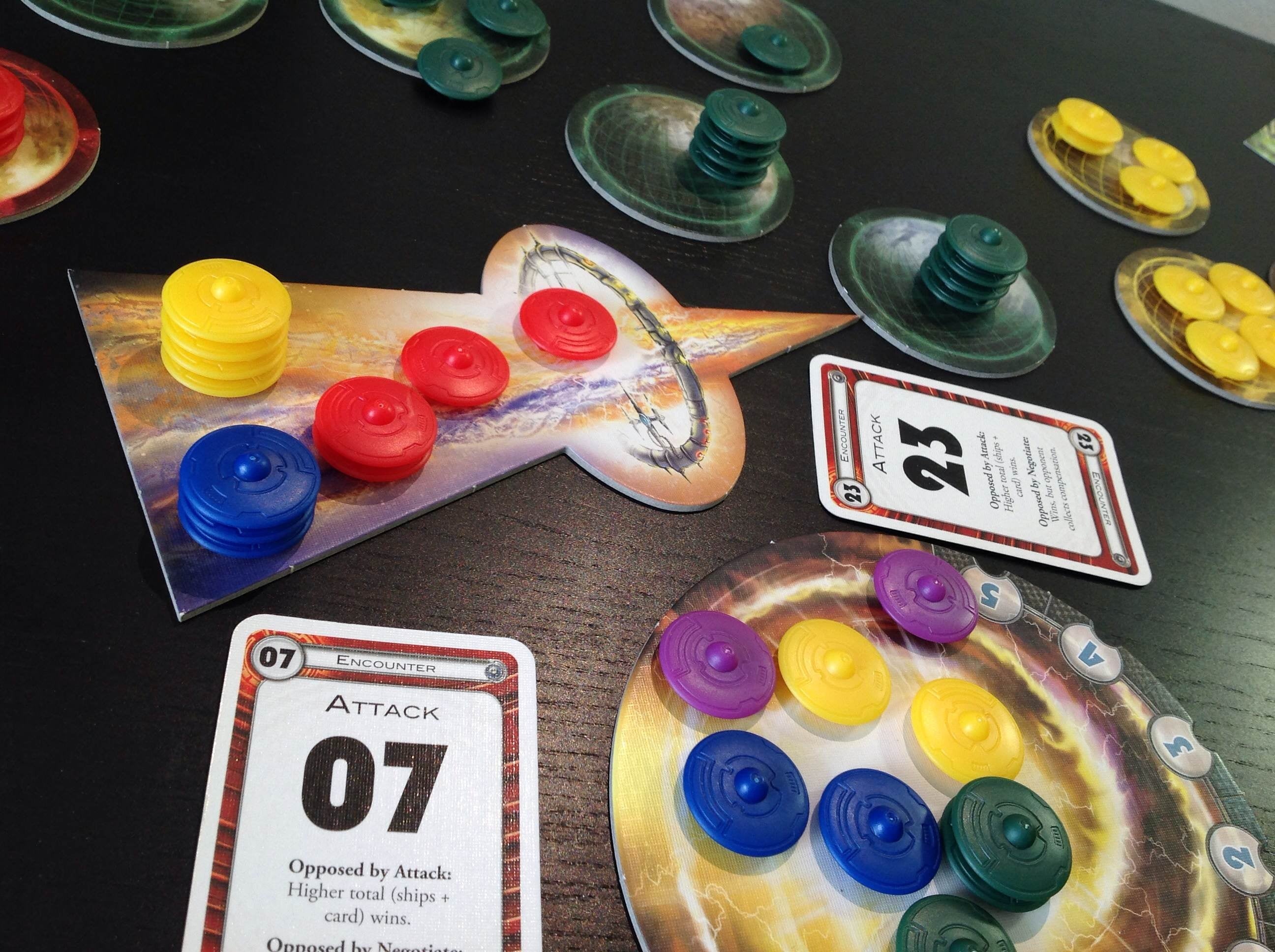
Cosmic Encounter and me

Cosmic Encounter is one of my favourite boardgames. It may even be my favourite boardgame, but I probably need to play it more than I currently do to make sure.

(This isn’t a review—you can find reviews aplenty on boardgamegeek.)


Early Cosmic

I started playing Cosmic Encounter in 1981 or so. I had just begun roleplaying (Traveller), and the advert for Cosmic Encounter in Games Workshop’s catalogue caught my eye. Once it arrived, I was hooked. We played it incessantly—both with my RPG buddies (in and around games of Traveller) and my ‘normal’ school friends.

The penultimate week of the school year was ‘project week’. We had the opportunity to do exciting things like youth hostelling or parachuting. One topic, generally reserved for those that couldn’t afford the exciting projects (or weren’t able to get into the popular projects), was boardgames. This was the early 80s and I was miles away from the nearest games shop. Boardgames meant Monopoly, Escape from Colditz, Cluedo and its friends. (Even the Spiel des Jahres was in its infancy and wasn’t something I’d learn about for a few years.) Anyway, I chose (yes, chose) boardgames for two years and brought in Cosmic Encounter for the week. I mention all this because I remember one girl who was clearly not happy to be playing boardgames; but there was one game she would play: Cosmic Encounter.

Which alien is best?

Before I started buying expansions, I tracked the success of the aliens. To my surprise, Philanthropist was the alien most likely to win. This alien lets you give a card to your opponent—which means you give away your rubbish cards and keep your good ones. It also means you draw more cards—something that would become known as ‘card advantage’. So over a decade before Magic: The Gathering popularised the term, Cosmic Encounter taught me the importance of card advantage. Since learning that, I’ve always preferred powers that let me draw cards, and shied away from those who hoard their hands.


The second most successful alien was the most obvious candidate: Virus. Virus multiplies its attack card, and is strong in challenges. But not as strong overall as Philanthropist. 

Third, I think, was Laser. Last was Clone—I’ve never liked Clone (probably because I like drawing cards). Clone only works if you’ve got an encounter card you want to keep, and it means that you’re rarely drawing new cards and so miss out on Artifacts (or Edicts as they were known then), Flares and other goodies in the deck. I wouldn’t inflict Clone on a new player either—it’s not fun enough and doesn’t sell the craziness of Cosmic Encounter at its best. (It’s okay as a second power in the right combination, which is why I haven’t thrown it out.)

My favourite power, though, is Sorcerer (you may switch cards) as I love the delightful mind tricks it creates. (Sadly I don’t play the new aliens enough to know if I have a new favourite.)


I liked the hex boards—they set Cosmic Encounter apart from the other boardgames of the time. And changing to a regular board was one of several things that Games Workshop did horribly wrong with their version. But as much as I liked the hexes, I prefer Fantasy Flight’s planet design. Definitely the best.

Expansions and other editions

It wasn’t long before I had all the Eon expansions, including the weird hexes. Despite having all the expansions, we didn’t play them much (besides the extra aliens and 5th and 6th players). Moons were too silly and slowed the game down. (I’m not a fan of expansions that slow games down for little return.) Lucre wasn’t exciting enough, and the alternate hexes weren’t that good—although we used the alternate cone and Praw a fair bit.

I bought the awful Games Workshop edition and was disappointed with the mess they made of it.

I didn’t get the Avalon Hill edition, but I bought Mayfair’s Simply Cosmic (which disappointed me as it didn’t have enough of the craziness I craved).

In the deep freeze

Then I stopped playing.

I moved away from home and didn’t get a regular boardgame group until after the renaissance started in the 90s. So while Settlers of Catan and Magic: the Gathering became popular with my roleplaying group, Cosmic Encounter remained in my cupboard, unplayed.

Since 2000 I have probably played more boardgames than ever—but, sadly, Cosmic Encounter has not been amongst them. There have, I think, been a few reasons for this:

  • Until the Fantasy Flight edition, the only copy I had that was worth playing was an ancient Eon copy full of expansions held together with sticky tape. Cosmic Encounter had to compete against newer games with their better graphic design, and Cosmic Encounter lost.
  • Gameplay has improved since Cosmic Encounter came out. When it was first released, Cosmic Encounter compared favourably to Monopoly and Cluedo. Now it must compete against Ticket to Ride, Carcassonne, Wingspan and others. Unsurprisingly, Cosmic Encounter sometimes shows its age.
  • I have learned that an hour is my preferred length for a boardgame. I normally don’t want to play a single game for much longer than that—that should be enough to give you a good, solid game and still have time to play something else later on. (Also an hour often suits real-life commitments.) Cosmic Encounter, unfortunately, often takes longer than that. Even longer if you are introducing new players. (I don’t mind setting aside longer for a good game, but an hour often works for the casual gamers I usually play with.)
  • The learning curve for Cosmic Encounter is steep, especially if you add all the craziness (which is how I like to play). However, without the craziness (and if your new players haven’t got into the spirit of it), Cosmic Encounter can be a bit pedestrian.

Three player Cosmic Encounter—with two players

But I still want to play. 

Unfortunately, Cosmic Encounter doesn’t appeal to Mrs H, but luckily Megan is happy to play. So I created a dummy player for three-player Cosmic Encounter, which we play now and again. It’s not as good as a full player, but it’s better than nothing.

The dummy player always has a mandatory power and draws encounter cards from the deck (it has no hand). I created a deck of cards for the dummy player’s decisions—how many ships to commit, asking for allies, whether to ally when invited, and whether to make a deal. Other decisions (such as where ships are taken from or which planet to attack) are usually obvious and agreed among the players. The dummy player has been known to win before now...

Favourite boardgames

Recently I thought about my favourite boardgames (which currently include Glory to Rome, Dominion, Oceans, Wingspan—and Cosmic Encounter) and noticed that I like games with variety. Games with lots of stuff that let you do different things—I like a game that forces you to make the best of what you’ve got and work for the win.


Do I like Cosmic Encounter because I like those kinds of games, or do I like those kinds of games because I like Cosmic Encounter?

House rules and variants 

Cosmic Encounter has always seemed a game that encourages house rules, and I’m no different. So these are my house rules.

If you’ve got a vacant planet in your system (ie, completely empty with no colonies), then you can colonise it for free when moving your ships (from the warp, or returning from a successful defensive alliance, or whatever). I’ve always played this way—because it’s always more fun to have the use of your alien power than not to have it.

I don’t use the Fantasy Flight rules for the cone (or gate). As per the original Eon rules, defensive allies always go on the ring on the cone, while offensive allies sit with the attackers in the mouth of the cone. (Okay, that’s not really a house rule, just me refusing to move with the times.)

One thing I don’t like about the new edition is the scoring tracker. Partly that’s because it can take up so much space, especially if everyone is on the same score (although I could put the scoring tokens on top of each other). Also, I don’t always remember to move the scoring track as colonies are won and lost. Mainly, however, I remember the delight (or frustration) of winning (or losing) Cosmic Encounter because we had not paid attention, and a player already on four colonies was asked to ally with the attack. The scoring track makes it much easier to keep an eye on who is in the lead, making those delicious sneaky victories much harder.

Cosmic Encounter and the future

So I think that’s about it—Cosmic Encounter and me.

Going forward, one thing I haven’t explored is playing Cosmic Encounter online using Tabletop Simulator. Perhaps that’s something to explore.


Monday, 14 March 2022

Airecon 2022

So last weekend found me spending two days at Airecon 2022, the friendly boardgame convention in Harrogate. I’ve been to four or five Airecons—the last one was in 2020 and was the weekend before everything locked down because of the pandemic. (Previous posts here.)


Airecon was my first big event since lockdown. I’ve done a few things since then, but nothing on the scale of Airecon and I was shattered by the end. And I was there for less than 50% of the time…

On the Friday I played a few demos, chatted with some old friends, and ran some Fate Accelerated. On Saturday I attended with family (my daughter, brother and nephew) and we played games. I didn’t attend on the Sunday.

Boardgames

We played a load of demos and games—these are the ones that stuck with me.

Moon: I played two demos of Moon, the forthcoming game by Haakon Gaarder and published by Sinister Fish (and coming to Kickstarter in May). Moon completes a trilogy of games with a similar look that started with Villagers (which we really like) and continued with Streets (not such a hit with us, but I should give it another chance). In Moon, you are running a moonbase, and it’s a drafting game much like Seven Wonders or Sushi Go.

As I don’t have either of those in my collection (and given that Megan enjoyed it when she tried it on Saturday), it seems likely that I’ll back the Kickstarter.

Trek 12: Trek 12 was Megan’s favourite game—rolling dice and creating chains or groups of numbers. I found it surprisingly tricky, and Megan well and truly thrashed me. She bought a copy (and is playing it as I type this).


Sagrada
: I enjoyed Sagrada, a dice-placing game about stained glass windows. I won the four-player game we played, but Phil picked up a copy, so no doubt I’ll be playing it again.

The Aurors

On Friday afternoon, I ran The Aurors, my Fate Accelerated adventure of hunting dark wizards in the world of Harry Potter. I had five inventive players who came up with lots of suggestions. None had played Fate before, but they picked it up pretty quickly.

I started the game with a Setting Grid and questions (as Backstory Cards). I could tell the players hadn’t done anything like that before, but they embraced the concept, and we used several ideas during the adventure.

The players clearly knew their Harry Potter and came up with loads of great ideas, including:

  • Asking if the first victim’s ghost was around. A Fate token made that so, and they got key clues much earlier than the previous times I’ve run it.
  • Rather than fight the acromantulas, the animagus changed into one and spoke to them instead. That was great—during character generation I told the players they could choose stunts and other aspects of their character during play, and this was a great choice.
  • The plot involves a powerful wizard’s wand, and one player had an idea to go to Ollivander’s and see if there was a twin, and whether it was available. Again, another Fate token spent, so I gave them the twin wand (a special +2 stunt).
  • They looked up Aberforth as an old member of the Order of the Phoenix.
  • And they posted lots of ministry guards—but of course, Lucivere cut through them like a hot knife through butter because the PCs are the heroes of our story.

I think my GM-ing was okay. I ran with their ideas which meant deviating from my notes now and again, but we ended up with a big battle at the end during which they defeated Lucevere Razorblood, dark wizard and Dementor inventor. We took about three hours, all told, which was about right.

You can download The Aurors here and I wrote about it previously, here.

Overall

I like Airecon. Next year I’ll try to run more than one RPG—but there’s so much going on that I don’t want to spend my whole convention in the RPG room.


Saturday, 18 January 2020

2019 in games

How is it already mid-January? Perhaps I should have started this a bit earlier...

Never mind the politics, how was 2019 in terms of games?

Freeform Games

2019 was another good year for Freeform Games. Sales were up 13% on 2018 which was great. Amazingly, we’ve doubled our sales since 2014, but I’m taking that with a pinch of salt as 2013 and 2014 were low points: we’re only 38% up on 2011.

(The difference is down to Google. If I remember correctly, there was an algorithm change in 2013 that hurt us badly compared to the previous years. A reminder of how vulnerable we are to factors outside of our control.)

We only had one new game this year - and that was simply a Christmas version of one of our older games. It was a bit too late to have much of an impact in 2019. I’ve written more about our year on the FFG blog, here.

Freeforms

2019 started well with Death on the Gambia (which I ran and wrote about here) followed by The Torch of Freedom (in which I played the Russian ambassador and wrote about here).
Death on the Gambia

Torch was followed by Peaky in April, where I co-wrote Tea at Longbourne and played in The Circus of Wonders and Shadows and Seeds of Humanity (more on Peaky 2019 here).

Tea at Longbourne was a delight to write and seemed to go down well with the players. It has been played again since and I look forward to taking it out for another spin.

Unfortunately Peaky was my last freeform of 2019. I had hoped to get a Leeds freeform group going, but I’m really bad at that kind of organising. And I had hoped to meet with the Liminal Dreams crew in Huddersfield, but I’ve not managed to do that either. Maybe in 2020 I can get my act together, but judging by my past performance, that seems unlikely.

Tabletop RPG

I ran four tabletop roleplaying games this year:


I played D&D, Liminal, Fate Accelerated, Dragon Age and a homebrew fantasy heartbreaker that I can’t remember much about. These were all at Airecon, Furnace or GoPlayLeeds.

Fate - my tools of the trade
Unfortunately my semi-regular online group fell away due to scheduling conflicts, but hopefully we’ll pick it up again.

In 2020 I’m hoping to run The Aurors at GPL, and maybe something a bit different such as Hillfolk. I’ve also got an Achtung! Cthulhu! one-shot brewing, so maybe I’ll get that done for 2020. I’m also hoping to do more tabletop with Megan and the family.

New RPGs for my collection in 2020:

  • Liminal: Created by Paul Mitchener and featuring some stunning artwork by Jason Behnke, Liminal is a British urban fantasy (think Neverwhere, Rivers of London, Ultraviolet and the like) game that ought to be right up my street. The only reason I don’t like it more is that it’s a little too close to the Other London games I’ve been running recently. (I’m also not a huge fan of the system, but that’s my reaction to learning something new than anything being particularly bad about the system.) I backed this in pdf form on Kickstarter, and I probably need to get my hands on a hard copy so that I can read it properly. (I find most RPG pdfs very tiresome to read on my tablet.)
  • Mouse Guard: I won this in the Furnace raffle and read it on holiday. The system looks intriguing. It’s based on Burning Wheel, and the games are split into GM Turns (much like normal RPGs) and Player Turns (which are similar, yet different). I can’t quite see how it works, so I feel I need to play it before running it. Not sure how it works in a one-shot though. I’m indifferent to the background - I’ve read a couple of the comics but I’m not inspired by them.
  • Fate of Cthulhu: I Kickstarted the pdf of this. The setting appealed - in the future Cthulhu has arisen and you are sent back in time to prevent it happening. So Terminator v Cthulhu. Not sure when I will get to run it, but never mind, it’s not taking up any shelf space. (Unlike Liminal, I was okay reading the pdf of this - the Fate books are formatted such that they’re pretty easy to read on a tablet.)

New RPGs for 2020 will include Fiasco and Trilemma Adventures, both of which I Kickstarted and haven’t arrived yet.

Boardgames

I played 187 boardgames in 2019, so one every other day on average. A lot of these were solo games as the rest of the family isn’t quite as excited about boardgames as I am… My top three most-played games were Villagers, D-Day Dice and Pandemic Legacy Season 2.

Villagers is my game of the year, I think. I Kickstarted it in 2018, and it turned up in May, just in time for me to take on holiday. We all enjoyed it, which means we’ve played it a lot. We have barely dipped into the expansions yet.

D-Day Dice is another Kickstarter, which took two years to arrive. I may have over-invested in it, as I already had the first edition (which I have now given to a good home). DDD is a push-your-luck resource management game, and plays really well solo. I usually win, but I enjoy the thought and strategy involved.

I played through Pandemic Legacy Season 1 in 2018, and I almost completed Season 2 in 2020. I have just the last game to play. I think I prefer Season 2 because of the way the board so drastically changes (and I found Season 1 to be a bit of a drag in the 6-9 month section). However, I haven’t quite been motivated to complete Season 2, which probably speaks volumes. It’s possible I’ve had enough of Pandemic for a while.

Games new to the Hatherley games library (all of them Kickstarters this time) include:

  • Villagers and D-Day Dice, as mentioned above.
  • Rival Restaurants arrived just before Christmas, and has a nicely chaotic trading system. Seems good with at least four people, although some of the abilities seem a bit unbalanced. I’m not sure how much I like this, but Megan likes it which is good. It’s maybe a bit light, but I probably need to play it more.
  • I haven't played Brexit: The Real Deal yet. I backed it in impulse. I ought to play it at some point.
New game to the collection in 2019
I’m not planning to buy any more boardgames in 2020, I think I have enough. I am expecting Oceans (another Kickstarter) to arrive at some point soon, and I may get rid of some to make some space. And maybe there will be gifts…


Other games

As usual I played a bit too much World of Tanks Blitz in 2019, and I created two treasure hunts.

Overall

So that was 2019. 2020 will be more of the same. At this point in the year I am not expecting to buy more games, but we’ll see.

Wednesday, 18 December 2019

More things I'm enjoying

Three more great things!

Dinosaurs

I’ve been getting back in touch with my inner seven year old, and have been learning about dinosaurs. I started with Audible’s A Grown-Up Guide to Dinosaurs and then followed that with The Rise and Fall of the Dinosaurs by Steve Brusatte (who appears in the Audible series). We then followed that with a trip to Lyme Regis in Dorset where we visited the dinosaur museum.

Dinosaur "Man" from the Lyme Regis Dinosaur Museum.
Want more dinosaurs? Here's a dinosaur blog, and here’s a site full of dinosaur pictures.

(My favourite dinosaur is Triceratops.)

The Expanse

Series 4 has just started on Amazon and I’m half way through it, and it’s just brilliant.
So far. And while it’s broadly similar to the book, there are enough differences to make it worth watching. It’s interesting seeing the TV series introduce characters who will be pivotal later on. So Series 4 is a combination of Book 4 (Cibola Burn), one of the novellas (Gods of Risk) and some new stuff.

A word of warning - the first few episodes of season 1 are a bit heavy going - so do persevere with it.

The books are also excellent - consistently scoring 4s and 5s when I read them. I haven’t read the most recent (Tiamat’s Wrath) as it’s still in hardback, but as soon as the price drops I will pick it up. Auberon, the recent novella, was a pleasant surprise.

And it turns out that there’s an Expanse fan wiki (full of spoilers, so be warned).

D-Day Dice

D-Day Dice is a cooperative world war two boardgame where you play a unit of Allied troops storming the beaches of Normandy. The game involves rolling lots of dice to build up your forces (troops, courage (needed to move up the map), stars (needed for officers), and tools (needed for equipment) as you work your way up to a bunker that you must conquer to win.

It’s a cooperative game, and is really enjoyable solo. Many cooperative games seem like puzzles, and D-Day Dice is perhaps more puzzle-y than most. But I enjoy it, and I Kickstarted the 2nd edition, which landed recently. Expansions add more variety (most of it good, some of it not so good) and I’m enjoying working my way through the different maps.

Saturday, 30 November 2019

Things I'm enjoying

A few things that I’ve enjoyed reading/playing/listening to/watching.

The Case of Charles Dexter Ward

Following on from The Conception of Terror which I talked about last time, The Case of Charles Dexter Ward is a 10 part BBC podcast dramatization HP Lovecraft’s story of the same name. This time the story is told from the perspective of two investigators from the ‘Mystery Machine’ podcast looking into Charles Ward’s disappearance. You don't need to know the story as it's quite different from the the original. Anyway, it’s great fun and sounds exactly like a Call of Cthulhu investigation. All 10 episodes are currently available to download from the BBC - along with the start of the next one: The Whisperer in the Darkness...

Villagers 

Villagers is a really nice card game for 1-5 players (although there is a solo option, it’s much better played against others). Following the black death, you must re-populate your village with blacksmiths, carpenters, swineherds, miners and so on. It takes less than an hour to play, and is often a very tight game, with just a few points between first and second place. We’ve played it loads - one of my new favourites.

The Laundry Files

I’m re-reading Charles Stross’ Laundry Files series, starting with The Atrocity Archives and working my way through to the latest, The Labyrinth Index. I’ve finished fifth book (The Rhesus Chart) and am about to start The Annihilation Score, the one with the superpowers. It’s a delight and I’m really enjoying the series. I feel that I'm getting more from them now - I don't know if that's because I know what the future stories bring, or whether I'd simply forgotten so much. Anyway, highly recommended if you like your Lovecraftian horror mixed with workplace humour.

Wednesday, 13 March 2019

Airecon 2019

Overall, I had a delightful Airecon 5. Airecon is the annual board and tabletop rpg convention held in March in the Harrogate Conference Centre. This was my third visit (it's virtually on my doorstep so it would be daft not to go).

This year, for the first time, I didn't go alone. Megan came with me, as did my brother and Jack his son. They all enjoyed themselves, and Megan decided to come back on the Sunday with me.

Here's how our convention played out.

Saturday

We started with Arrr, a playtest of a game of pirates digging up treasure. This involved getting our meeples to the buried treasure, rotating sections of the board to get paths to line up. There were some rules about stealing other player's treasure, but these seemed a bit complicated (a few too many exceptions involved) and when we started playing the complexity of just getting my meeples to my treasure meant I couldn't handle the stealing rules. I said this, Phil agreed, and we decided to ignore stealing for this game.

Arrr
Maybe stealing works once you've figured out the movement, but as a race game it was fine. (But I won, so maybe my view is coloured by that.)

Over at the Asmodee section of the game we decided to try Dice Forge. We were taken through the rules by one of the demo team, and had a very enjoyable game. Dice Forge features six-sided dice with interchangeable faces that you upgrade - it's a bit like a deckbuilder but you only have 12 cards. It plays quick and I like rolling dice. I won this as well.

Thumbs up for Dice Forge
After Dice Forge we wandered around the stalls a bit, I caught up with a few people that I knew, and then we grabbed something to eat from one of the several food outlets.

After that I went to find Megan (who was dropped off by Mrs H) while Phil and Jack played a few other games. When we came back, Phil and Jack were deep in a game so Megan and I played Wibbel, playtested a bee game (a bit too random - Megan had a great theme suggestion though), and played a huge version of Tsuro using carpet tiles (fun mainly for the physicality of it).

Phil and Jack then joined us to play Hey That's My Fish with the players as the playing pieces. We played a team game (kids v adults), and the team aspect was very interesting in trying to agree who should move each turn. Happily for all, it turned out to be a tie.

Hey! That's My Fish!
We then headed back to the Asmodee demo section to try Pandemic: The Fall of Rome, which we lost heavily. We followed that up with Four Elements (a four player flicking game similar to carrom) before having a final game of Dice Forge (which Phil decided to buy).

Sunday

My original plan for Sunday was to go on my own and play a tabletop RPG. (My even earlier plan was to run some tabletop, but I wasn't organised enough for that.) However, Megan had such a nice time on Saturday that she wanted to come with me. I'd booked myself in on a game, but it had no free spaces so instead we found a game with a couple of free spaces and played that instead.

Our characters - we were all playing women.

I checked with the GM that it was suitable for a 12-year old, and we started playing. The game was a Victorian Fate Accelerated investigation into mysterious goings on at an archaeological dig in Egypt. Unfortunately the game was very slow and I could tell Megan was bored (I wasn't that excited myself). Worse, I don't think we could ever have worked out what was going on from the clues we were given (even the grown-ups, let alone Megan).

A couple of things would have improved it:

  • Fewer players: When we joined, we had four players total. That's a good number for a tabletop RPG, it means that everyone gets plenty of limelight. Unfortunately, we were joined by two more players, making us six. Unless you're playing Hillfolk (or another game designed for lots of players), or you're an exceptional GM, six players is really too many.
  • Replace the first scene with shared history: Although the game was set in Victorian Egypt, the first scene was set at our lodgings in London and basically consisted of us being hired to investigate mysterious goings-on. We were never going to say no, but dutifully we played this out over 30 pointless minutes. Instead, we could have started in Cairo and replaced the hiring section with some character building and shared history.
  • Provide context with the clues: In an ideal scenario, we would have pieced together the clues, understood what was going on, and developed a plan to stop it. Unfortunately while we were finding clues, as players we didn't understand what we were seeing. As a result, all we did was poke the scenery and reacted to what turned up. If we'd understood what the clues meant, maybe we could have been more proactive. While the GM did bring the final scene forward, I'm pretty sure the mystery was unsolvable. The denouement featured a previously unknown NPC and some mad science, which I certainly didn't see coming.

Sorry for the rant. I set high standards for convention games as I don't like disappointing players (and I don't like to be a disappointed player).

Adding a cat to the wall of cats
Lunch followed the RPG, and then designer Jon Hodgson demoed Bang and Twang, a very lightweight card game that was a fun but probably needed a few more beers to properly enjoy.

Megan and I then played Assembly, a cooperative game that we narrowly lost (we would have won it on our next turn). We finished Sunday with The River, a worker placement game that I came joint first in.

The River
Sunday at Airecon was noticeably quieter than Saturday, and speaking to one of the traders they said that it felt like everyone was just passing through the trade stands on Sunday, unlike Saturday where they would stop and browse. I couldn't disagree, as I'd done exactly that!

So that was Airecon 5, and we are all looking forward to Airecon 6 next year.

Wednesday, 7 November 2018

On dice


My favourite dice are 2d6, with pips not numbers. They are the dice of my childhood. The dice of Monopoly and Escape from Colditz. I love the rattle they make and I've used them so often that I instinctively understand the probability curve.

For me, six sided dice are "proper" dice.

"Proper" dice
Two dice v 2d6

Until I started playing Call of Cthulhu, dice always had six sides. So there was never any confusion when I asked someone to "roll the dice". Call of Cthulhu was the first game I owned that needed polyhedral dice, and with that came the need to define the number of sides. So "two dice" slowly became "2d6".

And Call of Cthulhu wasn't my first RPG - that was Traveller. Traveller only used six siders, and just referred to them as 2D. (I didn't play D&D until much later.)

Pips v numbers

On six sided dice, I find pips much faster to read than numbers. (And when I say "much faster", we're talking fractions of a second.) That's because I pattern match, rather than count the pips.
Five pips and two pips = seven. Simples.

If the dice have numbers, I have to mentally add the numbers together. If the dice has pips, I just recognise the pattern.

This works for 2d6 - I don't think it works for larger numbers of dice (I didn't enjoy GURPS enough to embed 3d6 in my brain).

Of course, this only works for six sided dice. Pips on a d12 would be just daft.

Readability

As I get older, dice readability becomes more important to me. So I like dice with good contrast between the numbers or pips and the background.

I find dice with weird fonts and additional decoration hard to read, so I try not to use them.

Special dice
Special Fate dice.
I hates 'em I tell you, I hates 'em.

Special dice unique to that game can actually put me off a roleplaying game (Star Wars I'm looking at you). If I were to rank RPGs purely according to the dice they use, it would look like this:

  • 2d6 (Traveller, Dungeon World)
  • Other multiples of d6 (Risus, GURPS, Cthulhu Dark)
  • Polyhedral dice (F20 games, Call of Cthulhu)
  • Special dice (Fate, Star Wars)

I suspect that one of the reasons I like PbtA games is that they're powered by 2d6. (Dungeon World spoils that by needing a bunch of polyhedrals as well.)

If a game uses special dice it has to be pretty special for me to want to play it. So Fate is special enough, but Star Wars isn't.

My dice collection

My dice collection looks like this.

(My dice collection: I may be over invested in d6s.)
The only dice that I can remember buying specifically are:

  • Percentile dice because I needed to run Call of Cthulhu at Continuum in 2016.
  • The green d6s for Cthulhu Dark (as yet unplayed). I bought the purple d6s at the same time because I liked the colour.

Note I do not own any d4s, d8s or d12s. The only d12s I own are in boardgames (Ankh Morpork and Tiny Epic Kingdoms).

A Level Mathematics

I earned a grade A at A-level Mathematics. A third of the questions were statistics questions, and our statistics started by using 2d6 to calculate probability. And I was good at that because of all the games I played.

Being good at 2d6 probability opened the door into statistics, and ended up really enjoying it.

So I like to think that games (and specifically dice) directly led to my A grade in A-level Maths.

So that's it: me and dice.