Showing posts with label Most Trusted Advisors. Show all posts

Monday, 15 April 2024

Most Trusted Advisors at the table

A few posts ago, I said how much I was looking forward to playing Most Trusted Advisors. How did that work out?
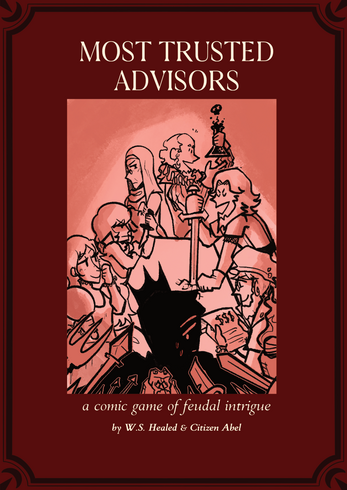
As this was my regular group, we were playing online using Discord and Trello. We play for about two hours – more than that, and I get tired. (This seems to be an issue online, I can cope with longer sessions when face-to-face.)

Character creation

Character creation took us 90 minutes, which was longer than I expected, but I think that was an artefact of playing online. The playbooks seem straightforward to me, and I copied the key sections to Trello. However, a couple of my players struggled with some concepts, and everything took longer than I expected. I’m sure it would be quicker if we played face-to-face.

Our characters were:

  • Margrave Hildegard of House Kolero (The Marshal) – a Zobian Traitor
  • Earl Mikolas the Just of House Arachnia (The Treasurer) – an Inquisitor
  • Count Lorentz the Surreptitious of House Blackgammon (The Blackguard) – a member of the Sky Chamber

Session #1 (what’s left of it)

With 30 minutes left, I kicked things off with the Liege bringing worrying news to his advisors: he’d heard the ruler of arch-rival Zobia has two birthdays. So he wanted another birthday, with the next one in two days’ time. Arrange it!

The Treasurer suggested a three-day holiday, which the Liege liked very much. (Actually, the Liege might have misunderstood the Treasurer, but three days it is…)

So, rather than raise money for the celebrations (which haven’t been decided yet), the Treasurer bought all the beer on the docks (to sell it back to the inns later). The beer is now in a marquee on the dockside, which is where we ended the session.

I felt it was a bit of a rocky start. I’m not sure why, but my players seemed to struggle with their characters. Although I felt they had lots to go on (character creation created plenty of links and agendas), it took a while for them to warm up. I don’t know if that was me, the game, them – or a mixture of all three.

After the session, I looked through their characters. I pulled together a short list of events, based on what came up during character creation, that I could use in future sessions. Where things were undecided, I filled in the blanks.

For example, the Marshal had the following agenda: “A notoriously lecherous and gullible noble knows a vital state secret. Discover it by any means necessary.” I decided who the noble was (Sir Oscar) and what secret they knew. Then, I added an event to my list: a message from the Zobian traitors asking for an update on progress.

I’m glad I took the time to do this, as it’s not something I could have done easily on the fly at the table. If I ever run this at a convention, I will need to think of how I do this. (I suspect the answer is to use cards. The game has tables, but cards are a physical reminder to refer to.)

Session #2: Planning the birthday

In session two, the advisors determined the outline of the birthday party. Day one will be a blessing of the realm, day two will be a tournament, and day three will be a grand ball. The players start to slot their various plans and machinations into the celebrations.

The Blackguard persuaded the wife of Lord Hawett (Lorentz's bitter enemy) to host it at their enormously extravagant mansion on the outskirts of the city.

The Treasurer’s money-making scheme worked (ish), but dockers complained about the high prices, and the innkeepers were unhappy. The Blackguard tried to steal the money, but The Treasurer spent a twist and foiled it.

I pushed an agenda by appearing as the Liege and asking that Father Brian (whom the Inquisition wanted to stop spreading radical messages of kindness and tolerance) speak at his birthday service. The Treasure arranged for Father Brian’s death, but this backfired by turning him into a martyr! (The roll was a partial success).

The Blackguard then spent a twist to get the Treasurer’s execution order and blackmailed The Treasurer with it in return for details of a secret passage into Lord Hawcett’s mansion.

Finally, the Marshal contacted the Zobian ambassador to arrange for the finest Zobian food for the birthday celebrations.

Session #3: The Blessing

Session #3 flowed smoothly as everyone’s plans started coming together:

The Marshal failed to negotiate down the quote for the Zenobian food, and the ambassador challenged the Marshall to a duel. It will be settled at the jousting.

The Blackguard, in disguise as Father Honeyfeather, gave a blessing on day 1 of the birthday celebrations. (I asked the player what he planned, and he gave such a long and detailed description of the service that I didn’t have the heart to make them go through it all again, so we cut straight to the end of the service.)

At the following cheese-and-wine event (held on the prince’s pleasure barge), Judge Strauss handed The Secret History of the Sky Chamber to the Treasurer. The pages were blank, but the Treasurer successfully concocted a potion that revealed the text. 

Over cheese and wine, the Marshall convinced Sir Oscar (see above) to reveal his secret: the name and location of the true Liege! (That the Liege was an imposter had been decided during character generation.)

Session #4: The Tournament and the Grand Ball

Our last session, and the players seemed to really enjoy themselves. Key moments included:

  • The Blackguard married his many daughters off – some successfully, others less so.
  • The Marshal killed the Zobian ambassador in a duel.
  • The Treasurer foiled a plan by the Blackguard to steal The Secret History of the Sky Chamber.
  • The Treasurer created false documents implicating the Zobian ambassador’s widow (who was getting much too cosy to the Liege).
  • The Blackguard created a scheme to poison the wine for everyone except for his rival and the Zobian ambassador’s wife, then prevented that plot to turn himself into a hero and expose his rival and the ambassador’s wife as enemies of the state. The plan succeeded, although sadly, some nobles died because they were too eager to drink the wine.

We ended the game there, finishing with the PC’s legacies:

  • The Treasurer became the Witchfinder General.
  • The Blackguard became known as the famous figure in folklore, “The Black Count.”
  • The Marshal changed the political system by installing the true heir to the throne.

Finally, we played ten minutes of How’s it going Geoffrey? This short minigame explores recent events from the perspective of the unluckiest peasant in the land – my players enjoyed this immensely.

So what did I think?

We enjoyed Most Trusted Advisors. We played for about five or six hours (excluding character generation), over four sessions.

While it started slowly, once my players got into their characters and pursued their agendas, things motored along smoothly. I suspect there’s more I could have done to get things going at the start, but at this point, I’m not sure what.

We found it extremely collaborative, with the players chipping in suggestions throughout.

I had a few issues with the rules.

Action ratings: I struggled with action rolls because, often, there wasn’t an appropriate action rating that suited what we were trying to do. Some examples:

  • The Treasurer implemented a plan to kill a troublesome priest and make it look like the Marshal was to blame. This was carried out by underlings, as obviously, the Treasurer wouldn’t dirty his own hands. However, there isn’t a “scheme” action rating. We used Ruin for this action, but at a few times, we scratched our heads trying to work out what action rating to use.
  • Our characters persuaded NPCs to do things several times. However, there isn’t a “persuade” action rating. We fell back on Appease and Bluff rather too often.

Maybe we were playing it wrong, but it took less than an hour of playing for us to hit some of these issues. So following session 2, I changed the action rolls:

I replaced Ruin with Scheme, merged Survey into Study, and introduced Persuade and Scheme. I grouped the abilities by “base ratings”:

  • Physical: Balance, Duel, Shadow, Skulk
  • Mental: Bewitch, Concoct, Study, Scheme
  • Social: Appease, Bluster, Disdain, Persuade

The players put 3 points into the base ratings (Physical/Mental/Social – no more than 2 points in any one base rating) and then 3 points into the specialisms (no more than one each). Their action rating was their base rating + specialism.

Doing it that way meant that if there wasn’t an appropriate specialism, I could use the base rating. This system worked well – I had no problems with dice rolls for the rest of the game. 

Twists: Twists are powerful; they let the players avoid conditions and introduce new elements into the game. Players started each session with three, but because our sessions were short, my players always seemed to have plenty. Next time I will reduce the number of twists.

Conditions: I found the conditions suggested in the rules (angry, bankrupt, scandalous, etc) hard to apply to our dice rolls. I found it easier to create story-based misfortunes and complications, but I didn’t ever inflict a condition on a PC (although the players used twists to avoid a couple).

While I felt the rules were okay, they didn’t support play particularly well, and I was fighting them before I changed action ratings. 

Scenes: I recently ran a couple of games of Hillfolk at AireCon and have been thinking about the difference between the two games. While I don’t think Most Trusted Advisors needs Hillfolk’s dramatic focus, I wonder if it would benefit from scene discipline. I ran it as I would a traditional TTRPG, and in hindsight, that may have been a mistake.

Revisiting the pdf, I discovered today that Most Trusted Advisors uses the word scene liberally (“scene” appears 25 times in the pdf). But it never explains what it means by “scene”, nor how to set/frame/close them – and whether scenes are framed by the players or the GM.

So what works best? A fluid trad-like approach, or defined scenes? Next time, I’ll try more formal scene framing.

(Bizarrely, even though I’ve done scene framing in other games, I didn’t think to try it. I’ve only thought about it now. I’m not sure what that says about me.)

Overall

For me, Most Trusted Advisors wasn’t quite as good as I had hoped. While the characters and background and secret societies were wonderful, I found two areas let it down:

  • Getting started: It took us a while to get properly into our stride. Was that the game, or was that us? I don’t know, but I think the game could have done more (or offered advice) to get things going.
  • System: Given its lightness, I found the system fiddlier than necessary (and that’s aside from making a mid-game patch). 

I can’t imagine ever running Most Trusted Advisors as anything other than a one-shot (even though we took four sessions, I regard our game as a one-shot), and it could be simpler and fine-tuned to make that easier.

Most Trusted Advisors

You can get Most Trusted Advisors from the creators’ page on Itch.io, here.

Monday, 11 March 2024

First impressions: Most Trusted Advisors

It’s not often that I read a roleplaying game and can’t wait to get it to the table. Microscope was one (a story game rather than a “proper” RPG, but even so) and Hillfolk another (although that took me years to play). Most Trusted Advisors, a Forged in the Dark game by W.S. Healed & Citizen Abel is another.

Most Trusted Advisors

is a 54-page “comic game of feudal intrigue.” The players take the roles of a profoundly incompetent monarch’s eponymous privy council. As lords and ladies of the realm, they must keep their liege safe from foreign agents, court conspiracies, and their most dangerous enemy: their own incompetence. The GM gets to play the monarch – The Liege.

So it’s the game of Blackadder II. The GM plays Queenie, while the players are Blackadder, Lord Melchett, Malcolm Tucker, Moist von Lipwig and others.

What’s not to love?

Setting

Most Trusted Advisors is set in the fictional city of Valdrada, the capital of the feudal realm of Dulcinea. 

Valdrada is a mashup of 15th-century Florence, 13th-century London, and 11th-century Paris. It’s a city of castles, slums, sprawling streets, busy markets, theatres, taverns and brothels.

A few truths about Dulcinea:

  • It’s ruled by a Liege, a blithering royal shit with immense political power. Their Most Trusted Advisors are the ones actually running the realm.
  • The Nobility occupy most positions of political, social, and economic power. They are all to the last man either useless or malevolent, often both.
  • The Burghers, city-dwelling merchants, occupy the rest. They’re equally useless and malevolent, but usually better at hiding it.
  • The Church is a powerful institution that demands belief in their god or gods. Some people believe in witches and sorcery, which may or may not be real.
  • It’s neighboured by the Duchy of Zobia, a bitter historical enemy. A Great War has been fought, and the ink is still drying on the treaty.
  • Thousands of peasants slave away thanklessly to keep the realm running.

Plus, the players get to add their own truths as part of the game setup.

This melting pot background means never having to worry about being historically accurate – or accidentally offending someone. (And Most Trusted Advisors definitely doesn’t want to offend.)

Would Most Trusted Advisors work if it were set in Elizabethan England? I’m sure it would, but I’m not a history buff and I’m happy to set it in a nonsensical world and not worry about accuracy.

Rules

Most Trusted Advisors uses a stripped-down Forged in the Dark engine. At least, I assume it’s stripped down because there’s really only one roll: Action rolls.

Anytime a character is attempting something dangerous (or uncertain), they make an Action roll. To do this, they pick an appropriate action rating (such as Bluster to lie or bluff) and then roll a number of d6s equal to their rating. Ratings range from 0 to 4, and you pick the highest result. A six is a success, a 4-5 is a partial success and a 1-3 is a tragedy.

Tragedies and partial successes attract misfortunes, which are conditions such as Angry or Enemy of the Crown.

That’s pretty much it for the rules. There are some fiddly bits such as flourishes (sort of enhanced actions), twists (spend them to avoid misfortunes and do other things), Ducats (bennies), and arms (countdown clocks shaped like shields).

There are also fortune rolls, which are used to answer questions like “How good is the feast’s dessert?” You build these like action rolls, but really, they’re the kind of thing I would roll 2d6 for and interpret the result, high = good, low = bad. That kind of decision-making is part of my GM tookit – it feels weird to have a game specifically tell me how to make those rolls. (Yes, I realise fortune rolls are from Blades in the Dark.)

Playbooks

The six playbooks in Most Trusted Advisors are delightful.

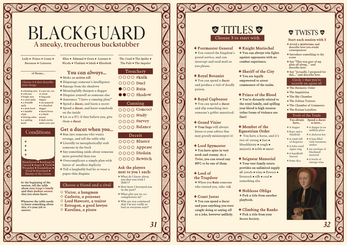
  • The Treasurer, a persnickety, long-suffering bean counter
  • The Lover, a charming, naïve consort to the monarch
  • The Alchemist, a brilliant but unhinged occultist
  • The Hierophant, a pompous, self-righteous priest
  • The Marshal, a bold, hot-headed general
  • The Blackguard, a sneaky, treacherous backstabber

Abilities are described as “titles”, which is nicely thematic. You choose three as part of character generation, and they’re things like:

  • Keeper of the Swans: As a Twist, you can unleash angry, escaped swans wherever you please
  • Royal Librarian: You can spend a ducat and know of a book that can tell you exactly what you need to know.
  • Lord Spymaster: You have spies in every nook and cranny. As a Twist, you can reveal any NPC to be one of them

(The one I don’t like is “Noblesse Oblige: Pick a title from another playbook.” Not because I don’t like picking another title, but because it’s messy and it requires either more mastery of the game than is likely amongst my players, or too much dreary analysis paralysis. [I don’t like this option in PbtA games, either.])

So the characters are great. Don’t tell me you don’t want to play right now.

Secret societies

And of course there are secret societies! Six of them, each with agendas, contacts and even more titles. The agendas give players extra objectives – more things to do.

  • The Hermetic Order: Secretive occultists in search of metaphysical truths
  • The Inquisition: Religious fanatics looking to punish sins, real or imagined
  • The Sky Chamber: There is no such organization as the Sky Chamber
  • Zobian Traitors: Seditious and cunning spies, loyal to the Duke of Zobia
  • The Chamber of Commerce: Wealthy burghers and merchants conspiring for profit
  • Karian Loyalists: Staunch traditionalists still loyal to a long-deposed dynasty

The Liege

The GM, meanwhile, plays the Liege, an unpredictable, irresponsible idiot. So Queenie or the Prince Regent from Blackadder. Lieges come in different flavours, each with their own playbooks:

  • The Royal Buffoon is the median wealthy jackass.
  • The Have-at-Them is an upstart warmonger.
  • The Bleeding Heart is terminally afflicted with noblesse oblige.
  • The Loathsome Toad mistakenly thinks they’re a master of intrigue.
  • The Powder Keg is a paranoid tyrant always looking for someone to behead.

Liege playbooks come with a list of characteristics and two signature Misfortunes and Mishaps. (Misfortunes happen when the dice are rolled, as mentioned above. Mishaps are things the GM can do to kick a session off, or during a lull in the game – along the lines of GM moves in other games.)

I suspect I’ll pick the Royal Buffoon for my first game, but they all sound like fun.

But what do you do?

Once characters have been created, the Liege starts everything off with a mishap. If you can’t think of anything, there’s a table of inciting incidents at the end, such as: “Your liege’s brother has claimed the throne.” As liege, you demand that your advisers sort it out – and you’re off and running.

As a player, you want to become the Liege’s most trusted advisor – the first amongst equals, as it were. Except they were never your equals.

The game ends with a footnote – where your character ends up in history. To determine your fate, you roll one dice for each of these that are true:

  • You survived until the end of the game.
  • You’re your Liege’s most trusted advisor (the Liege player decides who this is!)
  • You completed one of your secret society’s agendas.
  • You completed two or more of your secret society’s agendas.

Success lets you choose questions to answer from the legacies list (How did you permanently change the realm’s political system?); failure means choosing from the list of infamies (Why did nobody go to your funeral? What was the least convincing excuse?)

It’s worth letting the players know how the game will end so they can work towards those. Once they realise they will get dice for not dying, being the Liege’s favourite and completing their agendas, they should drive all the action.

Epilogue: There’s then a slightly odd, optional epilogue, a short mini-game called How’s it going, Geoffrey? Where you look at events from the point of view of the unluckiest peasant in the realm. It sits slightly oddly, and I’m not sure how I feel about it. I’m sure I’ll try it when I run Most Trusted Advisors, but from reading it, I’m not entirely convinced.

But it’s not perfect

Some things are explained in a bit too much detail, as if I’ve not played a roleplaying game before. Is that likely? Is anyone likely to stumble across Most Trusted Advisors without knowing what they’re getting? I suspect not, but anyway.

Fortune rolls: I’ve already mentioned fortune rolls. Making snap decisions is something every GM has to learn – yet most games don’t cover it. Does that mean it’s missing, or is it not needed?

Countdown clocks: Most Trusted Advisors takes a page to explain “Arms” – which took me a moment or two to realise it was just a new name for countdown/progress clocks. Part of me likes the way the mechanic is renamed to suit the setting, but a bigger part of me is irritated that so much explanation was needed for something that is pretty simple (and described in many other games).

Safety and inclusion: I’ve seen so many sections on safety tools that my eyes usually glaze over them. Does every game need a section on safety tools? Can we not just point to the many excellent online web pages? Apparently not.

Anyway, Most Trusted Advisors has sections on safety tools, warns not to be antisemitic when using secret societies, includes a page on queer identity and oppression, and talks about ethnicity. Even the epilogue minigame, How’s it going, Geoffrey? is there to help reflect on how awful most people’s lives were in the Middle Ages.

I know I’m a white, middle-class, middle-aged bloke, but to me, it all feels a bit heavy-handed. But maybe that’s the point – and my slight irritation reflects more on me than it does the game.

GM improvisation: Most Trusted Advisors relies on the GM to keep things going. While character creation should result in conflict and agendas, if the players don’t fully embrace the idea that they are driving the action, the game could struggle to get going.

Why I like it: ticking boxes

Most Trusted Advisors ticks many of my boxes. The key things I like in a game are:

A plot. For me, this is probably Most Trusted Advisors’ weakest area. While there’s no specific scenario, between the initial premise, character generation and the rules for determining your character’s fate, some sort of plot should present itself. However, it’s very reliant on the players – if they falter, everything then relies on the GM.

The characters are important. I like the characters to be important to whatever the game is about (my pet gripe are convention games that just use the published pregens without tying them to the adventure). Characters with a stake in what’s going on help keep their players engaged.

Players talk to each other as characters (not just to the GM). Most Trusted Advisors is slightly player-v-player, so the players should talk to each other rather than just to me. And as part of character generation, the players create shared backstories by asking each other questions.

Other points in Most Trusted Advisors favour include:

  • It looks easy to run – most of my friends are familiar with Blackadder and the playbooks are full of flavour.
  • It’s ideal for one-shots, and I like one-shots. (I suspect it’s exhausting to run and play, so it might even be rubbish for longer games.)
  • Character generation includes choosing a friend and a rival. Why don’t more games do this?
  • For the most part, it’s really nicely written.

Overall

So that’s Most Trusted Advisors. I’m looking forward to playing it – hopefully soon.

You can get Most Trusted Advisors from the creators’ page on Itch.io, here.
And click here for my report of play.