Showing posts with label computer games. Show all posts

Monday, 9 June 2025

The Lords of Midnight

I have become slightly obsessed with The Lords of Midnight, an old computer game from 1984 that I remember playing on the ZX Spectrum. I found an excellent adaptation on the Google Play store, and I’ve been playing that on my tablet.

And it’s excellent. And hard.

By World of Spectrum, Fair use, Link

A little history

The Lords of Midnight was written by Mike Singleton and originally released in 1984 for the ZX Spectrum (and was soon converted for other computers). The game featured an innovative 3-D effect that made playing the game feel like you were exploring a world. Features would appear on the horizon and get larger as you approached. It was amazing. 

The game is clearly inspired by The Lord of the Rings. You start by controlling the Fellowship of the Ring, er, I mean four characters: Aragorn, Gandalf, Elrond and Frodo. Sorry, I mean Luxor the Moonprince, Rorthron the Wise, Corleth the Fey, and Morkin, Luxor's son.

Against them is Doomdark the Witchking (ie Sauron), who has locked the land of Midnight in perpetual winter.

There are several paths to victory. Morkin can seek Doomdark’s ice crown (rather than the one ring) and destroy it (there are several ways this can be done). Or you can try for a military victory by recruiting the titular lords and winning on the field of battle, which is much harder and takes much longer.

The map (from here)

As for Doomdark, he wins if both Luxor and Morkin are dead, or if Morkin is dead and he conquers a particular citadel.

The game in 1984

I loved The Lords of Midnight, and remember playing it long into the night, in the corner of our lounge where our ZX Spectrum was plugged into our television. I think this must have been during the summer before I went to university, so I had time to spare.

I don’t remember the game being particularly difficult – I remember winning twice: the easy way and the hard way. But my main memory of the game was exploring the land, watching mountains and forests and keeps and armies appear before me.

The game in 2025

Mike Singleton passed away in 2012, but The Lords of Midnight lives on as Chris Wild continues to support the game and bring it to Android, Windows, iOS and OSX. His site, thelordsofmidnight.com, is full of useful information about the game. (And hints and tips, which I found useful as I’m too impatient to want to have to learn everything from scratch.)

The game plays well in 2025 – assuming that the 8-bit graphics do not put you off. For me, as long as the game is good, I don’t really care about the graphics. And is the game good? I think so.

On Android, the game seems a bit slicker than back in 1984. Certainly, it’s faster. But it also seemed harder.
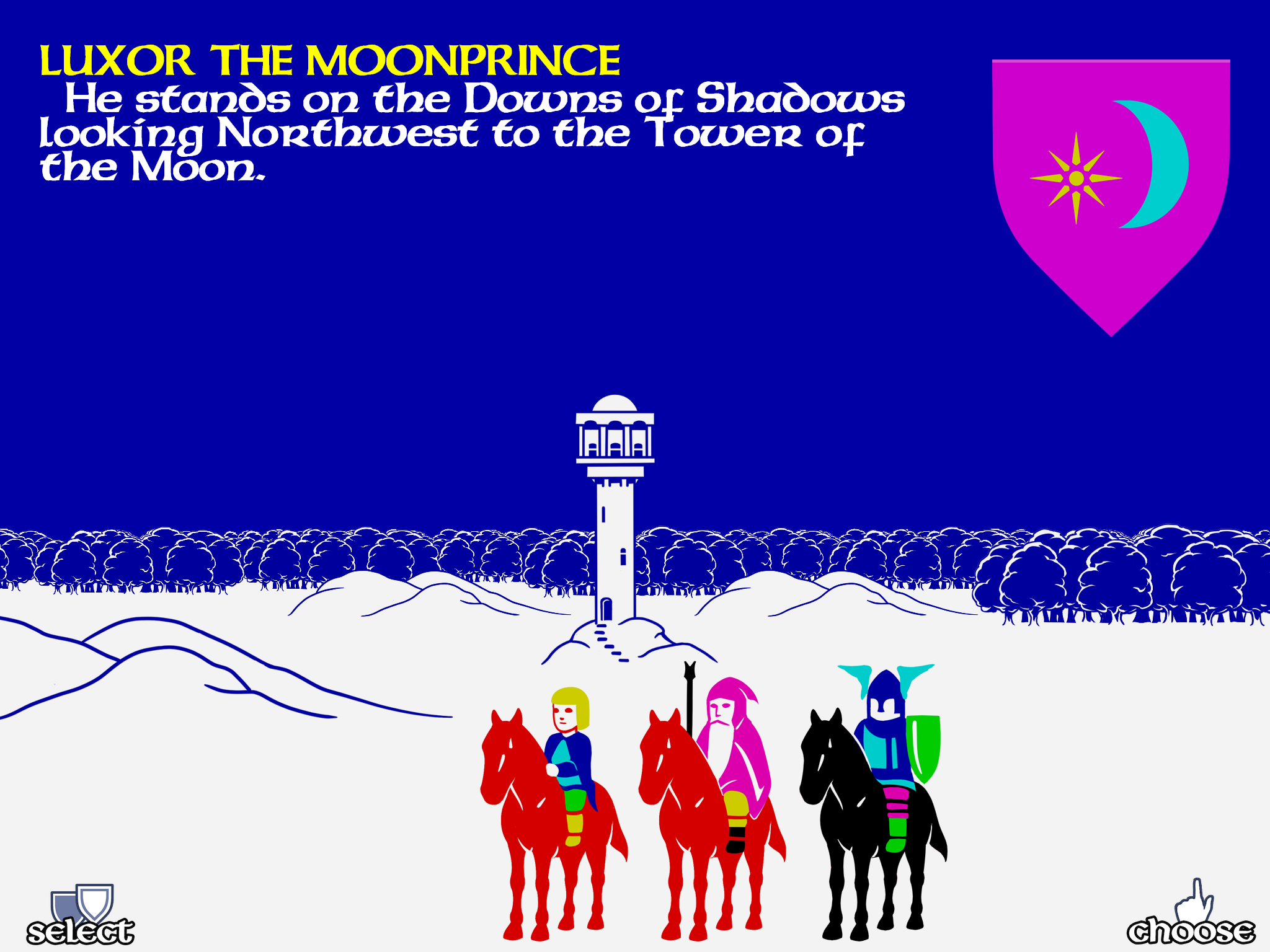
State-of-the-art 1984 graphics

It took me a couple of games to win – I made a couple of mistakes in the first few games, as I was learning how to play again, running around the map, recruiting lords and trying to remember where things were.

I think I won my third game (the easiest way), but then spent several games (and more hours than Mrs H knows about) trying to win militarily. This seems to be much harder than I remember – but maybe I didn’t win militarily last time? Or perhaps I just got lucky?

Anyway, the military game consists of running around the map, recruiting lords (and getting them to recruit more) and their military forces. There are more than 30 characters, and they’re scattered all across the map.

Along the way, Doomdark’s ice fear grows – characters grow demoralised and tired and can’t always continue. But as you win more and more victories against Doomdark’s forces, your troops’ morale improves.

Things I liked

Reliving the 80s: It’s such a good game, and challenging. It’s not easy to win the military victory. And it feels epic, despite its 8-bit origins.

Winning: And finally, I beat Doomdark on the battlefield. It took a long while – victory came on day 73. This time, I retreated to the fortress in the south and waited for Doomdark to attack, and then headed north. I may try something else next time and see if I can do it sooner.

The automap: This is a huge improvement from the old days. Back in 1984, we had to take copious notes. Now, the game creates a map as you go along, so you can see where everything is. It’s a huge help – I wouldn’t want to play The Lords of Midnight without it.

Finding all the lords: I used this page to create a rough map so I knew where to find them. Even then, it’s not easy. (Korinel the Fey is particularly hard to recruit, as they are under attack early in the game. I spent one game fruitlessly searching for them, not realising they had already been killed.)

Grouping: The game is much easier when you can group the lords and move them by controlling their leader. It’s only a shame I didn’t discover it earlier!

The Lord of Midwinter: After Mike Singleton died in 2012, Chris Wild added The Lord of Midwinter to the game as an Easter egg. I saw him a few times.

Things that could be better

User interface: While the user interface is undoubtedly better than we had back in 1984, it could do with a couple of improvements. For example, I would like to have the map button (which I used all the time) on more screens. Maybe all of them.

Battle reports: It would be nice to read a single battle report, instead of going through each character to see how they fared. (I quickly stopped.)

Lords without armies: I carelessly lost a few lords to wolves and skulkrin because I had forgotten they weren’t travelling with an army. (Or maybe they had lost their army in battle.) Lords with armies cannot be killed by the random monsters roaming the land, but lone lords can. And so I lost a few lords while clearing the map of critters, which was annoying. An indicator to show that they weren’t travelling with an army would have been very useful! (This was before I discovered the group feature.)

Gender: The character gender split is very 1980s—all male. (Although I think an update may change that at some point.)

But Chris Wild is a one-man band and supporting The Lord of Midnight for the love of it, these are very minor niggles and I thoroughly enjoyed my return to Midwinter.

What’s next?

And now I’ve done it? Do I try a couple of the harder options (such as switching off the ability for troops to cross mountains)? 

I don’t know, but first I’m going to tackle Doomdark’s Revenge, the sequel. I remember this being much harder…

Monday, 30 January 2023

The Illuminati computer game

I wasn’t expecting to enjoy playing Illuminati again. But I am.

Some history

I first played Illuminati, Steve Jackson’s card game of group-based world domination, in the 1980s. It was of its time – slow, fiddly, but with a deep streak of humour.

In 1994, Illuminati was reborn as INWO (Illuminati: New World Order), a collectable card game following the CCG craze that Magic: the Gathering started. INWO was like Illuminati dialled up to 11 – more groups, lots of crazy plots and bizarre combos.

INWO card game

Over the next few years, INWO spawned two expansions, Assassins and SubGenius, but we haven’t seen a new card in decades.

“I can’t help but wonder if it would be easier ACTUALLY to take control of the world?”

INWO was both more streamlined (action tokens replacing income) and more complicated (secrecy, immunity, resources, places, personalities, instant attacks…). It rewarded deep mastery, and I loved it. 

But it was also frustrating. The rulebook isn’t short, and as each group had its own ability, exceptions and special cases were inevitable. (As the compiler of an unofficial FAQ, the UFAQ, I was very aware of all the complications. Teaching INWO was a nightmare.)

(The quote above is from one of my friends.)

Variants

In 2010 or so, I dusted off my cards and pulled together some variants (rules and cards). I created a wiki to capture them all. (I don’t know why I didn’t do this on BoardGameGeek. I should upload them.)

I created a variant with very different rules that satisfied my issues with INWO. I’ve played it once or twice, but given the lack of fellow INWO players to hand, I haven’t played it (or regular INWO) in over a decade.

The deep freeze – and Kickstarter

So, to sum up, I was over-invested. But after about 2012, I put away my cards and variants and stopped thinking about INWO. Instead, I played other games. Simpler games. Games that were easier to teach. Games that weren’t so geeky. Games with a modern design and less waiting between turns.

And I didn’t think about INWO for years. Not until I learned of a Kickstarter for an Illuminati video game. I signed up for the basic tier – I wanted to support the game, but I didn’t like their business model as I didn’t want to buy all my cards again. (We’ll see…)

Illuminati – the computer game

In early 2023, the Illuminati computer game was released on Steam – and I’m enjoying it. It’s still being developed, so it’s rough around the edges. Gameplay combines classic Illuminati and INWO, with some plot cards and INWO’s colourful design (much of it updated). Over time, more of INWO is planned to be incorporated – but not too much, I hope. (Some things aren’t worth including.)

I’ve played several two-player games against the AI. I now win regularly. I have yet to play a game against a human opponent.

Gameplay

The Illuminati computer game is a cross between Illuminati and INWO. You have your own deck of plots and groups (as per INWO), but there’s also an uncontrolled area (as per Illuminati). There’s no deckbuilding (yet?), so everything is random, much like Illuminati.

There are no automatic takeovers, apart from one at the start of the game, so you are making attacks to control almost every turn. The plots are a cut-down sample from INWO: Mostly +10s, power boosters, reloads and alignment changers.

Illuminati computer game

The other big change is the power structure, which is laid out as a pyramid with your Illuminati at the top. All groups are played the right way up – this change works for the computer version.

The good

Things I like:

  • The new groups and art are great. As ever, the groups are biased towards the USA, but that’s inevitable. The random decks and uncontrolled area are a lot of fun, and you see lots of groups that would never see play in INWO.
  • Only one automatic takeover – at the start of the game. This took me a moment to figure out, as I had expected INWO’s auto-takeover every turn. But I think I prefer this way of playing – there are more attacks, and the game is more interactive as a result. (INWO often resulted in players playing defensively.)
  • Attacks fail on a 12. This is a huge change – in INWO, attacks failed on an 11 or 12. As attacks were relatively rare (you could grow your power base with your automatic takeovers), this made luck a huge factor. An unlucky roll could lose the game for you. Reducing the chance of failure from 1 in 12 to 1 in 36 is a big deal – I like it.
  • I like the new pyramid structure, with all the groups facing up. (However, I am confused by the underlying logic. The computer tells you where is free in your power structure, but it’s not always clear why those slots are free.)
  • Reloads are simpler – restore an action to a group of a specific alignment that doesn’t have one. There’s no discarding or action token requirement, unlike INWO. I prefer this simpler, cleaner approach.
  • Similarly, the power boosters are simpler. Instead of increasing power to 6 (as INWO), they increase it by +3.
  • The in-game tutorial is good. I muddled through a couple of games without it, but I wished I’d started with the tutorial.
  • I like the combination of a neutral zone and a private dossier.
  • Illuminati plays quickly – it takes 15 or 20 mins to play a game against the AI. I think there would be too much hanging around with more than three.
  • I like the clarity of play. INWO could get very muddled, with every group having a unique ability and the interactions creating analysis paralysis. This is much simpler. Having said that, I’d like to see some of INWO’s craziness, but probably not all of it. (More on that below.)

The not so good

Illuminati isn’t perfect, however. It’s an early release, and updates are released all the time. So this list is likely to be out of date fairly quickly.

  • The graphical display isn’t great. Once you have lots of groups, you must pan around to see your power structure. 
  • The interface isn’t great, and it’s not always clear where to click. Once you get used to it, it’s fine. But initially, it’s awkward and doesn’t give a good first impression.
  • Documentation is non-existent. It would be nice to read how Secrecy and Immunity work (are they the same as the original?).
  • Where groups can be placed is confusing. It’s not a big issue (as the game highlights all available slots), but I can’t figure out the underlying logic. For example, even when your Illuminati’s control arrows are all used up, you can still use it to attack to control (with the group going elsewhere in the power structure). I like this, but it's not how I remember INWO.

Going forward

While the game plays well at the moment, adding complexity from INWO may make things worse:

Cancellers: Cancelling was a real pain in INWO. Cancelling slowed everything down – not just because cancelling an action stopped it, but also because you needed to factor in the likelihood of your opponents cancelling your actions in your planning. And that added to the analysis paralysis.

Do we really want to have to click “Do you want to cancel?” for every action?

For me, I wouldn’t include any cancellers. Instead, I’d change the Nuclear Power Companies’ ability to remove a group’s action. Secrets Man Was Not Meant To Know could do the same. Hoax could remove an already-played power/alignment changer.

New World Orders in combat: Playing an NWO in combat was always frustrating as everything needed adding up again. It’s much simpler with the computer doing all the adding up, but I suspect it would be better if NWOs had to be played outside of an attack.

At any time: In INWO, many cards can be played during your opponent’s turns. This included power boosters and alignment changers, which can be played only on your own turn in the computer version. I think I prefer this limitation – the complexity of playing cards during opponents’ turns may slow the game down significantly. So I hope those cards will be minimised.

Things I’m looking forward to:

  • Some funky group abilities that aren’t just attack bonuses. (Brazil, Fraternal Orders, IRS, NPCs (but see above), Pentagon, Phone Phreaks, and so on.)
  • Resources, instant attacks, NWOs and other elements from INWO.
  • Deckbuilding. As much as I like the random decks, I’m looking forward to deckbuilding.
  • More AI Illuminati – the AI plays the Network at the moment.
  • Stuff that only a computer can do – there’s talk of a campaign game where you start in the 1980s and continue through to the 1990s and 2020s. That sounds fun.

Would I recommend?

So would I recommend the Illuminati computer game? Well, I’m very happy playing it and I’m looking forward to seeing how it develops further. If you’re a fan of INWO or Illuminati, I think you’d be happy. But I’m not sure I’d pick it up if I weren’t into either of them. Not yet, at least.


Saturday, 21 October 2017

Addicted to World of Tanks Blitz

I have just uninstalled World of Tanks Blitz (WoTB). Again.

My brother introduced me to WoTB a couple of years ago and I’ve been playing it on and off ever since. I find it ever so addictive, and what happens is that I install it, play it a lot (and become quite grumpy when I do), and then uninstall it to break the habit.

And then, a couple of months later, I reinstall it again...

So I was extremely interested to listen to Adam Alter's Irresistible, which talks about behavioural addiction of various forms, including computer games.

Alter defines addiction as something you enjoy doing in the short term, that undermines your well-being in the long term — but that you do compulsively anyway. (It seems that most of us have a behavioural addition of some sort.)

Six ingredients


Alter says that: "Behavioral addiction consists of six ingredients: compelling goals that are just beyond reach; irresistible and unpredictable positive feedback; a sense of incremental progress and improvement; tasks that become slowly more difficult over time; unresolved tensions that demand resolution; and strong social connections."

I know I find computer games addictive. I always have. (For example, last time I uninstalled WoTB I found myself playing Star Realms over and over on my tablet.) But WoTB seems particularly insidious - and that may be because it includes all of Alter’s six ingredients..

For example:

  • Compelling goals that are just out of reach: Grinding to get the next tank, playing in events, trying to complete missions.
  • Irresistable and unpredictable positive feedback: the various medals, achieving mastery in a tank (which compares your performance against everyone else’s).
  • A sense of incremental progress and improvement: the slow rise in win rate, learning maps and player behaviour, learning each tank’s strengths and weaknesses.
  • Tasks that become slowly more difficult over time: Climbing levels is easy to begin with, but takes longer and longer as you climb the tiers.
  • Unresolved tensions that demand resolution: I must complete that last mission, I've lost three games in a row, just one more before I quit.
  • Strong social connections: Platoons, clans, team chat, in-game friends.


A rare mastery for me
So WoTB is designed to be completely compelling, and I’ve been suckered. (My wife is less enthralled, to say the least.)

I think there’s an additional factor to addiction - and that’s appeal. For example, despite being highly addictive, I’ve never smoked. It’s never appealed. WoTB, on the other hand, is all about something that’s fascinated me since childhood: tanks, and WW2 tanks at that.

Undermining my long-term wellbeing


I’ve already mentioned that WoTB can make me grumpy, but there are other things it does to undermine my long-term wellbeing.

Playing WoTB means I spend even longer on the computer than usual and can interfere with my sleep (especially when I was playing it on the tablet - I now won’t play it after 9pm). It also stops me from doing more positive things, such as writing or playing boardgames.

At least I’ve stopped playing it on my tablet - that gave me headaches and tense shoulders as well...

Making it harder


Alter’s advice to overcome a compulsion is to make it harder to get to the thing that’s addictive. I thought that by moving it from the tablet to the PC would help that, but it turns out that I just spend more time on the PC instead. (Worse, I find the PC controls much easier than the tablet…)

I’ve tried using a kitchen timer (or my phone) to limit my games and avoid the "just one more game!" syndrome. That only works occasionally, and the best solution is to completely uninstall WoTB, but that means not playing it at all - and I like playing WoTB.

So I haven’t figured out a good way of managing my time while it’s installed. The best thing is to uninstall it, which is what I’ve done.

But I have no doubt I will install it again at some point...

Further reading


Click here to read a New York Times article on Irresistible.

And here’s an extract from Wired.

And relatedly, a piece by Google’s “design ethicist”.

Saturday, 1 July 2017

Knee Deep in Doom

I’ve just finished listening to 2003’s Masters of Doom: How Two Guys Created an Empire and Transformed Pop Culture by David Kushner and read by Wil Wheaton. I couldn’t stop listening to it - I was even kicking everyone out of the kitchen so that I couldn’t continue to listen while I did the washing up. (It’s not something I can listen to when Megan is around - the language isn’t very age appropriate.)

Anyway, I really enjoyed listening to how John Romero and John Carmack met, created some astonishing games, and then self-destructed. And it got me thinking about Doom again.

Doom was released in December 1993, but I don’t think I played it until 1994. My first PC was a 486-66 DX2 (if I remember correctly). I bought the parts from a shop in Armley and, with my good friend Richard’s help, built it. I bought it so that I could play X-Wing, but it wasn’t long before I was also playing Doom.

Richard introduced me to Doom (and X-Wing and many other games as well). He was always a lot better than me, and we played cooperatively at first - he helped me learn the levels.

I loved the shareware levels, Knee Deep in the Dead. We played them over and over. We didn’t often play much deathmatch - Richard was so much better than me that it wasn’t that much fun. I’ve never really liked deathmatch (which is particularly interesting given the prominence that it had in most of the Doom community, at least according to Masters of Doom).

I didn’t enjoy the later levels of Doom (The Shores of Hell and Inferno) as much as the shareware levels. To my mind they weren’t as attractive, nor as memorable. They’ve sort of faded in my memory into a bit of a flesh-coloured blur. Doom 2 I really liked, and was one of the many millions that bought it as soon as it came out in September 1994.

Masters of Doom describes the t-shirts the designers bought themselves with the Doom logo on the front and “wrote it” on the back. I remember seeing Sandy Petersen at Convulsion in July 1994 wearing one of those t-shirts, and thinking how cool that was. (Wil Wheaton does a great Sandy Petersen impersonation.)

I also remember Sandy saying that each of the Doom levels was designed to be playable from scratch on ultraviolence. That added a new dimension for me - each levels was a puzzle to be solved. Sure, they were easy enough when you started a level with all the weapons from the previous level, but starting with just a pistol? That was a new challenge.

With Doom 2 I really started noticing how the levels were designed, with the ever more powerful weapons leading you through the levels.

It’s interesting that Masters of Doom comments that while Sandy’s levels were fiendish, they weren’t as pretty as those designed by John Romero. That’s something you can see in Knee Deep in the Dead - Sandy’s only level (the finale, Phobos Anomaly) is difficult, but not as visually appealing as the previous levels.

My favourite Doom 2 memory is playing level 15 Industrial Zone (I think) cooperatively with Richard. We were working our way through the levels and unexpectedly encountered a cyberdemon. It’s not there when you play single player. We lured it into the respawn area where it killed us. We respawned, fired a few shots with our pistol before it killed us again. And again. And again. On and on this went. I don’t know how long it took us to take down that cyberdemon with just a pistol, but our corpses filled the area.

I tried Quake, but didn’t get on with it. It was a too brown, the controls were too hard to use, and and it just seemed like Doom but harder.

I played a few other first person shooters. I enjoyed Dark Forces and Duke Nukem 3D. I enjoyed the story aspect to Half-Life, but I missed having discrete levels to play through. My overall favourite was Dark Forces 2, which (for me) blended levels with story perfectly.

But that was the end of first person shooters for me.

I pretty much stopped playing computer games altogether in 1998. They were taking up too much time, and I was finding them a little too addictive.

(Since reading Masters of Doom I have found shareware Doom for android. It’s a bit fiddly saving a game as you need the keyboard, and as I can’t figure out how to call that up mid-game I’ve been using my bluetooth keyboard. But it works and it’s as fun as I remember - although the controls aren’t as intuitive as they were on the PC.)