Showing posts with label Other London. Show all posts

Monday, 13 January 2025

Flashbacks and overlapping investigations

In The Dead Undead, I created a flashback. The investigation starts with a dead vampire, at which point I tell the PCs that this is very similar to an unsolved case a few weeks ago.


At which point we skip backwards in time and pick up that investigation. 

This worked really well – except the players forgot that this was an unsolved case. That was my fault – we played the flashback over a couple of sessions, and because the flashback was effectively no different to how we normally play, the players forgot that this was an unsolved case, and I had to remind them.

(Perhaps we should have played in black and white, or something.)

I’m thinking about this because the next case, The Orphan Room, also has a flashback. Or at least, it could have a flashback, and I’m thinking about how I want to run it.

(I suspect both investigations have flashbacks is because I started The Orphan Room ages ago, and while I was mulling it over, The Dead Undead dropped into place and I pinched the flashback idea from The Orphan Room.)

It takes me time to craft an Other London investigation, and so my regular group plays Other London only rather intermittently – between games of Kingdom, Good Society and more. So we do one investigation, then the next. And so on.

Overlapping investigations – probably a bad idea

Real life is rarely so ordered, and part of me would like to run an Other London game where the investigations overlap.

So the flashback from The Dead Undead occurs before (say), Murder of a Templar. And then the second murder in The Dead Undead occurs as Murder of a Templar is wrapping up. (And the flashback in The Orphan Room might even happen before all of that…)

But.

The problem with the flashback in The Dead Undead was that the players found the lack of leads frustrating. (Obviously, it didn’t help that they had forgotten we were playing a flashback. I should have reminded them.)

I suspect it would be equally frustrating if I started overlapping investigations.

We’re not good at leaving things unresolved, so there’s an inherent danger in trying this.

While unsolved cases are a feature of everyday policing, I can’t think of any examples in fiction. I’m sure there’s a reason for that.

So, I think for now, this remains an idea for the shelf.

I’d still like to do it, but it will need the right group of players. And I’ll explain what I’m doing – and hope they trust me enough to go through with it!

Monday, 9 December 2024

Other London: The rats

I had an idea for an Other London faction led by a rat king. I’m not sure it will fit into the current investigation I’m working on, so I’m parking it here so I don’t lose it.

The Rats

Concept: Rat swarm commended by an intelligent rat king

Trouble: Hunted by those who made Us

Goal: Seek allies and find a safe harbour

In a laboratory somewhere, researchers conducted unethical experiments and created a rat king. Unknown to the researchers, their new creation was intelligent and was learning as much about them as they were about it.

When the rat-king had learned enough, it escaped the laboratory and fled through the sewers. It now hides from those who hunt it in London’s underground places: sewers, drains, cellars, tunnels.

The rat king, who calls itself Seven-as-One is no longer alone. It leads an army of rats, plus it now has a few human allies. However, it still searches for a safe space – and it still seeks human allies.

Information, rumours, lies

  • Rats have recently behaving strangely in London.
  • Rats are everywhere, watching, listening.
  • Someone or something is controlling rats.
  • A rat king has come to Other London.
  • Rat kings have a gestalt intelligence formed from several stupid rat brains.
  • Rat kings can direct and control other rats.

Questions

  • Who made Seven-as-One?
  • How was Seven-as-One made, and is it repeatable?
  • What happens if one of the seven dies - can it be replaced?
  • What does Seven-as-One really want?
  • Can Seven-as-One find a home?

Enemies: Fae (for whom rats are unclean vermin), their creator

Allies: None – yet

Location: Anywhere out of sight, underground.

Seven-as-One: Nervous rat king made of up seven laboratory rats linked by their tails, gestalt intelligence, quick learner, I learned more from my creators than they realised

Awesome (+4) at: Commanding rats

Good (+2) at: Computers, electronics, languages, subterranean London

Bad (-2) at: Moving fast

Stress: O O

Seven-as-One is always thinking ahead, fearing the worst and expecting danger around every corner. Their caution isn’t just paranoia, the scientists who created Seven-as-One would dearly like their creation back. Seven-as-One learned computers and electronics from the lab they were kept in, and communicates with their human allies through and old laptop. (They find touchscreens hard to use; their claws get in the way.)

Loyal rat army: Swarm of wriggling rats

Awesome (+4) at: Escaping, wriggling, scavenging, scaring folk

Good (+2) at: Biting, gnawing, climbing, following Seven-as-One’s orders

Bad (+2) at: Taking independent action

Stress:  O O O

Consequences:

Mild (2)

Marky P: Young agent of Seven-as-One, quiet and watchful, a runaway

Good (+2) at: Scavenging, taking care of rats

Bad (+2) at: Talking to people

Stress:  O

Marky P is a runaway kid who stumbled across Seven-as-One and is now their human hands. Marky ran away from his abusive father and had been living on the streets for a few days before meeting the rat king. Seven-as-One recognised a fellow runaway, and the two now help each other.

Monday, 2 December 2024

Could AI art be good for some TTRPGs?

I had lots of lovely conversations at Consequences, but one that stayed with me was one that I had with Kris Alice that covered all sorts of topics and inevitably stumbled on to the subject of AI.

And, as is often the way, I realised later what I should have said at the time. So here I am.

While we mostly agreed, I found the conversation slightly awkward because I’ve used AI art for character portraits in my Other London RPG books. I don’t hide the fact, or try to pass them off as anything other than AI art. But they’re there and it was clear that Kris Alice disapproved.

Evil AI character portrait
from The Dead Undead

As I understand it, the two main arguments against using AI art are copyright and employment.

(There’s also an argument against AI about their huge energy costs, but I don’t know enough about it to argue either way.)

Stealing copyright

So, one of the complaints about AI is that it steals the copyright of real artists.

I have no idea how true this is.

I have a vague sense of how ChatGPT and text-based AI tools work (they’re a bit like suped-up predictive text on a smartphone), and as a result, to me, they don’t feel like a breach of copyright. (I am sure my words have been used to train the models at some point, and I’m relaxed about it.)

But AI art? That seems like magic to me. Maybe it’s exactly the same, maybe it isn’t. I don’t know.

So I genuinely don’t know if AI art is stealing copyright. (And when you dig into what copyright actually is, things aren’t much clearer.)

But I’m not a lawyer, and it’s been ages since I played one in a game. Right now, as far as I am aware, all that the courts have ruled is that AI art cannot be copyrighted. (So if you want to steal the character portraits in my books, I can’t stop you.)

They’ve yet to decide whether using art to train an AI model is theft – but that’s a matter of time before that decision is made.

Stealing work

The other argument is that AI art puts real artists out of a job.

That may be true. But in playing with AI art, I’ve learned that it’s very hard to get exactly what you’re looking for. If you’re looking for a consistent vision, or if you have a particular idea of what you want illustrated, you’re better off with a human. (At least, for now.)

If you just want generic fantasy art and you’re not too fussy, then AI will suit you fine. 

Otherwise, you’ll need a real artist.

(For the rest of the art in Other London, I took photos and played around with them in an art package. I couldn’t get what I wanted from AI.)

Mediocre artists at risk

Much in the same way that artisan bakers exist alongside mass-produced sliced bread, I don’t think talented artists have much to fear from AI art – as their art will always be in demand. However, I think mediocre artists have more to worry about. 

Mediocre artists like me.

I create the art for most of the games at Freeform Games. I create a pen-and-ink sketch for each item, scan it in, tidy it up, then print it out and colour by hand, before scanning it in. I’d be so happy if I could replace that with AI art.

Here’s a teabag I did for one game.

So for the purposes of this post, I tried to get an AI programme to give me a picture of a teabag. Here are the results:

These are what Artflow's AI thinks a teabag is...

I admit that my prompting skills need work, but I don’t think I’m out of a job just yet.

But what about Other London’s AI art?

I tried to argue with Kris Alice that no artists were hurt by my use of AI art in Other London because I was never going to use human art anyway. If AI art hadn’t been an option, there would be no character portraits, and the book would be a little less attractive.

However, I think there may be a deeper point that I only thought of afterwards.

Without AI art, Other London might not exist at all.

Now, I can’t remember my thinking at the time, but I’m pretty sure that without being able to use AI for the portraits, Other London would still just be a pile of notes on my hard drive. 

So maybe AI art isn’t the destructive force it’s often taken for?

Maybe, like word processors and DTP software, it creators like me bring their work to a wider audience.

Yes, some of that work may be mediocre (I hope Other London isn’t, but your opinion may vary). And yes, AI art has a certain “look” that isn’t always appealing.

But if AI art means that people like me can bring their words to life, then surely that’s a good thing? 

At least, I think it is. But maybe I would say that.

Other London’s future

Should Other London become a success (and it’s not even sold 50 copies yet), then I’m happy to find an artist to work with to replace the AI portraits.

But right now, it’s either AI character portraits or no portraits, and I like to see what my NPCs look like.

Monday, 23 September 2024

The Dead Undead: After action report

We’ve just finished The Dead Undead, my latest investigation for Other London: Desk 17. The mystery has been solved, and we’re taking a break while we do something else.

Goals

I had three goals.

  • Playtest the scenario before putting it on DriveThru and itch.
  • Use the players’ characters as the basis for some more pregen playbooks.
  • Have fun.

So I achieved the first goal – I made a few tweaks to the investigation, but it didn’t need a drastic reworking, and it’s now for sale.

However, the second goal is a work in progress. As I described some time ago in this post, the players took their characters in weird directions and turning them into Desk 17 pregens is not quite as straightforward as I hoped.

Luckily, the last goal was a total success – I had fun, and the players told me they also enjoyed themselves. (They were certainly very engaged.)

It also took us a lot longer to solve than I expected. We took 11 sessions to play through, which, given we are easily distracted, probably meant about 16-18 hours of play, which is pretty good.

Other London lore

I also learned a few things about Other London.

Desk 17’s offices: We decided during session zero that Desk 17’s office was in the old London Necropolis Railway station building on Westminster Bridge Road (above the cafĂ© and bookshop). I didn’t know that was a thing, but you can read about it here. (It led to a lovely moment when they brought in a witness who thought their offices were so cool!) The office stairwell is haunted by a spook who appears to be feeding on the magic of one of the PCs – that can only go badly.

Vampires and their reflections: "Can I see her reflection in the polish?" made me wonder about vampire reflections. I decided there and then that vampires didn’t reflect in silver-backed mirrors, but other reflections (puddles, chrome, modern mirrors) were fine. And the same for cameras – they show up on digital cameras but not wet film.

Vampire servants: One NPC in the investigation has a prolonged life because they drink vampire blood. I decided to keep the exact benefits vague – it depends on who you drink from and how often you drink.

Vampire funerals: What does a vampire funeral look like if vampires don’t explode in a shower of dust (and in this investigation, they don’t)? I created a vampire family plot.

Folk songs: As part of session zero, the players created the EFDSS as an ally. They visited the library and found an old folk song that told the story of a fae gang who burnt down a windmill that was blocking their view of the sunrise, killing everyone inside. That’s the first time I’ve dropped clues and history into a folk song.

Aspects-only Fate

I run Other London using Fate Accelerated. Not that we lean hard into its narrative approach, but because I find Fate to be a simple, lightweight system that is fine even if your style is mostly trad (as mine is).

However, I’ve found myself irritated by approaches recently, so I thought I’d give aspects-only Fate (from page 26 of the Fate System Toolkit) a try. In essence, a character’s aspects give them a +1 to rolls where they apply. +1s are cumulative.

I liked it. Typically, players rolled the dice with a +1 or +2 bonus instead of their usual +2 or +3 with FAE. It toned down their power and made more rolls uncertain. (I usually set the target for an overcome roll at +2, making rolls more chancy.)

Having said that, we didn’t roll dice very often – maybe two or three times a session. We only play for two hours (often much less as we are easily distracted by other things) and don’t roll many dice (lots of conversations with NPCs, but they rarely need dice).

I also tweaked a couple of other things.

Rather than refresh fate points to three each session, I’ve started them all with three fate points, but they only refresh one each session. (They can still earn them through invokes as normal.) So this means they can’t spam them as much as they might otherwise do.

In practice, this didn’t have much effect – nobody ran out of fate points.

My other change had no impact, largely because we didn’t get into combat. Instead of the usual (slightly counterintuitive) FAE stress boxes, I was going to cut them down to three single-use boxes. That would have made the PCs less robust in a fight, but we didn’t actually have a fight (the investigation’s climax resulted in a standoff in a park, but we didn’t break into combat).

The Dead Undead

I’ve put The Dead Undead onto DriveThruRPG and Itch – and also created bundles on each where you can get everything Other London related at 50% off.

Other London: The Dead Undead on DriveThruRPG

Other London: The Dead Undead on Itch.io

The Orphan Room

I’ve started the next investigation, and I know it’s called The Orphan Room. I sort of know what’s going on, but I haven’t worked out the details.

Time to get my thinking cap on.

Monday, 16 September 2024

Where is Desk 17’s office?

As part of session zero for Other London: Desk 17, I get the players to create Desk 17 itself. I’ve created a worksheet where the players answer simple questions (Where is Desk 17’s office? What’s weird about it? And so on.), choose their support team and select a couple of stunts.

And it crossed my mind that I could give players a menu of options for the location of Desk 17’s offices.

Ideas for where you might find Desk 17

Inside Marble Arch. This has form, as three small rooms were genuinely used by the police from 1851 to 1968.

The London Necropolis Railway station on Westminster Bridge Road. We are using this in our current game.

Mappin Terraces in Regent’s Park Zoo. Constructed in 1913-14, the hollow spaces inside were once used for the aquarium – but are they now Desk 17 offices?

Mornington Crescent tube station. Mornington Crescent has pedigree – it not only houses the secret entrance to Charlie Stross’ Laundry but also the Peculiar Crimes Unit (from Christopher Fowler’s Bryant and May series) is located in offices above the station (until they are destroyed in a bomb blast).

In Centre Point. Converted to residential flats, much of the tower is now empty (led to its being called one of London's "ghost towers")

In the BT Tower. In the old revolving restaurant, perhaps?

50 Berkley Square is supposed to be the most haunted house in London. Desk 17 would fit right in.

The Kingsway telephone exchange, hidden in tunnels deep below Chancery Lane tube station.

Or some less salubrious ideas (particularly when you’re channelling Slow Horses):

  • Below a Soho massage parlour
  • Above a chicken shop
  • Behind a candy store
  • On a barge in Surrey Quays.

Monday, 2 September 2024

The Dormant Accounts

I was listening to Writing the Universe (BBC Sounds) and Robin Ince was talking with John Lloyd about The Restaurant at the End of the Universe. They played a clip from The Hitchhiker’s Guide to the Galaxy which talked about depositing 1p in your own time and using compound interest over billions of years to pay for your meal at Milliways. And that made me think that if that was the case, there would be bank accounts here and there, slowly accumulating interest.

And then I wondered what that would look like if you stumbled on some of those accounts today. Then I wondered what sort of story you might generate from that, which is when I decided to turn it into an Other London idea.

As I didn’t have the answers, I decided on a faction. (I have no idea if or how this will ever make it into a game, but it’s a fun idea to noodle around with.)

Trent & Rochester & Associates

Concept: Legal firm managing the estates of the dead

Trouble: A troublesome heir who wants what’s rightfully theirs

Goal: Maintain the accounts until their owners return

Trent & Rochester & Associates (“the firm”) is a small firm of lawyers specialising in managing the investment accounts of those “no longer around” (a euphemism) to manage them. The accounts themselves are held in banks and other financial institutions. The firm merely manages them. The firm does not disclose how many “clients” it has, but charges handsomely for its services.

At least one account has been managed by the firm since it was founded in 1766. The firm has reportedly managed many others for over 100 years. These are not ordinary accounts.

Trent & Rochester was founded in 1766 by Thaddeus Trent and John Rochester after they graduated from Cambridge. They set up business in London, providing discreet financial services to specialist clients. In 1812, shortly before Mr Trent died at sea, the firm changed its name to Trent & Rochester & Associates. Rochester welcomed a new associate, Thomas Taylor, shortly after.

Since then, the firm has only ever had two partners. Currently, these are Timothy Thwaite and James Rochester (no relation).

Mr James Rochester (no relation): Wealthy aristocratic lawyer, partner in Trent & Rochester & Associates, skilled bureaumancer, recluse

Awesome (+4) at: Probate law, investment law

Skilled (+2) at: General law, bureaumancy, knowledge of Other London factions, wine, 

Bad (-2) at: sports, youth culture

Stress: O O

Rochester went to Harrow and studied at Cambridge. He spent ten years working in the City for a variety of investment bankers and law firms, where he was a promising high flyer. However, in an unexpected move, Rochester joined Trent & Rochester & Associates. Since joining the firm, he has become a recluse and no longer sees his family or old friends.

The inheritor

Seraphina Black is an art student studying at West College London. She has learned that her great-grandfather, Peregrine Black, was extremely wealthy and that his assets should have been hers – but instead, they are held by Trent & Rochester & Associates.

Unknown to Seraphina, Peregrine was one of the original members of the Golden Dawn. Peregrine was a Seer and predicted the rise of modern technology. His account includes detailed instructions for investing his wealth - for example, his last instruction was to invest in "Googol" in 2005.

Seraphina Black: Streetwise art student, I’m older than I look, I grew up in Tower Hamlets – of course I’m carrying a knife, I may have latent Seer powers inherited from my great-grandfather

Skilled (+2) at: Art, London street culture, surviving and scavenging, scrapping 

Bad (-2) at: Following rules, listening to my parents

Stress: O

Questions

  • Who owns the accounts?
  • How many accounts are there?
  • Will they return? If so, when?
  • Why do they need so much money?

Information, rumours and lies

  • The firm only ever has two partners, and its “associates” are little more than fake identities for Trent and Rochester (unliving immortals who take different names over the centuries)
  • Clients include vampire lords, angels, sleeping fae, or King Arthur
  • Isambard Kingdom Brunel had an account with the firm
  • The firm steals money from “dormant” bank accounts – there are no clients
  • The firm is struggling with anti-laundering laws and needs computer specialists to help with modern accounts
  • Some old accounts have been recently closed

Location: One Canada Square, Canary Wharf

Enemies: Modern banking laws, HMRC, The Order of the Gilded Reflection

Allies: The City of London, Lord Slyke, Lord Boston, The King of the Tangled Wood


Monday, 24 June 2024

Other London: Custodians of the Echo

As I've said before, I’m running a short Other London investigation at the moment.

We've started afresh because I want to see what new characters (covered briefly last time) and factions they develop during session zero.

I’ll have a bit to say about how the investigation went in due course, but here’s one of the factions they created (and I then fleshed out).

The players suggested something to do with the English Folk Dance & Song Society at Cecil Sharp House and a secret group interested in folk history. I then filled in some of the details (and put it in my faction format) between sessions.

Custodians of the Echo

  • Concept: A secret society of folk music historians.
  • Trouble: Extremely limited resources
  • Goal: Track down "The Song of the Tree of Albion"

Folk songs are magic.

The Custodians of the Echo is the name given to a secret group of folk historians based at Cecil Sharp House. They are the true power behind the English Folk Dance & Song Society, and the EFDSS's members unwittingly help them complete The Song of the Tree of Albion.

There are always eight Custodians (a sacred number - a “square”), four men and four women.

The Song of the Tree of Albion: According to Austen's 1788 Compendium of British Song and Story, The Song of the Tree of Albion is an ancient piece of music and dance. According to legend, this composition was created by minstrel Aeldric Goodfellow, known as Aeldric the Melodious, for King Arthur. It is said to contain melodies and harmonies that can influence the natural world, heal the sick, and communicate with spirits. The work is composed of both music and lyrical poetry but was torn into seven pieces, each of which has been lost to history.

Lila Hawthorne: efficient EFDSS secretary, Custodian of the Echo, I've always had green fingers

Skilled (+2) at: EFDSS bureaucracy, folk history and lore, gardening and plant magic

Bad (-2) at: Anything to do with technology.

Stress: O O

Lila works at Cecil Sharp House where she runs the administration team. She is a keen gardener whose green fingers are aided by her use of plant magic. She sometimes wonders if one of her grandparents was a fae.

Information, rumours and lies

  • The EFDSS's library contains Britain's best collection of folk history.
  • The EFDSS library's restricted section contains several works of powerful magic.
  • The Custodians of the Echo are all powerful magicians.
  • The Custodians are all fae.
  • The Custodians command the Black Drummers, an elite fighting unit.
  • Modern Morris dance moves are loosely based on Black Drummer fighting moves.
  • English ceilidh dances sometimes have occult meaning.

Questions

  • What is the Echo?
  • Where is the Custodian's library?
  • Do the ceilidhs at Cecil Sharp House have occult significance?
  • Are the Black Drummers real? Who commands them?

Allies: Desk 17, Whitechapel Coven, Lord Boston

Enemies: The Black Watch, Miniaturists

Location: The Custodians of the Echo can be found at Cecil Sharp House, the headquarters of the EFDSS.

Monday, 17 June 2024

Pre-generated characters or not?

As I said a couple of posts ago, I’m currently running an Other London investigation for my regular group.

When I ran Other London previously, I used the pregens in the book. These are playbook-ish Fate Accelerated pregens. There are five characters, each with options so players can tailor them. They work well at conventions.

Questions on the pregens help tie everyone together, and using pregens means I haven’t got to worry about someone creating a character unsuitable for Desk 17.

As my players had all played Desk 17 before, I decided to let them create their own without using my pregen templates. The result was, um, interesting.

Letting players have their heads

Thomas created a career detective who had been demoted to Desk 17. They’ve upset someone powerful and suffer from the “evil eye”.

Terry created a talented cat burglar who has been press-ganged into Desk 17 after they were caught killing a werewolf.

At this point, we were in danger of Desk 17 turning into Slow Horses, with none of the PCs actually wanting to be in the department. Worse, the PCs so far had no actual magical abilities, which might be a handicap in Other London.

So I asked Jon (who was still mulling things over) for a character who had something magical about them and was also a willing Desk 17 employee. So he created a “street word wizard” (whatever that is) member of Desk 17.

PCs more interesting than the investigation?

While these were great, their backstories were much more interesting than my investigation. I was initially worried that this would derail the investigation, but so far, this hasn’t been a problem. 

I have had to ask the players to explain their characters. Some things were left deliberately vague so they could find out during play, and other things are simply opaque. For example, it wasn’t until session 4 that I asked Jon what he meant by “street word wizard.”

We are weaving their backstories and links into the game. I’ve asked them to draw on their backstories and contacts rather than just rely on me, and that’s working well: we’ve met lots of contacts and visited places important to the characters. So that’s working as intended.

More fun than pregens

After the last session, I asked the players how they thought it was going. They said they were enjoying the game (phew!), and Jon said that he was enjoying his character more than if he were playing a pregen, because he’s often not sure how to play a pregen.

I found that particularly interesting, as I really like pregens. Pregens tell me the kind of game the GM is interested in running, and they are usually suited to the game. (At least, good pregens do…)

If I’m left to my own devices, I can easily go off-piste.

The freeform influence

I wonder if I embrace pregens so easily because I play (and write) so many freeforms. The biggest difference between freeforms and traditional larps (and most ttrpgs) is that players create their own characters with a traditional larp/ttrpg, while you are given a character in a freeform. It’s a very different experience.

(And as a result, I’ve played a ridiculously wide range of characters in freeforms – see the list here)

There is a darker, reason I prefer pregens: I don’t really enjoy creating characters. At least, I didn’t used to. Back in the old days, I found character creation a chore. I wanted to get to the playing bit as quickly as possible, and creating a new character always got in the way.

These days, session zero is more structured and includes innovations such as actual bonds linking characters together (not something we did much of in the good old days), and I enjoy it much more.

Playbooks – the happy medium

So for me, playbooks (or partly-completed pregens with options for tailoring) are the best of both worlds.

I love them, and Other London comes with five playbook-style pregens that players can tailor. (I’ve used these when running at conventions and it works well.)

One of the reasons I asked my players to create their own characters is so I can use them to create more Other London playbooks, but I think we’d better finish the investigation before I think about that.

Monday, 3 June 2024

Writing RPG adventures: How much detail is too much?

I’m playtesting The Dead Undead, the next Other London investigation for Desk 17, the Met’s occult crimes unit. In The Dead Undead, the PCs are investigating murdered vampires.

I wrote the investigation before Christmas, but it’s taken me a few months to get it to the table.

Draft cover for The Dead Undead

I know I’ve been critical about published adventures on my blog recently, so I may be sensitive to how I’ve written the investigation. But as we played, I wondered whether I’d put enough information in.

It’s a balance. I want to include enough detail but not too much. I want to give GMs enough information to run the investigation, but I don’t want to overwhelm them with details or make them worry about getting it “wrong.”

Reddish sand

For example, I wrote, “Audu’s bedroom contains a coffin containing sandy red soil.” (Audu is a vampire.) That’s all I say about the soil.

As the PCs sent the soil for analysis, I decided on the spur of the moment that the results would show that the soil was from Morocco. As a result, I’ve started to give other elements in that location a North African vibe.

That’s just how I’ve done it – I don’t mind if another GM decides differently and decides that the soil comes from Romania, or anywhere.

But because I’ve decided that the soil comes from Morocco, and as I’m the investigation’s author, does that make it canon? Does that mean I should update the text to include that detail?

Questions that set the scene

I try to write Other London investigations in a way that lets the GM (and players) make it their own. Creating characters is collaborative, and the players decide (during session zero) where the Desk 17 office is located, what makes it unusual, and who the support staff are.

Scenes start with a question to get the players to contribute to the scene. (In this case, What do you find unsettling about the sculptures and artwork here?)

I’m telling the reader that it’s okay for them to make the investigation their own. At least, I hope I am.

So, no, it isn’t canonical that the red soil comes from Morocco, and that detail won’t be in the final investigation.

But we’re all different…

Perfect Organism

Perfect Organism is my scenario for the ALIEN rpg set shortly after the events of Aliens – the Colonial Marines and ICC are investigating the loss of the Sulaco.

I’ve written the scenario in the style of a normal ALIEN cinematic scenario with pregens, acts and events for each act.

However, because I write concisely (and I’m not paid by the word…), I’ve not padded it out with unnecessary details. So the events are merely bullet points that the GM can flesh out to suit their game. (Eg, “On the ground, the convicts start coming around, and radio Kathar Station for help.”)

And of course, one piece of feedback wanted me to expand on those bullet points to make them more like the events in Free League’s adventures. As I find Free League’s adventures to be overwritten, I didn’t do that.

We’re all different

We’re all different.

What is too much detail for me might not be enough for someone else. 

But when it’s my game, I get the final decision.

Wednesday, 15 March 2023

AireCon 2023

So last weekend was AireCon 2023 in Harrogate. This year it was even bigger, which meant it was in the larger halls. I was there for three days. On the Friday, I ran two roleplaying games; on the Saturday I popped in to play games and catch up with friends; and on the Sunday, I was there with family. (Previous AireCon reports here.)

At the entrance to AireCon with Megan on Sunday

Friday

Friday was exciting because of all the snow that had arrived overnight. It didn’t last long but caused some travel chaos. I caught the bus, so I just had to contend with some slippery pavements, which I navigated with care.

I ran Perfect Organism (for ALIEN) and The Bone Swallower (for Fate Accelerated) and had time to wander around.

Perfect Organism (game files here)

Perfect Organism is my ALIEN cinematic set in a W-Y station in orbit above LV-426. The USCMC are investigating the loss of the Sulaco (from Aliens), and, well, things don’t go according to plan… Perfect Organism sold out before AireCon, so I knew I had five players. This would be my first time running it with all five players – my previous runs each had three. I was interested to see how the additional characters changed the scenario. I had expected everything to take longer, but to my surprise, we took less time than before.

This time, the players never made it out of orbit. That’s because one of the new characters shut down any suggestion that the PCs head down to LV-426 itself. Had they gone down to LV-426 (as earlier groups had), the game would have lasted longer.

It didn’t matter – the players seemed to have a blast. They leaned into their conflicting agendas – for much of the time I just sat back and watched them.

My favourite moments were the number of excuses the lead scientist had for keeping the investigators from looking at anything too deeply. She was so inventive – “There’s always a reason,” said one of the others.

Me and most of my Perfect Organism crew

Finishing earlier than expected gave me time to chat with Graham (the organiser and someone I know from Furnace), grab some lunch and a pint of beer, and buy Ivan Brett’s two books, The Floor is Lava and Bored? Games!

The Bone Swallower (more info here)

The Bone Swallower is the adventure in my Other London: Desk 17 setting book for Fate Accelerated. Again I had five players. (I’m normally wary about running games for five players, as I find it difficult to ensure everyone has enough spotlight time. But from what I can tell, I think I got it right at AireCon in both games this year. Although I may not be the best person to judge.)

My players knew of Fate, even if they hadn’t played it before. Except for one – for whom this was their first time roleplaying! While they were hesitant at times, they soon got stuck in and played along with the rest of them.

Five players is a bit much for an investigative scenario (it can feel like the players are going in mob-handed at times), but we split the party when we needed to, and their investigation took a different route to previous runs.

(It also changed one scene dramatically. Previously, there’s one scene where I’ve seen players be a little tentative. This time, convinced they had found the suspect, they went in hard and fast and quickly overpowered the bad guys.)

My favourite bit was tracking where the missing Iona had gone – using an eyewitness and traffic cameras to find the van. Nobody’s tried that before, so I was thinking on my feet.

Again, it felt like a successful session, and I felt pleased.

With my Friday duties finished, I headed back to the bus station.

Over tea, after telling Mrs H about the convention, we played Licence Plate Sentences from The Floor is Lava (but we grabbed some random letters as we were in the kitchen rather than in the car). Mrs H is so much better at it than I am!

Saturday

Overnight, I dreamt that Taylor Swift had written a song about an unpopular D&D setting she really liked. I think it was pretty good – but I can’t remember anything now. Mrs H suggested it meant I had had a good time yesterday, which was hard to argue with (although I don’t play D&D…)

Anyway, I hadn’t originally planned to be at AireCon on Saturday. However, the snow prevented the planned visit from the in-laws, so I was free to brave the bus into Harrogate again and I was there by about 11.

Saturday was a day of catching up with old friends and playing boardgames.

Games played:

Star Wars: The Deckbuilding Game: A Star Wars-themed Star Realms, with a few twists. Maybe if I didn’t have so many Star Realms cards, I would be interested in it.

Letters from Whitechapel: I played this twice, a hidden movement game along the lines of Scotland Yard where one player tries to avoid capture by the others. Three of us hadn’t played before, but we picked it up pretty quickly. I was an investigator in the first game, and we caught Jack (the villain) before he murdered his second victim. As that was over fairly quickly, we played a second game, and this time I was Jack. I won on the last turn, but goodness, it was stressful! I was exhausted at the end. (One of the other players, who’d played before, said it was one of the best games of Letters that he’d played.)

I found this game by spotting a lightsabre – the system AireCon uses that lets players know that people are looking for more players. It’s a great system – and along with the area where you can linger if you’re looking to play a game means nobody should be looking for a game for long.

King of Tokyo: I entered the AireCon King of Tokyo tournament at the last minute. (I was nearby as it Cwas setting up.) I was knocked out in the first round – the winner of our table obviously loved the game and was a worthy winner.

Other moments of note included chatting with gaming pals and telling Ivan Brett (author of The Floor is Lava and Bored? Games!) about Freeform Games. I cursed myself for not having a business card with me…

Sunday

Over breakfast, we played the gloriously silly Brian? Brian! From The Floor is Lava

Anyway, Sunday was family day for me. I had deliberately avoided the demo and playtest areas so far as I knew I would likely spend time there today with my family (my daughter Megan, brother Phil and nephew Jack). And that’s what happened.

Megan at the AireCon sign

We had a lovely time – games played included:

7 Wonders: An Asmodee demo (some cards removed, I think). I knew how to play, but it was new to the others. However, they all liked it, and Jack won. I like 7 Wonders, but I don’t own it because it needs 3-7 players, and I won’t get it to the table often enough. (Lots of my friends have it, though, so I get to play it when I see them.)

My shelfie: Build a point-scoring bookshelf. I won this. It was okay, but nothing to write home about.

Silly selfie while playing My Shelfie

In the footsteps of Darwin:
I played this with Megan and came last. Megan was pleased to beat me. Gorgeously illustrated tableau-building game. Not too heavy. A game I’d happily play, but not one I need for my collection.

Taco Cat Goat Cheese Pizza: I was terrible at this – a crazy loud snap variant. Jack won, and I definitely lost. Megan wanted a copy as she knew her friends would enjoy it. Unfortunately, the copy she bought was the FIFA version, which she wouldn’t have chosen had she realised. So she’s going to tailor it.

Cobra Paw: Roll dice and take the matching dominoes. I thought I’d be rubbish because Megan’s so good at pattern-spotting (she thrashes me at Dobble and Panic Lab and Set). But Phil won, and I came second. Not too bad for the old folk.

Scout: Phil was looking for a game to play at restaurants, and after asking around, we tried Scout, an intriguing trick-taking game. It fitted the bill, so he picked up a copy. (I often put Timeline or Red 7 or No Thanks or some dice for Perudo in my pocket for those situations.)

It was then time for us to head back, so that’s what we did.

Loot

I was fairly restrained at AireCon—my loot is shown below.

Airecon loot - small by many standards

I’m very happy with the books and counters, and Megan is happy with Taco Cat Goat Cheese Pizza (despite the FIFA branding). The freebies are fine:

  • The extra card for Dixit reminded me to get it to the table more often.
  • I’ll give the Ticket to Ride promo cards to someone who has TtR: Europe.
  • Megan and I played with the Dobble, Time’s Up and Cortex cards when we got home. Dobble was fine—she beat me as usual (we have a set), and she’s taken the cards as a portable set to play with her friends. She also beat me at Cortex (which neither of us liked). Time’s Up might have been fun (like Articulate but with some twists), but we only had the two of us, and there were too many pop culture people that neither of us knew.
  • The King of Tokyo character was a freebie for playing in the tournament, and Megan has taken that for a friend who has the game.

Gloom of Kilforth tempted me—but I need to do some research first. Megan was more interested in the upcoming version, Call of Kilforth (pirates!), so I may get that when it comes out.

I was also tempted by Earth Rising, a new cooperative game about making the world a better place (fighting poverty, solving climate change, reversing biodiversity loss and so on). It’s a great message, and the game seemed interesting. Maybe if there had been a copy to buy, I would have walked away with it. But only maybe – I don’t know how much overlap there is with the upcoming Daybreak (which focuses on climate change).

I was also tempted by the journalling RPG Be Like A Crow, which looked beautiful. But I already have (and don’t play) Thousand Year Old Vampire and I don’t suppose Be Like A Crow would be different, and I don’t need more games on my shelf to sit unplayed.

(Isn’t it interesting that the games that tempted me are all solo or cooperative? I think that’s because I know I can get them to the table. If I buy a multiplayer game, I’m relying on it appealing to my family.)

AireCon 2023 - final thoughts

Overall, I had a wonderful time. Megan was sorry she could only go on the Sunday – next year, she wants to go on Saturday and Sunday.

I thought the new halls were good. While the smaller halls are much nicer (the large halls are rather industrial - not that anyone notices when they have their heads down, studying the board), AireCon never felt overcrowded, even with the obvious increase in attendees.

AireCon 2023's industrial vibe

And although I would love to do AireCon every weekend, as an introvert, I did find it exhausting. Time to recharge the batteries!

Monday, 20 February 2023

Progress report

Okay, time for a quick status update on my various projects.

Writing Freeform Larps

Writing Freeform Larps, my book about how I write freeforms, is nearly done. I had a first draft ready in January, and I asked the uk-freeforms mailing list for anyone who wanted to comment on it. I got a good number of responses and a lot of great comments. I’ve worked through those comments (I took on board about 80%, I think), so I’m now close to publishing.

I’ve decided I want this in book form, but I’m not precious about getting an ISBN. So I’m using Lulu, plus there will be a pdf download on Itch.io.

I’m currently working on the cover – a minimal design and back-cover blurb. As cover design is not my strong point, the best I am hoping for is legibility. Maybe one day it will have an awesome cover.

With luck, this should be ready in March, and then I will have to promote it.

Way out West

Updating Way out West is my current project for Freeform Games. Currently, Way out West comes in several forms:

  • A free version for 10 players
  • A free version for 10 players for kids
  • A standard version 
  • A standard version (10-14 players) for kids
  • An expansion pack with ten extra characters
  • An expansion pack with ten extra characters for kids.


This is too many and is painful to manage; I’m simplifying it:

  • I’m folding the expansion pack into the main game – so Way out West will be for 10-24 players.
  • I’m removing separate kids and adult versions. The differences were minor – we removed most of the drinking references and changed “saloon girls” to “waitresses” for the kids’ version. As that’s just a terminology change, I’m using the kids’ version as a basis.
  • I’m updating the game into our latest format as I do this.

When I’m done, that should leave us with two versions:

  • A free version for 10 players
  • A standard version for 10-24 players

I imagine this will be finished in April.

Other London

I’m pleased with how Other London has gone. I’ve discussed this previously, but this is where I am now:

  • Other London: Desk 17 is the setting and background.
  • Other London: The Fallen is a free investigation.
  • Other London: Murder of a Templar is a second investigation.

These are available on DriveThruRPG and Itch.io. (Or they will be soon – as I speak, I’m waiting for DriveThru RPG to approve Murder of a Templar.)


Next up is Other London: Tales of Terror, a collection of Tales of Terror suitable for Other London. I’ve just started this, so it will be a few weeks before it’s ready. 

Turning Other London into a physical book (through DriveThruRPG) is still on the to-do list, but I will probably have to wait to upgrade my laptop.

Count Magnus’ Descendant

My scenario based on MR James’ Count Magnus (discussed previously) is pretty much complete. I am testing it and assuming that goes according to plan, I will upload it to Itch.io and DriveThruRPG.

The Roswell Incident

After Retcon B’s successful run of The Roswell Incident, I am putting it into Freeform Games’ format. We don’t have any alien games at the moment, and while it isn’t strictly a murder mystery (although it could be…), it might sell reasonably well.

I’m also interested to see how our customers react to a more-freeformy game. But first I need to get it ready, and this has meant quite a few changes, such as creating a newspaper for the game as background.

Messages from Callisto

Messages from Callisto follows on from Children of the Stars (itself following All Flesh is Grass and The Roswell Incident). It was ready shortly after Christmas, but thanks to needing to prepare for Retcon, I’ve only now started thinking about when I will run it (online). And looking at the calendar, it will not be until after Easter.

The future

All Flesh is Grass: I want to take the feedback from Retcon and update the game files, then put it on Itch.io. It’s so heavily based on Clifford D Simak’s novel that I don’t think I can charge for it. 

The Highgate Club: I’d like to get this freeform in a presentable state so I can put it on Itch.io.

Preparing for Consequences: I plan to run Children from the Stars and Messages from Callisto at Consequences in November. They will need tweaking.

The Orphan Room: The next Other London scenario is a pile of notes that needs bashing into shape.

Beyond Callisto: I will start planning whatever happens after Messages from Callisto – although I think I need to run that first and see what happens.

Monday, 23 January 2023

Other London: Desk 17 published!

So I’ve published Other London: Desk 17 on DriveThruRPG and Itch.io.


Other London: Desk 17
(DriveThruRPG or Itch.io) is a modern-day urban horror setting that uses Fate Accelerated Edition. The players play members of Desk 17, London’s supernatural police team. The 72-page pdf includes character creation, pre-generated characters, factions, folk, and a short investigation.

Other London: The Fallen (DriveThruRPG or Itch.io) is a free investigation for Desk 17.

How’s it doing?

Amazingly well, all things considered.

I put the core book up onto DriveThruRPG, didn’t announce it, and came back a few days later to discover I’d sold a small number of copies. It may be a small number, but given that I expected it would disappear into the ether, I’m thrilled.

I've sold one copy on Itch.io, which is better than expected.

Why isn’t it a book?

I’d love Other London: Desk 17 to be a book I can hold in my hand. But doing that through DriveThruRPG means mastering Indesign or Affinity.

I have Affinity Publisher, but I’m finding layout a challenge. Partly that’s because it’s not something I particularly enjoy, but mostly because my laptop doesn’t seem to have enough horses for Publisher, and it regularly hangs.

Maybe it’s not horses; perhaps it’s a conflict. But either way, it’s making laying out work much harder than I want.

But I’ll get there eventually.

What comes next?

Next, I’m getting Murder of a Templar finished. That’s the next investigation (and my favourite). The text is finished, but I need to sort some art. With a following wind, I’ll get it done by the end of February.

I have also realised I could do with a Desk 17 worksheet, for answering the session zero questions about Desk 17. So I’ll sort that out as well.

After that, I will start on The Orphan Room, which is currently a pile of notes. I haven’t run it yet, so it’ll be a while before it’s in a state to be published.


Monday, 9 January 2023

Society of statue people

Other London is filled with different factions, and part of my enjoyment when running Other London is seeing how the players navigate through those factions. (Desk 17 is, itself, a faction.)

As part of session zero game creation, I ask the players to come up with new factions which can be allies of Desk 17. The last time I ran the game, the players invented the society of statue people, filled with ex-Desk 17 burnt-out operatives and protecting London’s leylines.

I’ve taken that and expanded it into a full Other London faction.

The Worshipful Company of Statue Artists

Concept: Watchful street artists posing as statues

Trouble: Someone, or something, is picking off our members

Goal: Protect London’s ley lines

You can find them whenever the tourists are out: statue people. Motionless, watching. Just simple entertainment. That’s what they want you to think…

Among the run-of-the-mill, everyday statue people are those who belong to the Worshipful Company of Statue Artists. The Company (as its members call it) guards London’s ley lines and prevents magical havoc.

Karen, as a statue

Karen Carpenter: Statue artist and burnt-out D17 operative, I’ve seen too much, “No, not that Karen Carpenter.”

Skilled (+2) at: Observing, ley-line knowledge, Desk 17 processes and procedures

Bad (-2) at: Trusting anyone

Stress: O

Karen used to work for Desk 17, but found the pressure too much and quit. Nathan Pearce found her a position with the Worshipful Company of Statue Artists. She can now often be seen in Trafalgar Square as Queen Victoria, protecting the ley lines and observing the tourists.

Information, rumours and lies

  • Old Desk 17 artists often become statue artists.
  • Statue artists never appear alone – if you see one, another will be nearby. Somewhere. Watching.
  • Not all statue people are members of the Worshipful Company of Statue Artists.

Questions

  • Why are statue artists never alone?
  • Can statue artists tap into the ley lines they guard?
  • What are statue artists guarding the ley lines against?
  • Why do statue artists guard the ley lines only in tourist areas?

Enemies: King of the Tangled Wood

Allies: Desk 17, the rat king, Tuberunners

Location: Statue artists can be found at popular tourist spots. The Company’s headquarters are on a narrowboat, the Temptation, usually berthed at Camden Locks.


Wednesday, 4 January 2023

Other London: Desk 17 - status report

 I’m heading rapidly towards the finishing line for my Other London: Desk 17 RPG. 

Other London: Desk 17 is a modern urban horror RPG, where the PCs work for Desk 17, an obscure part of London’s Met that investigates magical crimes. So yes, it’s a bit Liminal and a bit Rivers of London, but also neither of those.


Assuming all goes to plan, the book will be 6x9 and around 80 pages long. There will be a bit of background, details on character creation, some pregens, lots of factions and NPCs, and a short investigation. Further adventures will follow. I’m using Fate Accelerated, which simplifies the system side.

I’m deep in layout at the moment. I have Affinity, but I’m struggling to use it on my laptop (it keeps crashing – I don’t know if that’s a conflict or if I have insufficient memory). So for the time being I’ve reverted to laying out the book in MS Word. That means I can’t upload it to DriveThruRPG, but I should be able to use Lulu. Either way, the pdf will come first – with luck by the end of the month.

NPC portraits

Artwork has been a challenge. Other London has been a labour of love. I’m not expecting much of a return, which rules out paying for artwork. But I like having artwork for NPCs, and Other London has a lot of NPCs.

So I’ve embraced AI art – in particular, Artflow.ai. Artflow lets me create portraits for everyone. They’re not perfect and can look samey, but I rationalised that by thinking that every artist has their own style – this is just artflow’s. 


One thing I like about artflow’s portrait creator is that you can tweak the results – turn the head, age them, and change their expression. The results can be a bit odd sometimes, but I’ve quickly been able to create portraits for all the major NPCs.

Other artwork

For other artwork, I’ve taken free-to-use images from Pexels and massaged them a little in paint.net.

Pregens

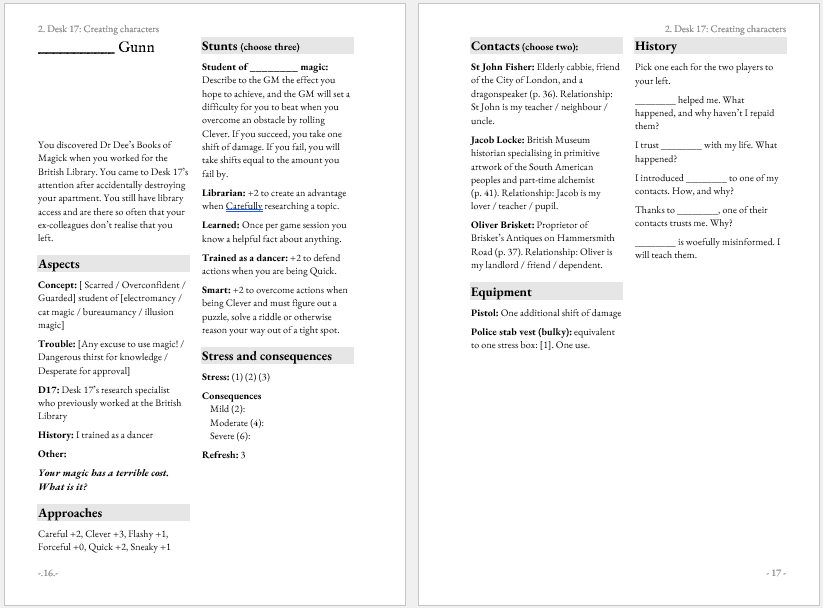
However, I have a dilemma for the pregens. I’ve created five pre-generated characters – they’re the ones I use at conventions when I run a Desk 17 one-shot. I’ve created them so they’re customisable – much like a PbtA playbook. So each character has options for their aspects, and they can choose different NPCs as their contacts.

And I want the players to choose their gender. But that means I can’t give them character portraits.

Current pregen design (character sheet design isn't my strong suit!)

I’m aware, however, that they would look better with portraits. But they wouldn’t be so useful at the table.

So I’m torn. I need to decide before too long.


Friday, 29 October 2021

Memories of Everway

I didn’t back the Everway silver edition Kickstarter as it’s not my thing, but it prompted me to reflect on the first edition.


Of course, these being 25-year-old memories, there may be some dust in there.

First edition

I bought Everway in the mid-90s when it first appeared. It was revolutionary in several aspects, particularly replacing dice with a tarot-like fortune deck and using fantasy artwork for character creation.

As for the setting, Everway was a world-hopping fantasy, each world (or “sphere”) linked by gates. The PCs journeyed through the gates in search of adventure, and the city of Everway was where all the gates were. (So very similar to how Magic: the Gathering’s background developed, with planeswalkers and different worlds.)

While it was a neat conceit to tie together the very different art styles used during character generation (more on that below), I found it all a bit bland. But then, it would always be a hard sell as, generally, I’m not too fond of fantasy settings.

Although I had Everway, I don’t think I ever ran it. I do remember playing it, once, at a convention. As I recall, Mike Cule was the GM, and while I think I can remember my character, I have no memory of the adventure itself.

The fortune deck

Instead of dice, Everway used a deck of tarot-like cards that the GM had to interpret. There were 30-odd cards, and they all had different meanings, which meant learning what each card represented. I found that was a formidable barrier, which I never overcame.

Perhaps if Everway’s setting had inspired me, I might have persevered with the fortune deck. But I didn’t like the setting, and the fortune deck felt far too fiddly to be worth persevering with.

A touch of genius

Where Everway shone, though, was in using illustrations for character generation.

Everway came with 90 illustrated “vision” cards. During character creation you chose a handful of cards and used them to describe things about your character. It was the first time I’d encountered anything like this—and I thought it was brilliant and shamelessly stole the idea.

In 1995 I played a lot of Illuminati: New World Order, Steve Jackson Games’ trading card game. I had masses of cards, and I took a pile I wasn’t using and used them to create wild, random characters for a modern-day improvisational conspiracy game. (I wrote this up for Pyramid magazine, and in my head, I always thought of it as Illuminated Everway.)

And when I didn’t have the art available, I used “scenes” (much like the vision cards but written out) to create one of my characters in an early Other London game. And because I throw little away, I still have them.

·         Scene: A pavement artist, black beret on the ground collecting coins. The artist is painting directly onto the paving flags with chalks (rather than paper) and is drawing a city scene of London, with a Gothic castle where St Pauls should be. People in suits are walking by. The only person looking at the painting is an old, shabby man.

·         Scene: A man working at a typewriter in a book-lined garret. Through the garret window, Alexandra Palace can be seen. A woman is leaning over the man’s shoulder, looking at what he is writing. Her feet aren’t touching the floor.

·         Scene: A kitchen table. There are two bottles of whisky, one empty and one half-empty, plus an empty glass. There’s a crumpled pack of cigarettes. A pack of newly-developed photos lies on the table. Most photos are of a happy smiling woman. And one of them shows people in black, cowering under black umbrellas in a green place.

·         Scene: A woman in her fifties. She wears glasses and is dressed in layers, topped by an old cardigan. She stands in front of a table, upon which is a strange skull mask and a chain of keys. In the background are artists easels and students watching intently.

I have no idea why games based on licensed properties with lots of artwork (such as Judge Dredd) don’t do something like this. The system and numbers could remain the same, but I bet characters would be more memorable if they were created using evocative artwork.

Everway: more miss than hit

So despite its brilliant character creation, the mediocre background and steep fortune deck learning curve meant I was never going to become an Everway fan.

I don’t expect ever to run Everway, but maybe I’ll play it again one day.

Wednesday, 10 October 2018

Furnace 2018

Last weekend I attended Furnace, one of several roleplaying conventions held at the Garrison Hotel in Sheffield. I last wrote about this two years ago (last year I could only attend one day and didn’t get around to writing up my thoughts).

Slot #1: Blades in the Dark

Pete Atkinson ran The Gaddoc Rail Heist with four players, and it went really well. I played a grungy female sharpshooter (whose name completely escapes me). The heist worked, and the dice were really with us until I was savagely mauled by some kind of spectral beast. I survived, but it was fortunate that we were at the end of the session.

I didn’t know anything about Blades in the Dark before I started, other than it was the game where you do heists. I was surprised by the background (a sort of dieselpunk fantasy world very similar, I'm told, to a video game I’ve not played) - for some reason I was expecting something in the modern day and we’d be recreating The Italian Job or Ocean’s Eleven.

I think more games could make use of the flashback mechanic to avoid planning paralysis - which nobody has time for in a convention game. (The idea is that you just dive into the heist, and if you come up against a problem then there’s a flashback where you set things up to overcome the problem.)

It was a great convention game, but I’m not sure I’d want to play a campaign. I wonder if lots of heists becomes a bit repetitive. I gather that the downtime stuff becomes more important, but even so.

Slot #2: The End of Laughter and Soft Lies

Dom Mooney ran this using The Sword, the Crown and The Unspeakable Power, which is a PbtA game that I’d not heard of before. It felt very like Game of Thrones, and was very player-v-player, which was a pleasant change of pace from the other games I played.

Dom started with character generation followed by sorting out the setting. That worked well, with all of us having a good idea of the setting, despite never having played the game before. (That contrasted with Blades in the Dark, which had an established setting that meant Pete kept having to explain things.)

I played Pill, a bloodletter (physician) and the only problem I had with it was that I found myself slightly sidelined at the start, as I found my character wasn’t particularly tied into the power play that kicked off. I eventually found my feet and started reanimating some of the key NPCs...

Looking back, it must have been very easy to run. Apart from the Emperor’s younger brother asking one of us for a speech, and the (not very unexpected) announcement of the death of the Emperor towards the end, Dom pretty much left us to it and we played the game ourselves.

Afterwards I did wonder if more structured scenes would have worked - as with Hillfolk. In Hillfolk everyone gets to call a scene, and I might have been less passive at the start if I’d been forced to act instead of just watching everyone else.

Slot #3: An early night

As usual, I skipped Slot #3 and headed back home for an early night while the rest of Furnace carried on without me. One day perhaps I'll book a room and stay for Slot #3.

Slot #4: The Bone Swallower

I ran The Bone Swallower using Fate Accelerated. I’d already run it for my online group, and it was interesting seeing how new players took to it. The adventure ran pretty much on time, and the players seemed to enjoy themselves.

I had four players for The Bone Swallower, which felt about right. I had five characters prepared, and I’m sure it would have been fine with five, but I find that four players is more manageable and ensures that everyone gets a chance to shine.

Slot #5: A Cthulhu City Story: Weeping for the memory of lives gone by

Another game run by Dom, this one using The Cthulhu Hack (which isn’t really my cup of tea). Dom somehow managed to turn the epic sandbox campaign that is Cthulhu City and turn it into a one-shot. And it worked!

I played Professor Hermes Winchester, a mathematics professor at Miskatonic University, and had a great time trying to figure out what was going on and how to get back to our reality.

I don’t know if this is how The Cthulhu Hack normally works, but Dom used the Gumshoe principle of letting us find the clue no matter what we roll on the dice. (I took the same approach for The Bone Swallower as well - I can’t imagine running a mystery any other way now.)

Overall

Overall I had a great time at Furnace. I think I chose a good set of games this year (that doesn't always happen) and I hope my game didn't lower the standard.