Showing posts with label Fate of Cthulhu. Show all posts

Monday, 19 December 2022

Fate of Cthulhu #4: And that’s a wrap

I finally finished my Fate of Cthulhu mini-campaign. Although we started well (see here, here and here), I was pretty fed up with it by the time we finished and was looking forward to doing something else.


Overall, we played 16 sessions of Fate of Cthulhu. The players succeeded in all the missions, and while Great Cthulhu’s rise wasn’t exactly thwarted, it wasn’t as catastrophic as in the original timeline. On average, each mission took four sessions.

I had some thoughts about Fate of Cthulhu in my earlier post. In essence:

Core concept: Good (travel back in time to foil Great Cthulhu), but too much murder hobo-ing for my group.

Missions: Fine. Not too detailed, so improvising is easy.

The system: I’m not a fan of Fate Condensed and much prefer Fate Accelerated.

And now I’ve finished, I have more thoughts.

Time travel rules!

The rules around time travel didn’t work for me. The idea is that as the PCs complete the missions, the timeline changes. This is represented by giving pluses and minuses to the missions they have yet to finish. But this is treated abstractly in the rules – and I didn’t find it clear what they actually meant.

For me, it would have been better to say that if you complete the mission successfully, you’ve changed time. If I were to run it again, I wouldn’t worry about all the admin involved in checking resistance boxes and what-have-you. Just do the missions – they’re fun as they are.

Missions

I gave the players complete freedom to tackle the missions in whatever order they chose, but in the end, they completed them in the order they were presented in the book. Destroying the skyscraper in New Zealand presented more challenges than usual – simply due to the scale of the problem.

However, given the nature of the game is that time is changing, there is no advice for how things might change depending on how the players are doing. In theory, having successfully completed a mission, something should have changed. But Fate of Cthulhu gives you no options – and it’s as easy to use the text as presented.

(There is one exception to this. In the last mission, The Great Serpent’s Lament, things are radically different to what the players expect. This worked for us, as it was our last mission – but it wouldn’t have made any sense had the players chosen this as their first mission.)

If I were me, I would provide options for each mission the GM can use to show how the PCs’ actions are changing the timeline.

The great anti-climax

And then there’s the end – I found that Fate of Cthulhu fizzled out. The PCs finished the final mission, but it wasn’t clear to them that they had completed it. The other missions were clear, but because the timeline had changed so drastically in this one, it wasn’t obvious to the players when the endpoint had been reached.

The final mission is followed by a scene where Great Cthulhu rises – but it was a big anticlimax.

Cthulhu Rising by artflow.ai

In conclusion

Overall we had a good time, but that was largely despite the system rather than because of it. Were I to rerun it, I would use Fate Accelerated rather than Fate Condensed, throw out the time travel rules, and think beforehand about how the timeline could change. Oh, and I’d choose one mission to be the climax and instruct the PCs that they must do that one last.

But I’m unlikely to run it again.


Monday, 6 June 2022

Fate of Cthulhu #3: Episodes 5-8

Okay, back to Fate of Cthulhu. See here for my broad pre-game overview, and here for sessions #1-4. I had hoped to post this sooner, but we lost a few sessions due to real life.

Recap

So, the TL;DR from last time: Our heroes (Roman played by Terry and Kaspar played by Jon) are trying to prevent the rise of Great Cthulhu. They have stolen a key cult artifact but haven’t worked out how to destroy it yet.

#5 The thing in the idol

In Arkham, the PCs rented a storage locker where they could store their kit and experiment with ways to destroy the idol.

Terry had the bright idea of dissolving the idol in hydrofluoric acid. So they bought a plastic tank and some hydrofluoric acid and dropped the idol into it to see what happened. (I didn’t roleplay collecting all this—I may have asked for a Fate point for them to have it all conveniently available. I don’t know how easy it is to buy hydrofluoric acid in the US, but I imagine it’s a controlled substance.)

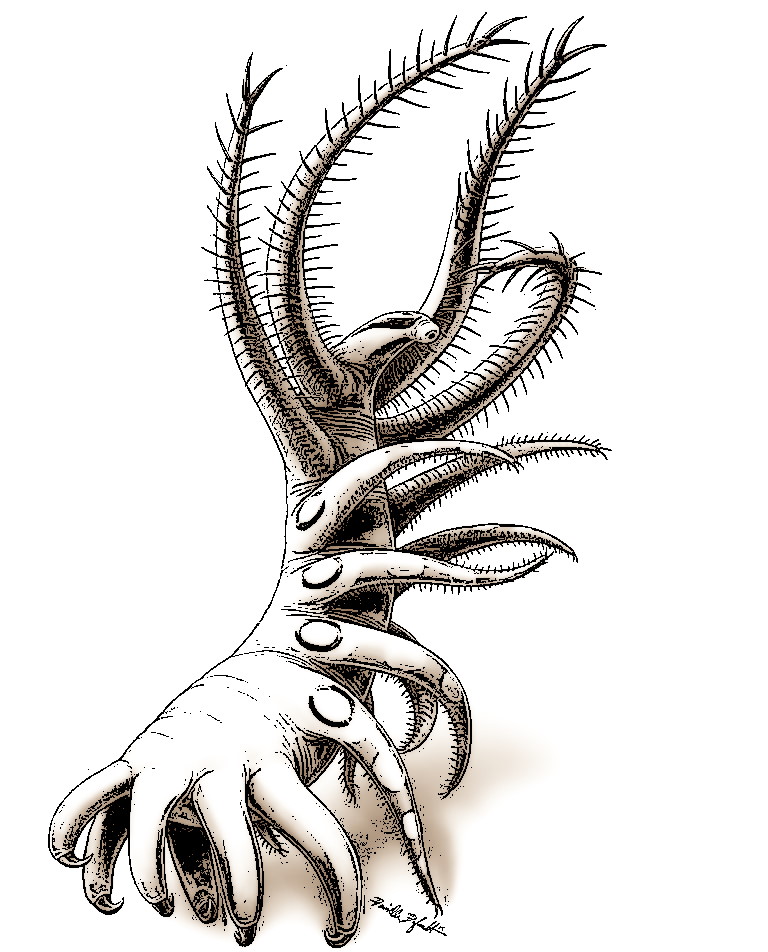
After a while, this appeared, completely unfazed by the acid.


And so now the players must deal with a Cthulhu skin parasite! (This is picture of a lobopodian I grabbed while the players were chatting.)

As well as working out what to do with the idol, the PCs investigated bytes and bodies. To draw out cultists they put the idol on Ebay (this was before they dissolved it in hydrofluoric acid). They also met, and befriended, Dr Agatha Manderley (Dean of the Miskatonic School of Occult Studies).

#6 The ritual

Finally, the PCs destroyed the idol and the thing in it. Dr Manderley found The Eye of Light and Darkness, a ritual that banished/warded evil things. (Thanks Masks of Nyarlathotep!) So the PCs cast that (spending quite a few Fate points in the process) and finally destroyed the idol/creature, finishing the first mission.

While the PCs survived the backlash from the spell, Dr Manderley wasn’t so lucky. When she recovered, she discovered that she now had a Yithian passenger in her mind…

We finished the session sorting out advancement and milestones, and I worked out what changes had been made to the timeline. There’s a process for this—it could be clearer, but I think I figured it out. Overall the PCs succeeded with two positive ripples and one negative ripple.

The way this works is you apply them to other missions, and a + means something is better than you thought (so I’ve decided Dr Manderley will be more helpful and survives longer than in the original timeline) and a - means something is worse.

#7 The junction box

The PCs made good progress on bytes and bodies and located the hacker’s lair by pretending to be an IT security company and approaching the New York financial institution mentioned in the briefing. They offered to recover the ransom for 50%. The institution said yes.

The PCs did this through a combination of Rapport and Deceive. I first made them spend a Fate point to have everything they needed to look like a business, then Jon used Rapport to create a good first impressions aspect that Terry invoked for his Deceive roll. With success with style, the PCs were rewarded with all the detail they needed—namely, the junction box that the IP address had been traced. From there, some legwork got them to the hacker’s lair.

On this occasion, skills worked better than approaches as Rapport and Deceive worked well in tandem. This wouldn’t have been so intuitive with Fate Accelerated’s approaches. Sneaky probably replaces Deceive, but what would Rapport be replaced by? Clever? Flashy? Sneaky again? It’s not so clear. 

We ended with the PCs staking out the hacker’s lair—we should finish this mission next time.

#8 The hackers

We end bytes and bodies with a fight in the hackers’ lair. There’s more of them, and they have a Ghoul, but they’re only NPCs and it isn’t long before the PCs have vanquished the bad guys and destroyed all the servers.

As we started the session I realised I needed a picture of the hackers. I had just been watching The Big Bang Theory, so that’s who I based the hackers on: Sheldon, Leonard, Howard, Raj and Penny. Sheldon was the lead hacker, obviously.

This session was mostly combat—and it turns out that Fate of Cthulhu uses popcorn initiative. We’d decided to use popcorn initiative before checking what the rules said, so it was nice to be playing run-as-written for a change.

Jon really leant into the murder-hobo aspect of Fate of Cthulhu. His character put a bullet through the brain of the lead hacker (Sheldon), and once the others had been dealt with and helped wreck their IT kit, he executed them. As part of the major milestone that happens after a mission is completed, we added murderous to his key concept.

I’m happy with how combat went—it felt like Fate, with aspects and burning Fate points to get results.

One hacker (Penny) got away, disappearing down a Ghoul tunnel. I have no idea if we will see her again.

We ended that session with the hackers dealt with, their lair and IT destroyed, and a copy of the Necronomicon in the PC’s possession. I’ve updated the timeline (a positive ripple for the resistance, this time) and next time we start a new mission.

So what do I really think of Fate of Cthulhu?


We’ll take a break now to return to a previous game and pick Fate of Cthulhu back up later in the year. So here’s what I think of Fate of Cthulhu so far.

Core concept: While the idea of Terminator v Cthulhu sounds great, it turns out to be much more murder-hobo-y than any of us had expected. When I think of The Terminator I think of Reece and Sarah Connor battling the Terminator—I don’t think of it from the Terminator’s viewpoint. But that’s exactly what we have.

This may be the nature of the Cthulhu apocalypse, but in every case you’re stopping something, or killing someone or blowing something up. And given how big the stakes are (preventing the end of the world), the PCs shouldn’t lose sleep over killing a few people to avoid the apocalypse. (Quantum Leap, this isn’t.) That’s a challenge for us, as we’re all in our fifties, and our murder hobo days are long behind us. So it’s taking some getting used to.

The missions: The missions themselves are fine. They would be better if they were a little clearer, but there’s just enough detail to work with (and they’re loose enough to improvise with). They need to be flexible because as the campaign progresses and the players change things, ripples in the timeline mean that things will change. I expect the final mission could be very different, depending on how the earlier missions fare.

One thing I appreciate about the missions is that they make it clear what the players have to do (although there is often a twist). That means we can skip the initial what-is-going-on part that you get in a lot of investigations and focus on the solution instead. That feels like a win to me.

Fate Condensed: As is probably clear, I struggled with Fate Condensed’s list of skills. (I have concluded that I’m not a fan of skill-based systems). The rest of Fate Condensed is fine, although sometimes I think we’re too old-school to play Fate ‘properly’. But we enjoy it, so that’s fine. And, of course, there’s no wrong way to play.

Am I going to run Fate of Cthulhu ever again?

I want to finish this short campaign to prevent Cthulhu from rising (or at least make it less-worse). But after that, I doubt I’ll run it again.

While I enjoy running it, it’s too murder hobo-y for my liking. We’ll get to the end, but once we’re done that will be it. I have so many other games I want to try.

Next time

Next time we finish Fate of Cthulhu.

Monday, 9 May 2022

Fate of Cthulhu #2: Sessions 1-4

Last time I gave my overall thoughts about Fate of Cthulhu. This time I will talk about what happened (for the first few sessions at least).

#1 Session Zero

We started with session zero: character creation. Although FoC suggests you can play either someone from the present or a time-traveller, it’s obvious that time travelling is more fun. So we created our two travellers: Roman Valeyard, historian, and Kasper Ausritten, anarchist manipulator.

Time travellers start with a corrupted aspect (using magic is dangerous), so Roman started as a living corpse, while one of Kaspar’s eyes was replaced by one from a Hound of Tindalos. (So we’re already some way from our traditional Call of Cthulhu investigators.)

Jon and Terry reviewed their briefing and decided that of the four missions, they would start with the stuff that dreams are made of. So we started there.

#2 The stuff that dreams are made of

For this mission, the PCs must steal a corrupted idol that contains a flake of Cthulhu’s skin (or something). The idol is being auctioned, and the GM notes provide ideas for running the assault on the auction house.

My Trello card for the idol

With all of time to play with, Jon and Terry decided to arrive eight months before the auction and steal the idol from its original owner. So we’d barely started and we were already off-script.

(I didn’t mind improvising—Fate of Cthulhu’s GM notes aren’t great and I was happy to run something different.)

So I invented Angus McBride, 43rd Earl of Sutherland and his private castle on Eigg. I decided that the earl controls a small cult worshipping Cthulhu (with his housekeeper Mrs Cartilage as high priestess).

Before we finished, the PCs had time for a quick reconnoitre (they booked themselves on a castle tour).

One thing that surprises me with skills in RPGs is how often I encounter situations where a skill would be useful, but it’s not in the game. I find Fate of Cthulhu social skills a little weird. We have Deceive, Empathy, Provoke and Rapport. What we don’t have is Persuade (although Rapport is an okay substitute) or Intimidate. And I’m not sure I’ve ever needed Provoke.

Anyway, both Jon and Terry took Provoke, and we realised our error when they wanted to charm the tour guide and learn more about the earl and the castle. Provoke didn’t really work—so Jon swapped Provoke for Rapport and got the information they needed.

#3 Stealing Cthulhu

In our third session, we leapt straight into the action, and the PCs broke into McBride’s castle, interrupted a sinister ritual, killed the bad guys and grabbed the statue.

I was pleased how I ran this. I grabbed a floor plan from the internet (search for stately home floor plans) and ran the session using that.


I remembered to use my Fate points (which I often forget to use) and compelled both PCs, so it felt more like Fate than many of our sessions. The fight was perilous—Kaspar was wounded badly as the fight with Mrs Cartilage didn’t go well. (It turned out the players hadn’t taken any fighting skills!) But they succeeded in the end and now have the idol—but don’t know how to deal with destroy.

I should say right now that I have done so little planning for this. I grabbed a floorplan during the session, and I decided where the secret temple would be there and then. It helps that the missions are not well detailed in the book—they’re so vague they are easy to improvise around.

#4 Planning planning planning

The stuff that dreams are made of ends when the PCs destroy the idol. But how do they do that? Even the scenario in the book isn’t clear on the subject. So the PCs weren’t sure what to do next. So this session was one of those discussion sessions where the players tried to work out what to do next.

We had a few “proper” scenes of roleplaying (I had fun as the voice of the creepy idol), but most of the time, we discussed what to do next. I don’t mind this—it’s easy to GM, and the players seemed to enjoy exploring their options.

So the players travelled to Arkham and started the next mission, bytes and bodies, before finishing this one. Perhaps they’ll figure out how to deal with the idol in Arkham.

(This session’s gripe about skills concerned the lack of anything related to computers or programming—particularly as the next episode is all about the internet.)

Next time

Next time we look at the next couple of sessions—and find out what happens when the PCs drop the idol into some hydrofluoric acid.

Wednesday, 4 May 2022

Fate of Cthulhu #1: An overview

I backed the 2019 Fate of Cthulhu Kickstarter, but haven’t run it until now. I’m halfway through running The Arrival of Great Cthulhu for my regular players, Jon and Terry. We’re playing online using Discord and Trello, my go-to setup for online RPG-ing.


Fate Condensed

Fate of Cthulhu uses Fate Condensed, a new iteration of Fate that is a halfway house between Fate Core and Fate Accelerated Edition (FAE). Well, it’s mostly a simplified version of Fate Core as it uses skills rather than approaches.

This is my first time running Fate with skills. I usually run (and play) FAE, and I’ve struggled with it. My main issues are:

  • Aspects become less important. It’s all very well having your high concept as best pilot in the galaxy and giving yourself Drive 4. But what if someone has Drive 5? Are you still the best pilot in the galaxy? FAE simplifies things by removing skills—you are the best pilot because your high concept says you are. (That’s not to say FAE is perfect—approaches can be hard to get your head around.)
  • The presented skill list is limited. No computer use, no medic. A lot of social skills – empathy, rapport, provoke, deceive. I’m not sure that level of granularity is needed here when it’s lacking elsewhere. (We’ve used rapport a lot as that seems most useful.)

While I was getting my head around Fate of Cthulhu’s skills list, I dipped into the Fate version of Achtung! Cthulhu to see what they had done—they’d expanded the skill list to include soldier (general soldiering), medic and tradecraft (replacing burglary). 

Achtung! Cthulhu replaces lore with mythos, which Fate of Cthulhu doesn’t, but I wish it did.

Fate of Cthulhu broad concept

In 2030 (or so), the stars are right and a Great Old One has risen. It’s our heroes’ job to travel back in time and change the timeline and halt (or at least ease) the apocalypse.

So Fate of Cthulhu is Terminator vs Cthulhu. However, my players, who are now in their late 50s and with their murder-hobo days behind them, were horrified to realise that they weren’t Sarah Connor or Kyle Reese in this version of The Terminator: they are the terminator itself.

The Arrival of Great Cthulhu

Fate of Cthulhu comes with five apocalypses: Cthulhu, Nyarlathotep, Dagon, Shub-Niggurath and the King in Yellow (Hastur). While Nyarlathotep is probably my favourite (it has shoggoths and elder things—both parts of the mythos I like), I decided that as I’ve never used Cthulhu in any of my Cthulhu gaming, it was about time I did. 

And so I chose The Arrival of Great Cthulhu.

Each apocalypse comes with four missions. Achieve those, and the PCs can (may?) avert the apocalypse. Or at least make it less-apocalypse-y. Great Cthulhu’s missions are:

  • Destroy an artefact of Cthulhu.
  • Stop an internet hacker from releasing spells onto the internet.
  • Destroy a building made of weird concrete.
  • Assassinate a cultist.

The players are given a briefing (which contains details of the apocalypse and the four key events they must change). The GM is then given additional material explaining what is really going on, plus some stats for key NPCs or monsters.

But not many stats—and if the players are proactive, they will quickly vary from the script.

I’m delighted with this, as I’m happy to improvise. If there were more detail, I would find it harder to improvise. But as it is, there’s just enough detail for me to understand the situation—and not too much to confound me.

Changing the timeline

Changing the timeline isn’t as straightforward as just completing the missions. If the players use too much magic or their corrupted aspects (Fate of Cthulhu has corruption instead of sanity), things can still turn out badly even though they get the results they wanted.

At least, that’s the theory.

From what I’ve seen in practice (as I write, we’re about five sessions in), modifying the timeline isn’t that clear. As play progresses, boxes are marked for the good guys (foiling a minion, changing the timeline in a good way) and for the bad guys (accepting compels on corrupted aspects, marking corruption). However, it seems easier to mark the bad guys’ boxes, which isn’t really the point. The PCs shouldn’t be making things worse.

Once boxes are marked, ripples will affect the timeline—so if things go wrong, the players can make things worse. 

But it all feels vague. So I anticipate hand-waving and improvising.

Actual play

Next time: What actually happened.