Showing posts with label Fate. Show all posts

Monday, 9 September 2024

Scenes in RPGs

I started roleplaying in the 1980s, went into a deep freeze in the late 1990s and didn’t come out until about a decade ago. “Scenes” were one of the new things indie games brought to TTRPGs, and I still find them tricky.

It doesn’t help that many RPGs don’t explain scenes properly. It seems like “scene” has become a specific piece of TTRPG terminology that is subtly different from its usual meaning. And everyone assumes that everyone knows what is meant when they talk about “scenes”.

As a result, it can be a bit of a muddle. This is my attempt to unravel that puzzle.

Dictionary definition

According to Google, there are two meanings to scene:

  • The place where an incident in real life or fiction occurs or occurred.
  • A sequence of continuous action in a play, film, opera, or book.

The first definition is straightforward, but when you start thinking about the play/film/opera/book definition, it gets a bit trickier.

Back when I helped out with the local pantomime, everyone knew what scenes were. Scene one was the big opening scene. Scene two took place in front of the “greys”, the grey curtains pulled across the stage that hid the backstage crew changing the scenery. When scene two ended, the greys opened to reveal scene three. And so on. A two-hour pantomime might have no more than nine or ten scenes.

In movies, scenes are often shorter. So rescuing Princess Leia in Star Wars becomes many scenes: the room where Luke persuades Han to rescue her, the turbolift, the detention centre, Princess Leia’s cell, and so on. Again, these are all location-based as they are different sets.

But in a roleplaying game?

Well, they vary. Some use scenes, some don’t. Some use scenes in a specific way, some use the term but don’t really define them.

Trad and other games

Broadly, in RPGs, trad games don’t use scenes. They might mention them, but they’re using them in the sense of the first dictionary definition: they’re a place or location.

So in Traveller, Call of Cthulhu, Liminal, D&D, Runequest, ALIEN, and the like, scene doesn’t have a particular meaning.

Scene-based games

Some games build scenes into their mechanics. Many of these are GM-less, and the term ‘scene’ is used when a player controls what’s happening.

(I’m sure many other games use scenes. These are the ones I am familiar with.)

GMless games

Games without a GM often use scenes as a way for each player’s character to have spotlight time. Other PCs may be in those scenes, but everyone at the table knows who the spotlight is on during the scene.

Fiasco: Each character gets four scenes where they are in the spotlight. Fiasco confuses things because players can decide whether to “establish” their scene (set it up – who is there, what’s going on) or “resolve” the scene (decide on its outcome – the other players establish the scene). Much as I enjoy Fiasco, I find this fairly counterintuitive in play – particularly when a player chooses to resolve.

Follow and Kingdom: Ben Robbins uses scenes in his games to “… shine a spotlight on your character to see what they think and do…” In both games, the player decides who is in the scene, where it takes place, and what’s going on. Then, you play to find out what happens.

Unfortunately, these games don’t clearly state the one piece of advice that I find makes a scene really sing: to know what your character wants from the scene. (They may not get it, of course.)

GM-ed games

Hillfolk and Good Society both use scenes.

Hillfolk has a strict player turn order. When it’s your turn, you create a scene involving your character. You establish it as with other games (where, when, who and so on) – and if it’s a dramatic scene, you decide on the emotional reward you want from another character.

(Hillfolk also has other types of scenes, but dramatic scenes are the main ones.)

Good Society uses scenes for roleplaying, but fails to explain clearly what they are or how to manage them. As a result, scenes felt directionless and saggy and dragged on too long.  I talked about this when I played Good Society.

Most Trusted Advisors uses “scene” liberally throughout the text, but it doesn’t explain what they are. However, from my experience of running Most Trusted Advisors, I think it would benefit from more rigorous scene discipline.

Tips for scenes

So for these types of games, these are the questions that whoever is establishing the scene needs to consider:

  • Where is it?
  • When is it?
  • Who is present?
  • What is going on?
  • What do I want?

And for me, the last point is the most important in helping to keep scenes punchy. If you know what you want going into a scene, it’s much clearer when the scene is over. (And I find it helps to tell the other players what you have in mind, so they can react accordingly.)

Games that get muddled

Some games use scenes liberally in their text (e.g. Blades in the Dark and Monster of the Week), but they don’t have much of a mechanical effect, so the fact that they’ve not defined what a scene is doesn’t matter too much.

Unfortunately, the same isn’t true for other games.

Fate Core defines a scene as “A scene is a unit of game time lasting anywhere from a few minutes to a half hour or more, during which the players try to achieve a goal or otherwise accomplish something significant in a scenario.”

Scenes are important in Fate mainly because a character’s stress boxes clear after each scene. But what is a scene? That’s left to the GM, and isn’t always clear, despite the advice above. I don’t know if rescuing Princess Leia from the Death Star is one or many scenes in Fate. Is rescuing the princess enough of a goal? Or can you break it down into smaller scenes? (Such as blagging our way into the detention centre, escaping from the detention centre, and getting back to the Falcon) As far as recovering stress goes, this difference could be critical. (I might do it either way, depending on the tone of the game.)

Lady Blackbird allows characters to refresh their dice pools by having a “refreshment scene” with another character. Lady Blackbird doesn’t explicitly say what these are but suggests that they’re quiet moments with other PCs. (I really like these as a way to encourage roleplaying between characters – it’s such a lovely design.)

Going back to Star Wars, Leia’s moment with Luke aboard the Millennium Falcon just after Ben Kenobi’s death is the sort of thing I imagine when I think of a refreshment scene. (And Luke has clearly refreshed his dice pool as he mans the Falcon’s gun turret and blasts away at the incoming TIE fighters.)

And it’s not just me

And it’s not just me! This recent post on substack and this thread on RPGnet suggests others are thinking about this as well. I had already earmarked this as something I wanted to reflect on after playing and running Good Society and Most Trusted Advisors earlier in the year. These posts have, however, prompted me to finish this post.

Monday, 19 December 2022

Fate of Cthulhu #4: And that’s a wrap

I finally finished my Fate of Cthulhu mini-campaign. Although we started well (see here, here and here), I was pretty fed up with it by the time we finished and was looking forward to doing something else.


Overall, we played 16 sessions of Fate of Cthulhu. The players succeeded in all the missions, and while Great Cthulhu’s rise wasn’t exactly thwarted, it wasn’t as catastrophic as in the original timeline. On average, each mission took four sessions.

I had some thoughts about Fate of Cthulhu in my earlier post. In essence:

Core concept: Good (travel back in time to foil Great Cthulhu), but too much murder hobo-ing for my group.

Missions: Fine. Not too detailed, so improvising is easy.

The system: I’m not a fan of Fate Condensed and much prefer Fate Accelerated.

And now I’ve finished, I have more thoughts.

Time travel rules!

The rules around time travel didn’t work for me. The idea is that as the PCs complete the missions, the timeline changes. This is represented by giving pluses and minuses to the missions they have yet to finish. But this is treated abstractly in the rules – and I didn’t find it clear what they actually meant.

For me, it would have been better to say that if you complete the mission successfully, you’ve changed time. If I were to run it again, I wouldn’t worry about all the admin involved in checking resistance boxes and what-have-you. Just do the missions – they’re fun as they are.

Missions

I gave the players complete freedom to tackle the missions in whatever order they chose, but in the end, they completed them in the order they were presented in the book. Destroying the skyscraper in New Zealand presented more challenges than usual – simply due to the scale of the problem.

However, given the nature of the game is that time is changing, there is no advice for how things might change depending on how the players are doing. In theory, having successfully completed a mission, something should have changed. But Fate of Cthulhu gives you no options – and it’s as easy to use the text as presented.

(There is one exception to this. In the last mission, The Great Serpent’s Lament, things are radically different to what the players expect. This worked for us, as it was our last mission – but it wouldn’t have made any sense had the players chosen this as their first mission.)

If I were me, I would provide options for each mission the GM can use to show how the PCs’ actions are changing the timeline.

The great anti-climax

And then there’s the end – I found that Fate of Cthulhu fizzled out. The PCs finished the final mission, but it wasn’t clear to them that they had completed it. The other missions were clear, but because the timeline had changed so drastically in this one, it wasn’t obvious to the players when the endpoint had been reached.

The final mission is followed by a scene where Great Cthulhu rises – but it was a big anticlimax.

Cthulhu Rising by artflow.ai

In conclusion

Overall we had a good time, but that was largely despite the system rather than because of it. Were I to rerun it, I would use Fate Accelerated rather than Fate Condensed, throw out the time travel rules, and think beforehand about how the timeline could change. Oh, and I’d choose one mission to be the climax and instruct the PCs that they must do that one last.

But I’m unlikely to run it again.


Monday, 6 June 2022

Fate of Cthulhu #3: Episodes 5-8

Okay, back to Fate of Cthulhu. See here for my broad pre-game overview, and here for sessions #1-4. I had hoped to post this sooner, but we lost a few sessions due to real life.

Recap

So, the TL;DR from last time: Our heroes (Roman played by Terry and Kaspar played by Jon) are trying to prevent the rise of Great Cthulhu. They have stolen a key cult artifact but haven’t worked out how to destroy it yet.

#5 The thing in the idol

In Arkham, the PCs rented a storage locker where they could store their kit and experiment with ways to destroy the idol.

Terry had the bright idea of dissolving the idol in hydrofluoric acid. So they bought a plastic tank and some hydrofluoric acid and dropped the idol into it to see what happened. (I didn’t roleplay collecting all this—I may have asked for a Fate point for them to have it all conveniently available. I don’t know how easy it is to buy hydrofluoric acid in the US, but I imagine it’s a controlled substance.)

After a while, this appeared, completely unfazed by the acid.


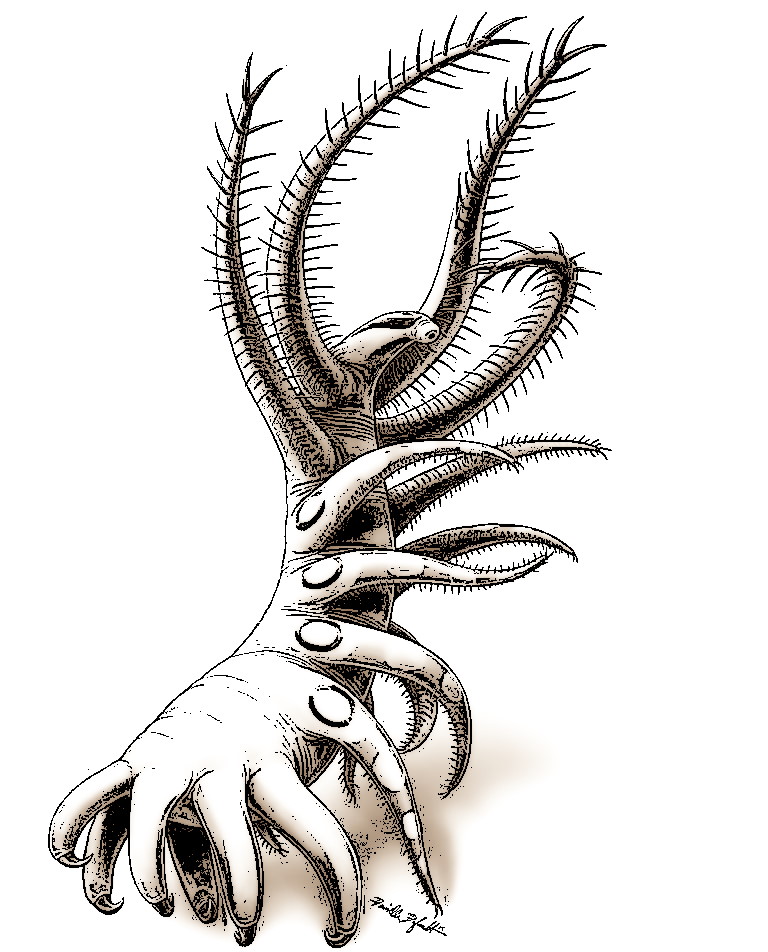
And so now the players must deal with a Cthulhu skin parasite! (This is picture of a lobopodian I grabbed while the players were chatting.)

As well as working out what to do with the idol, the PCs investigated bytes and bodies. To draw out cultists they put the idol on Ebay (this was before they dissolved it in hydrofluoric acid). They also met, and befriended, Dr Agatha Manderley (Dean of the Miskatonic School of Occult Studies).

#6 The ritual

Finally, the PCs destroyed the idol and the thing in it. Dr Manderley found The Eye of Light and Darkness, a ritual that banished/warded evil things. (Thanks Masks of Nyarlathotep!) So the PCs cast that (spending quite a few Fate points in the process) and finally destroyed the idol/creature, finishing the first mission.

While the PCs survived the backlash from the spell, Dr Manderley wasn’t so lucky. When she recovered, she discovered that she now had a Yithian passenger in her mind…

We finished the session sorting out advancement and milestones, and I worked out what changes had been made to the timeline. There’s a process for this—it could be clearer, but I think I figured it out. Overall the PCs succeeded with two positive ripples and one negative ripple.

The way this works is you apply them to other missions, and a + means something is better than you thought (so I’ve decided Dr Manderley will be more helpful and survives longer than in the original timeline) and a - means something is worse.

#7 The junction box

The PCs made good progress on bytes and bodies and located the hacker’s lair by pretending to be an IT security company and approaching the New York financial institution mentioned in the briefing. They offered to recover the ransom for 50%. The institution said yes.

The PCs did this through a combination of Rapport and Deceive. I first made them spend a Fate point to have everything they needed to look like a business, then Jon used Rapport to create a good first impressions aspect that Terry invoked for his Deceive roll. With success with style, the PCs were rewarded with all the detail they needed—namely, the junction box that the IP address had been traced. From there, some legwork got them to the hacker’s lair.

On this occasion, skills worked better than approaches as Rapport and Deceive worked well in tandem. This wouldn’t have been so intuitive with Fate Accelerated’s approaches. Sneaky probably replaces Deceive, but what would Rapport be replaced by? Clever? Flashy? Sneaky again? It’s not so clear. 

We ended with the PCs staking out the hacker’s lair—we should finish this mission next time.

#8 The hackers

We end bytes and bodies with a fight in the hackers’ lair. There’s more of them, and they have a Ghoul, but they’re only NPCs and it isn’t long before the PCs have vanquished the bad guys and destroyed all the servers.

As we started the session I realised I needed a picture of the hackers. I had just been watching The Big Bang Theory, so that’s who I based the hackers on: Sheldon, Leonard, Howard, Raj and Penny. Sheldon was the lead hacker, obviously.

This session was mostly combat—and it turns out that Fate of Cthulhu uses popcorn initiative. We’d decided to use popcorn initiative before checking what the rules said, so it was nice to be playing run-as-written for a change.

Jon really leant into the murder-hobo aspect of Fate of Cthulhu. His character put a bullet through the brain of the lead hacker (Sheldon), and once the others had been dealt with and helped wreck their IT kit, he executed them. As part of the major milestone that happens after a mission is completed, we added murderous to his key concept.

I’m happy with how combat went—it felt like Fate, with aspects and burning Fate points to get results.

One hacker (Penny) got away, disappearing down a Ghoul tunnel. I have no idea if we will see her again.

We ended that session with the hackers dealt with, their lair and IT destroyed, and a copy of the Necronomicon in the PC’s possession. I’ve updated the timeline (a positive ripple for the resistance, this time) and next time we start a new mission.

So what do I really think of Fate of Cthulhu?


We’ll take a break now to return to a previous game and pick Fate of Cthulhu back up later in the year. So here’s what I think of Fate of Cthulhu so far.

Core concept: While the idea of Terminator v Cthulhu sounds great, it turns out to be much more murder-hobo-y than any of us had expected. When I think of The Terminator I think of Reece and Sarah Connor battling the Terminator—I don’t think of it from the Terminator’s viewpoint. But that’s exactly what we have.

This may be the nature of the Cthulhu apocalypse, but in every case you’re stopping something, or killing someone or blowing something up. And given how big the stakes are (preventing the end of the world), the PCs shouldn’t lose sleep over killing a few people to avoid the apocalypse. (Quantum Leap, this isn’t.) That’s a challenge for us, as we’re all in our fifties, and our murder hobo days are long behind us. So it’s taking some getting used to.

The missions: The missions themselves are fine. They would be better if they were a little clearer, but there’s just enough detail to work with (and they’re loose enough to improvise with). They need to be flexible because as the campaign progresses and the players change things, ripples in the timeline mean that things will change. I expect the final mission could be very different, depending on how the earlier missions fare.

One thing I appreciate about the missions is that they make it clear what the players have to do (although there is often a twist). That means we can skip the initial what-is-going-on part that you get in a lot of investigations and focus on the solution instead. That feels like a win to me.

Fate Condensed: As is probably clear, I struggled with Fate Condensed’s list of skills. (I have concluded that I’m not a fan of skill-based systems). The rest of Fate Condensed is fine, although sometimes I think we’re too old-school to play Fate ‘properly’. But we enjoy it, so that’s fine. And, of course, there’s no wrong way to play.

Am I going to run Fate of Cthulhu ever again?

I want to finish this short campaign to prevent Cthulhu from rising (or at least make it less-worse). But after that, I doubt I’ll run it again.

While I enjoy running it, it’s too murder hobo-y for my liking. We’ll get to the end, but once we’re done that will be it. I have so many other games I want to try.

Next time

Next time we finish Fate of Cthulhu.

Sunday, 4 October 2020

Skills, RPGs and me

Liminal is a change for me: it has a skills list.

Since I re-started roleplaying in 2012 or so, I’ve been running very simple games: Fate Accelerated, Cthulhu Dark, and Monster of the Week. None use skills, and characters can do whatever is narratively appropriate.

So I’ve been running Liminal recently (see here for more on this) and I’ve often struggled to run it. What often happens is this:

  • Player: “I puff my chest out and suggest to the reporter that he shouldn’t be here.”
  • Me: “Okay, sounds like you’re trying to intimidate him. Make a roll”
  • Player: “What skill do I use?”
  • Me: “Erm, hang on…”

And then we all consult the rulebook and work out which skill we should use. And sometimes it’s not clear, so we have to make something up.

I find the simpler games much easier to GM:

  • Player: “I puff my chest out and suggest to the reporter that he shouldn’t be here.”
  • Me (Fate Accelerated): “Okay, that sounds like you’re being intimidating. That’s probably Forceful.” Make a roll…
  • Me (Cthulhu Dark): “Sure, roll 1D6.”
  • Me (Monster of the Week): “Sure, roll Manipulate Someone”

With a skill-based game I find I am spending too much time looking at the rules trying to work out how to interpret the player’s actions. I don’t have to look anything up in the other games.

Some of that is system mastery—but only some of it. While I’ve been playing and running Fate Accelerated for years now, as I have only run Cthulhu Dark once and Monster of the Week twice and I have no problem with them. Liminal is a more complex system and requires more system mastery. 

Isn’t it ironic?

It doesn’t escape my notice the irony in all of this: my first RPG was Traveller, followed by Call of Cthulhu and then GURPS. All skills-based systems, and all now more complicated than I can manage.

I’ve had a Traveller adventure sketched out for ages now, and one thing that is holding me back is whether to use the old Traveller rules (I have 1982’s The Traveller Book, but none of the modern iterations) or run it with Fate Accelerated. Using Traveller rules feels like hard work, while using Fate Accelerated feels like cheating. (But I suspect I would run a better game using Fate Accelerated.)

Looking forward

 As well as that potential Traveller scenario, I also want to run Alien and Fate of Cthulhu. Again, they’re skills-based systems (Fate of Cthulhu uses Fate Condensed, a halfway point between Fate Core and Fate Accelerated.)

I will be interested to see if I have the same problems with them.


Friday, 24 July 2020

Why I roleplay

I’ve recently played in a few very average tabletop roleplaying games, sessions where if I was completely honest, I wasn’t enjoying myself. That has led me to think about what I like about roleplaying, and how I can make sure I get more of it.
Roleplaying games
RPGs - some better than others

The bad games

So here’s a quick description of some of those games.
  • The one that was a string of battles: A Marvel Heroic Roleplaying one-shot which was basically three interconnected battles.  No miniatures, but not enough table banter either.
  • The one that was a miniatures game: A mini-campaign using D&D5e, where we had to clear out three caverns of baddies. Basically, a series of fights. (I’ve noted before that when combat starts D&D 5e basically becomes a boardgame. I like boardgames, but not when I’m roleplaying.)
  • The one that was a sandbox: A Lamentations of the Flame Princess one-shot where we (the players) poked the scenery with sticks to find the adventure.
  • The one that was a simulation: A mini-campaign which was brilliantly internally logical, but was actually rather boring, had little plot and created no interesting decisions.
  • The one where I played the wrong character: My only experience of Symbaroum, and the GM put lots of characters on the table for us to choose from. I chose unwisely—as my character’s skills did not suit the planned adventure.
So I clearly don’t like combat. And I’m not that keen on sandboxes—especially in one shots. I like to see a plot.

The good games

And to balance it, some of the good games:
  • The one where I felt I was in a movie: Set in the world of Werewolf: the Apocalpyse, but using Fate Accelerated, this one-shot really felt like we were in a movie – complete with cut scenes, montage and a spectacular climax.
  • The one where we talked to each other: One of the striking things about my only experience of Hillfolk is how often the players conversed with each other rather than the GM. I like games with lots of in-character chit-chat and banter.
  • The one-shot that became a mini-campaign: An unpromising Shadow of the Demon Lord one-shot that became a short mini-campaign filled with memorable player characters.
  • The one-shot with the clues in plain sight: An investigative one-shot set in the near future with an alien invasion – and a key plot point was on the table in front of us from the very start but we didn’t realise until part way through.
(And if you think it’s all GM related, there are two GMs on both of these lists …)

So in summary

I like dramatic plots that mean something to the characters, interlinked characters with backstory, characters that suit the scenario, and interesting decisions.

I don’t like pointless combat, playing a boardgame instead of roleplaying, boring sandboxes, and characters who don’t fit the scenario.

I don’t mind combat in my roleplaying games, but as long as it’s combat with a purpose.

An aside: It frequently amazes me that roleplaying caters for such a wide range of tastes. I don’t enjoy the system mastery that comes with dedicating yourself to something like D&D 5e—but some do. I have little time for character advancement or levels. I don’t like getting the miniatures out. I don’t particularly enjoy fantasy settings. But others do, and that’s great. But it’s probably best if I don’t join their games (and maybe they wouldn’t enjoy mine).

What do I like when I roleplay? #1: A Plot

So I like a good plot in my roleplaying – and frankly much of the time that can be summarised as: “a bad guy with a goal” (as Fate Accelerated puts it). That need not mean simple stories - even plots as complex as Masks of Nyarlathotep or The Lord of the Rings can be summarised as a bad guy with a goal.

Inevitably I’m less keen on sandboxes where it’s up to me to decide what’s important. I’m sure there’s a point where the sandbox absolutely rocks – but I don’t have the patience to get there.

What do I like when I roleplay? #2: Characters must be important

This may seem like an obvious thing to say – but the characters need to be key to the story. If the characters don’t care about the plot, why should they engage? They also need to have skills relevant to the upcoming session.

Unfortunately it’s all too common to sit down at a one-shot and be presented with a bunch of pre-generated characters that look like they’ve been taken from the rulebook, with little or no attempt to tie them into the story.

What do I like when I roleplay? #3: Players that talk to each other as characters

I can often tell how good a one-shot will be within 10 minutes of starting. That’s because the best one-shots always spend at least 20 minutes creating good bonds between the characters. If you dive in without creating that, then you just have a bunch of strangers at the table.

That’s why I like the bonds/strings/history in the PtbA games, Hillfolk character creation, and why I spent time trying to create DramaAspects. (I now use a combination of PbtA’s bonds and Galileo Games’ Backstory Cards.)

When the player characters have strong backstories and bonds, then they start with a shared history which makes it easier for them to talk in character.

Is that really it?

And that’s it. I don’t mind which system I play—I have my favourites but I’ll play anything if someone can tell me which dice to roll. In fact, I don’t mind if we don’t roll dice—I find that often happens in my games.

As long as I’m playing someone that matters in a story with a plot with plenty of in-character chat, then I’m happy.  I’m not sure why I don’t get that as often as I do.

Freeforms

It turns out that what I am looking for in a tabletop roleplaying session, I get in a freeform. Plot—check. Characters tie to plot—check. Players talking to each other—check.

When I started thinking about what I like (and dislike) in tabletop roleplaying I didn’t imagine that I’d end up comparing them to freeforms. But maybe that was inevitable. 

Although I had a fifteen-year hiatus from tabletop roleplaying, I never fully left the hobby as I was playing (and running, writing and publishing) freeforms instead.

I don’t know whether my love of freeforms influenced what I like in my tabletop games, or whether I love freeforms because they feature all the things I like—I suspect it’s somewhere in between.

What next?

Now that I have worked this out, I wonder if I can use it to my advantage and use it to improve my enjoyment of the games I am playing in. 

In particular, I shall try to I talk more often to other characters rather than to the GM. I’m sure I’ll still have to put up with boardgame like combat and sandbox games – but hopefully I’ll enjoy them more.

Tuesday, 24 March 2020

Operation Curious Warning

As promised last time, here's the link to Operation Curious Warning, my Achtung! Cthulhu D-Day scenario.

There are no statistics - the monsters are all in the book and I figure you can work out stats for the NPCs if you need to.

There are also no maps - but there are lots of links to maps and other resources that I found useful.

I also created a setting grid (for use with BackStory Cards).

This page has more RPG stuff by me.

Wednesday, 18 March 2020

Actung! Cthulhu - unplugged

I’ve just finished running a short scenario for Achtung! Cthulhu for my regular online group (Jon and Terry). I’ve got the Fate version of Achtung! Cthulhu, but we used Fate Accelerated because that’s what we’re used to.
Underprepared

I normally over-prepare and have maybe a bit too much material all prepared and ready to go. That’s because:

  • I like writing my scenarios up. Some of them I make available online. I have no idea if anyone runs them, but I get a lot of satisfaction from writing them up.
  • At some point I may want to run them at Furnace or Go Play Leeds, and when I’m running a con game for strangers, I like the security blanket that a properly prepared scenario gives me.

But this time I decided to run before I was ready. I had a few ideas, and the start of a clue-trail, but very little actually written down. So a break from tradition. Unplugged, even.

Timing

Although I’d planned it as a one-shot (and something that I may run at a con), it took us five two-hour sessions to work through. Making it shorter shouldn’t be a big problem though:

  • We spent most of the first session on character creation. For a con game I’d pre-prepare the characters.
  • We had lots of tangents. The game was set in the lead up to D-Day, and even though it didn’t make any difference to the game, with the Internet at our fingertips it was a lot of fun answering questions like “How many soldiers will a Horsa carry?” and “Who owned St Michael’s Mount in 1943?”
  • I didn’t worry about pacing because I didn’t have to.

I will have to cut it down a bit to run it at a con, but probably not as much as the original run-time suggests.

Operation Curious Warning

The scenario itself was inspired by MR James’ ghost story A Warning to the Curious, in which three crowns are buried along the East Anglia coast to prevent invasion. I just transplanted the idea to Normandy, and gave the players the mission to disable the crowns in advance of the D-Day landings.
I located the three crowns in Dieppe (lost to the sea), Mont-Saint-Michel (previously dug up) and Saint-Aubin-Sur-Mer (still in place, working its insidious magic).

The tricky thing was that given that the characters now knew where the landings were due to take place, they were not allowed to go to France until the night of the attack itself. So research all had to be done from England, supported by messages from France.

My original plans

Originally, I thought about having a countdown clock where the players efficiency would have an impact on the final battle. However, I didn’t do this partly because I was making it up as I went, and partly because I couldn’t decide how to do it.

Having completed the scenario, I’m not convinced it would have added anything and I’ve dropped the idea.

Coincidences

My original plan was to locate the final crown in the village of Luc-sur-Mer. I couldn’t find a map though. Then Jon found online a 1943 map that included Saint-Aubin-sur-Mer. I checked and found that it was just along the coast from Luc-sur-Mer, so I decided to move the crown.

However, it turns out that there are two Saint-Aubin-sur-Mers – the one near Juno beach and another to the west of Dieppe. As we had the map of the one near Dieppe, that’s the map we used (but located to the East of Juno beach).
With the crown now in Saint-Aubin-sur-Mer, that created another coincidence as the family name of the owners of St. Michael’s Mount in Cornwall (linked to Mont-Saint-Michel, one of the resting places of the other crowns) is St. Aubyns. Spooky.

Fate and investigations

In another game (Call of Cthulhu, Cthulhu Dark) I would have asked for some kind of investigation roll when clue hunting. For Fate Accelerated, I generally asked what the players were doing, and asked for an Overcome roll at difficulty 2.

On a success, I gave them information. If they failed, I told them that they hadn’t found anything – but that just meant they would have to look elsewhere as they were always going to find the clue. Eventually.

Occasionally the players spent fate points. For example, they wanted to know if an author they were following up had ever visited St. Michael’s Mount and spent a fate point to make it so.

Fate and massed battles

While the final battle to deal with the Nachtwolfe menace was fine (I enjoyed running it and the players seemed to have a good time), I’m not sure I used Fate as well as I could have.
Fate characters are competent and super-tough, but in this case they were academics in the middle of a battlefield, supported by Section M’s commandos. Inevitably the players wanted to take the lead (place tripwires, attack the Tiger tank, throw grenades at the armoured mi-go) when it would have been more sensible for the commandos to take the lead on that.

I could have created a Section M’s elite commandos scene aspect with three free invokes (or maybe extra Fate points) to help them.

I could also have gone fractal, and turned the opposing forces into characters (see this brilliant translation of The Avengers’ climactic battle into Fate Accelerated for an example - but I don't think I could ever do it this spectacularly).

So maybe something like this:

  • Section M Commandos: +5 fighting occult monsters, +4 elite commando training; -2 Behind enemy lines, Three stress, one mild and one moderate consequence
  • German forces: +2 Inexperienced German soldiers, -2 confused by the attack and imminent invasion. Two stress, one mild consequence.
  • Sinister Tiger tank: +4 Tiger tank, -2 close quarters awareness. Armour 2, Two stress, one mild consequence.

With the other monsters using their stats as per the Achtung! Cthulhu rulebook. (The monsters are really tough.)

But then I’m not very good at playing enemy forces in a battle, and forget to use them to their best advantage. So simply running the battle as I did was probably my best option.

What went well

From my perspective, the adventure went well. Some highlights:

The cluetrail: I departed from my usual “Gumshoe” approach of creating scenes with clues that lead to other scenes with more clues, and instead I simply had a list of clues. Then as the characters investigated (and I let them have free reign) I gave them clues from the list. Often I made up new clues to suit places that I hadn’t thought of (St Michael’s Mount, the College of Arms).

Karswell: The only real NPC I got to play was Anton Karswell, who had some information on the crowns and also had a copy of Dee’s Necronomicon. I based Karswell on the character of the same name from MR James’ Casting the Runes. We never did establish exactly why Section M considered him unfit for duty…

Planning the mission: I really enjoyed the section of the game where Jon and Terry planned their mission. We used a Google satellite map and used the Google Jamboard app to plan the mission. Of course, it didn’t quite go according to plan…

Mission planning using Google's Jamboard
The mausoleum: My original plan was to locate the crown in an old church in the village. However, Jon and Terry started getting interested in the chateau, so I moved the crown to a mausoleum in the grounds. I remember walking past a large pyramid mausoleum in a National Trust property last summer, but I really wanted something smaller. “Oh, like Mad Jack Fuller’s pyramid?” asked Jon. And there we had it.

OPERATION CURIOUS WARNING: The mission (codenamed OPERATION CURIOUS WARNING) was a lot of fun. The players landed safely in their glider, the commandos secured the wood while the von Schnopp (played by Jon) destroyed the crown with a nasty ritual from the Necronomicon (dooming him in the process).

They battled a mysterious Tiger tank before finding a Nachtwolfe lab and being driven off by a strange armoured creature. They destroyed the creature with plastic explosive, but that released the undead thing in the cellar.

The battle ended with von Schnopp being wounded by the undead thing which triggered him changing into a deep one before dying in a hail of explosive shells from the 20mm anti-aircraft cannons being manned by Kincaid (played by Terry)!

What didn’t go so well

I’m pretty happy with how the adventure worked, although there are a couple of things I could have done better:

Fate in a battle: I’m not very good at battles – I tend to be too easy on players. For instance, I almost never use all my fate points in a scene – I let players off far too easily. I probably need to be more ruthless, particularly at the end of a one shot. (I should note that von Schnopp didn’t die due to anything in the Fate Accelerated rules – he died because it was dramatically right and I’d discussed it with Jon beforehand.)

The coincidences: I think the players would have liked me to have made more of the coincidence between St Aubin and St Aubyn. But instead I stuck to my original plan.

The nightmare: I mentioned the nightmare in a previous post, but I could have done a bit more with it. I often find that I’m juggling so many other things that I don’t remember to include the things that arise during play.

Interestingly, the last two points are about reacting to things that arose during play. Maybe I need to be more flexible and hold my ideas less tightly?

So what of Achtung! Cthulhu itself?

A couple of years ago I wrote a not particularly complimentary review of Achtung! Cthulhu. In short, I felt it was overwritten with too much unnecessary history and not enough game.

Has my view changed now that I’ve run a game?

Not really. There were a few things I liked and used:

  • Section M and Nachtwolfe.
  • The stats for the monsters (although I didn’t actually use them much).
  • The information on the Necronomicon (that chapter worked really well I thought).

But I still found it heavily overwritten. I wanted a top-level summary of the different organisations (for a player handout as a summary of what they knew) but found it really hard to quickly summarise the difference between Black Sun and Nachtwolfe. The book goes into great depth about minutiae, without providing the big picture.

I eventually figured out that Black Sun were evil Nazi sorcerers, while Nachtwolfe were evil Nazi scientists. (And it was the scientists I wanted.)

But if all I was working from was my knowledge of pop culture and the Nazi occult, I suspect the game wouldn’t have been all that different.

Overall

So overall I was really pleased with Operation Curious Warning. The players seemed to have a good time and I was happy without my usual safety net. I now want to see if I can condense it a bit so that I can run it in a normal 3-3.5 hour convention slot.

Oh, and I want to write it up in detail. When I do I’ll post the details here.

Friday, 28 February 2020

Rolling dice

I’m currently running an Achtung! Cthulhu one-shot using Fate Accelerated. Our heroes are investigating a legend about three ancient crowns protecting the Normandy coast that the Allies need dealing with before the invasion.

I’ve noticed that when I’m running a game, I don’t roll dice all that much. I’m almost not engaging with the rules at all - we could be playing pretty much anything. I’m sure I’ll use the rules when we come to the exciting action scenes, but not yet (the players are still gathering information).

So the times I am rolling dice is to answer a player question when I’m not sure of the answer. Or when it doesn’t matter.

  • Is there a phonebox nearby?
  • Does the town have a museum?
  • Have I been here before?
  • Can I see any cats?


I normally just roll 2d6 and use my judgement. A high roll works is good news for the players, a low roll bad.

Sometimes I ask the players to roll...

Yesterday, the players sourced a copy of the Necronomicon, and when they saw it one of my players asked “As a published medieval historian, have I seen this before?” So I asked him to roll.

He rolled -4 (four minuses - the worst roll you can get in Fate). Heh heh heh.

So I explained that yes, he’d seen this book before - in his dreams. When he was younger he had had recurring nightmares involving an old book (this one) that stole his life essence and prematurely aged him.

And they’ve got to take it with them...

Sunday, 20 October 2019

The Aurors: A Fate Accelerated scenario set in the Wizarding World

A couple of years ago we finished listening to the Harry Potter audiobooks (and watching the movies and visiting The Making of Harry Potter) and ever since I've wanted to run a game where the PCs are Aurors hunting dark wizards. This summer I got my act together and prepared a one-shot which I ran for my daughter and her cousins, and then at Furnace.

Me (right) and five Aurors
While I'm sure there's a space for an improvised game where you come up with a dark wizard with a sinister plan, I don't really work like that so I wrote a more traditional investigative scenario. I based it around a dark wizard’s wand, added some classic Harry Potter locations, monsters and characters, and there you have it.

Much of it is canon - and some of it isn't. According to Harry Potter and the Cursed Child, Harry really is head of the Aurors, and Hermione is the Minister of Magic. The villain isn't canon though, and I made up the bit about the dementors' origin.

I used Fate Accelerated for my game system partly because it seems eminently suitable (one of the sample characters is from a wizard school) but mostly because it's the system I am most familiar with.

Characters

My initial plan was for the players to create their own Aurors. I prepared blank character sheets and a simple worksheet that took them through character creation.

While this was fine for the first run, some of the characters were a bit random and didn't really work as a group. So for the second run (at Furnace) I prepared a set of pre-generated characters that were more coherent and in the event worked really well.

I also answered the question one of my nephews asked - "Why do we need so many Aurors for this?" So I turned it into a training mission - with two experienced Aurors accompanying three trainees (although in terms of "power" they were all equally competent).

The real reason I had five Aurors is because that's how many players I had . But I'm pleased to have a more "realistic" reason - and in the second game the players really ran with the whole trainees idea.

Setting Grid
Death Eater masks

I created a setting grid (used for Backstory Cards) with some pre-defined questions so that I didn't need to bring the cards with me. I seeded the grid with people and places that were relevant to the scenario, which I think is the right way to use a grid for a one-shot.

Unfortunately my original questions were based too much on the Backstory Card questions, and they didn't do the job that I wanted them to: to tie the characters together and into the setting.

So after the first adventure I adjusted the questions so that all of them involve another character in some way. (I ran it for five players at Furnace - I got them to answer one question each, creating a bond between them and the player on their left. That way everyone had bonds to two other players. You can read how that went here.)

One thing that helped is that I seeded the setting grid with places and people that would appear in the story later on, and so for a one-shot it worked really well to bring in characters or places that had already been established.

Game files


Wednesday, 13 March 2019

Airecon 2019

Overall, I had a delightful Airecon 5. Airecon is the annual board and tabletop rpg convention held in March in the Harrogate Conference Centre. This was my third visit (it's virtually on my doorstep so it would be daft not to go).

This year, for the first time, I didn't go alone. Megan came with me, as did my brother and Jack his son. They all enjoyed themselves, and Megan decided to come back on the Sunday with me.

Here's how our convention played out.

Saturday

We started with Arrr, a playtest of a game of pirates digging up treasure. This involved getting our meeples to the buried treasure, rotating sections of the board to get paths to line up. There were some rules about stealing other player's treasure, but these seemed a bit complicated (a few too many exceptions involved) and when we started playing the complexity of just getting my meeples to my treasure meant I couldn't handle the stealing rules. I said this, Phil agreed, and we decided to ignore stealing for this game.

Arrr
Maybe stealing works once you've figured out the movement, but as a race game it was fine. (But I won, so maybe my view is coloured by that.)

Over at the Asmodee section of the game we decided to try Dice Forge. We were taken through the rules by one of the demo team, and had a very enjoyable game. Dice Forge features six-sided dice with interchangeable faces that you upgrade - it's a bit like a deckbuilder but you only have 12 cards. It plays quick and I like rolling dice. I won this as well.

Thumbs up for Dice Forge
After Dice Forge we wandered around the stalls a bit, I caught up with a few people that I knew, and then we grabbed something to eat from one of the several food outlets.

After that I went to find Megan (who was dropped off by Mrs H) while Phil and Jack played a few other games. When we came back, Phil and Jack were deep in a game so Megan and I played Wibbel, playtested a bee game (a bit too random - Megan had a great theme suggestion though), and played a huge version of Tsuro using carpet tiles (fun mainly for the physicality of it).

Phil and Jack then joined us to play Hey That's My Fish with the players as the playing pieces. We played a team game (kids v adults), and the team aspect was very interesting in trying to agree who should move each turn. Happily for all, it turned out to be a tie.

Hey! That's My Fish!
We then headed back to the Asmodee demo section to try Pandemic: The Fall of Rome, which we lost heavily. We followed that up with Four Elements (a four player flicking game similar to carrom) before having a final game of Dice Forge (which Phil decided to buy).

Sunday

My original plan for Sunday was to go on my own and play a tabletop RPG. (My even earlier plan was to run some tabletop, but I wasn't organised enough for that.) However, Megan had such a nice time on Saturday that she wanted to come with me. I'd booked myself in on a game, but it had no free spaces so instead we found a game with a couple of free spaces and played that instead.

Our characters - we were all playing women.

I checked with the GM that it was suitable for a 12-year old, and we started playing. The game was a Victorian Fate Accelerated investigation into mysterious goings on at an archaeological dig in Egypt. Unfortunately the game was very slow and I could tell Megan was bored (I wasn't that excited myself). Worse, I don't think we could ever have worked out what was going on from the clues we were given (even the grown-ups, let alone Megan).

A couple of things would have improved it:

  • Fewer players: When we joined, we had four players total. That's a good number for a tabletop RPG, it means that everyone gets plenty of limelight. Unfortunately, we were joined by two more players, making us six. Unless you're playing Hillfolk (or another game designed for lots of players), or you're an exceptional GM, six players is really too many.
  • Replace the first scene with shared history: Although the game was set in Victorian Egypt, the first scene was set at our lodgings in London and basically consisted of us being hired to investigate mysterious goings-on. We were never going to say no, but dutifully we played this out over 30 pointless minutes. Instead, we could have started in Cairo and replaced the hiring section with some character building and shared history.
  • Provide context with the clues: In an ideal scenario, we would have pieced together the clues, understood what was going on, and developed a plan to stop it. Unfortunately while we were finding clues, as players we didn't understand what we were seeing. As a result, all we did was poke the scenery and reacted to what turned up. If we'd understood what the clues meant, maybe we could have been more proactive. While the GM did bring the final scene forward, I'm pretty sure the mystery was unsolvable. The denouement featured a previously unknown NPC and some mad science, which I certainly didn't see coming.

Sorry for the rant. I set high standards for convention games as I don't like disappointing players (and I don't like to be a disappointed player).

Adding a cat to the wall of cats
Lunch followed the RPG, and then designer Jon Hodgson demoed Bang and Twang, a very lightweight card game that was a fun but probably needed a few more beers to properly enjoy.

Megan and I then played Assembly, a cooperative game that we narrowly lost (we would have won it on our next turn). We finished Sunday with The River, a worker placement game that I came joint first in.

The River
Sunday at Airecon was noticeably quieter than Saturday, and speaking to one of the traders they said that it felt like everyone was just passing through the trade stands on Sunday, unlike Saturday where they would stop and browse. I couldn't disagree, as I'd done exactly that!

So that was Airecon 5, and we are all looking forward to Airecon 6 next year.

Wednesday, 7 November 2018

On dice


My favourite dice are 2d6, with pips not numbers. They are the dice of my childhood. The dice of Monopoly and Escape from Colditz. I love the rattle they make and I've used them so often that I instinctively understand the probability curve.

For me, six sided dice are "proper" dice.

"Proper" dice
Two dice v 2d6

Until I started playing Call of Cthulhu, dice always had six sides. So there was never any confusion when I asked someone to "roll the dice". Call of Cthulhu was the first game I owned that needed polyhedral dice, and with that came the need to define the number of sides. So "two dice" slowly became "2d6".

And Call of Cthulhu wasn't my first RPG - that was Traveller. Traveller only used six siders, and just referred to them as 2D. (I didn't play D&D until much later.)

Pips v numbers

On six sided dice, I find pips much faster to read than numbers. (And when I say "much faster", we're talking fractions of a second.) That's because I pattern match, rather than count the pips.
Five pips and two pips = seven. Simples.

If the dice have numbers, I have to mentally add the numbers together. If the dice has pips, I just recognise the pattern.

This works for 2d6 - I don't think it works for larger numbers of dice (I didn't enjoy GURPS enough to embed 3d6 in my brain).

Of course, this only works for six sided dice. Pips on a d12 would be just daft.

Readability

As I get older, dice readability becomes more important to me. So I like dice with good contrast between the numbers or pips and the background.

I find dice with weird fonts and additional decoration hard to read, so I try not to use them.

Special dice
Special Fate dice.
I hates 'em I tell you, I hates 'em.

Special dice unique to that game can actually put me off a roleplaying game (Star Wars I'm looking at you). If I were to rank RPGs purely according to the dice they use, it would look like this:

  • 2d6 (Traveller, Dungeon World)
  • Other multiples of d6 (Risus, GURPS, Cthulhu Dark)
  • Polyhedral dice (F20 games, Call of Cthulhu)
  • Special dice (Fate, Star Wars)

I suspect that one of the reasons I like PbtA games is that they're powered by 2d6. (Dungeon World spoils that by needing a bunch of polyhedrals as well.)

If a game uses special dice it has to be pretty special for me to want to play it. So Fate is special enough, but Star Wars isn't.

My dice collection

My dice collection looks like this.

(My dice collection: I may be over invested in d6s.)
The only dice that I can remember buying specifically are:

  • Percentile dice because I needed to run Call of Cthulhu at Continuum in 2016.
  • The green d6s for Cthulhu Dark (as yet unplayed). I bought the purple d6s at the same time because I liked the colour.

Note I do not own any d4s, d8s or d12s. The only d12s I own are in boardgames (Ankh Morpork and Tiny Epic Kingdoms).

A Level Mathematics

I earned a grade A at A-level Mathematics. A third of the questions were statistics questions, and our statistics started by using 2d6 to calculate probability. And I was good at that because of all the games I played.

Being good at 2d6 probability opened the door into statistics, and ended up really enjoying it.

So I like to think that games (and specifically dice) directly led to my A grade in A-level Maths.

So that's it: me and dice.

Wednesday, 15 August 2018

Fate Accelerated with the family

Last week I ran The Crasta Demon, my Fate Accelerated fantasy scenario, with my daughter, brother, cousins and nephews. It was a real family affair, and they thoroughly enjoyed it. The last battle, against the demon itself was spectacular. The players set loads of traps and created numerous advantages that they stacked and ended up finishing off the demon in just two rounds.
Given that only one of my nephews has much rpg experience, they all took to Fate Accelerated really well. They didn't have a problem with the approaches, and I know that a couple of them (who have played D&D once or twice) appreciated its simplicity. So hurrah for Fate Accelerated!

While the game went well overall, there were a few things that I want to change.

The “easy” battle

The first encounter is supposed to be a simple battle against some goblins to show everyone how combat works. (That’s fairly traditional in a convention one-shot - you put in a simple battle at the start as a demonstration of how the game system works.) In this case, I had a mob of goblins that split into groups of three goblins each for each player.

The main problem is that I used the mob and teamwork rules from Fate Core, and while I gave normal goblins have +2 Fighting, as a mob the two extra goblins make that +4. I had a string of good rolls, which made the goblins much tougher than they should have been.

(When I first set this up, I didn’t roll for NPCs, but instead assumed that they rolled +0 each time. That sped up combat, not only because I wasn’t rolling dice, but also because the goblins never went above +4 and were fairly easy to beat.)

I also forgot to use the concede rules - it would have been shorter had the goblins run away when it’s clear that they’re losing.

Changes:

  • Remove the Mob/Teamwork rules, so Goblins will just attack on +2.
  • Try and remember to use the concede rules.
  • Change “Goblins” to “Razorlins” (as I’ve never been comfortable with goblins - it’s not a standard fantasy world).


Forceful in battle

The other thing I did that prolonged the fight is that I suggested that if the players weren’t using Forceful, then they inflicted one shift less in battle. So of course with most players using their “main” approach in battle (“I quickly/cleverly/flashily attack…”) that meant they were doing slightly less damage, so the goblins weren’t falling as quickly.

This wasn’t a problem in the final battle - by that point the players had got the hang of creating advantages, so they did that to give the Forceful character the best chance to attack and he was rolling at +13 or so.

I did wonder if characters should be allowed to inflict damage in a fight with any approach other than Forceful, but the view from the Google+ FAE community is not to go down this route. And thinking about Legolas and Gimli (in the Lord of the Rings movies at least), Legloas is Quick (and possibly flashy) while Gimli is Forceful - but they’re both equally lethal.

I think there’s still a risk of players trying to constantly use their best approach, but I must remember to ask “what are you doing” and then figure out which approach is right. The downside of that is that in a general melee, that can be draining on everyone as it means being constantly inventive rather than just rolling to hit.

The other advantage of using approaches other than Forceful is that it allows players to be awesome, and who doesn’t like that?

Cowardly is a terrible Trouble aspect

Finally, Megan chose “cowardly” for her trouble aspect (it was one of three that I had put on the pregenerated character). I gave her a Fate token for running away during the first fight, but she (rightly) pointed out that “cowardly” is boring. So we changed it for the second session, and I’m changing it on the character sheet.

The (updated) files for running The Crasta Demon are here.

Saturday, 5 May 2018

#1H1S Fail

I’ve been inspired by Guy Milner’s One Hour One Shot (#1H1S) posts on his Burn After Running blog, and I thought I’d give it a try.

Tl;dr: I failed


Inspired by Bite of the Crocodile God, Guy’s three-scene adventure for D101 Games (and available for free), I thought I’d create a short, three-scene adventure for Other London, my Fate Accelerated occasional Urban Fantasy game. So I created The Fallen, where the players first identify a suspect, then follow him back to his home (where they find further clues), and then deal with the nest.

Easy, right?

Well, I ran it for my regular gaming group and it took us a little over four hours. It really didn’t matter that it took four hours - everyone had a great time. But as far as #1H1S goes, it was a dismal failure.

Here’s where I think I went wrong.

Campaign group


So my first mistake was to have the players use characters from a previous game. That was great in that the players knew their characters and what was going on, but was bad in that they already had a pile of existing background baggage that they brought with them.

So I think a #1H1S needs to be completely standalone to get it done in an hour.

Fiddly pre-gens


I created pre-gens with a standard 4 hour convention slot in mind, so there are choices to be made. I think for #1H1S the pre-gens need to have fewer choices so we can simply start playing.

(While two of the players were reusing old characters, we had a new player who needed a character.)

Modern day


I love games set in the modern day. I don’t have to think about background detail, I don’t have to worry about explaining what technology is or what people wear. I can just concentrate on the game.

But it has its downsides, particularly if you are pushed for time.

The granularity of a modern day setting means that the detail is never-ending. Players can go into something simple (such as a surveillance job) in ridiculous detail - much more than the scene really needed.

Online distractions


I would much rather play face-to-face, but I usually play online (with players that I first started gaming with thirty years ago!). Online is fine - we use Googledocs and Hangouts, but the main problem is that it’s too easy to get distracted.

So the scenario opened with a surveillance job at the Burger King at Victoria Station - and we were able to find a recent photo of the exact location online. That was nice, but meant that everyone wanted to study the photo to figure out how where their characters were going to be, and that took time.

And later, I had originally set the third scene under a multistory car park in Lambourne End (because I thought that the name sounded appropriately sinister). However, when we checked Google Maps we found that Lambourne End was in the country, so we spent fifteen minutes or so relocating the car park to somewhere more suitable.

Scene 2b


I messed up when I prepared the scenario and I didn’t think about how the PCs could get into the bunker itself for the finale. We worked out how to do that during the game, but it resulted in a small scene between scenes 2 and 3 where they made contact with the 24 hour caretakers.

It didn’t matter in the context of what we were doing, but it obviously wouldn’t have helped me keep to a strict timetable. (But that’s one of the benefits of playtesting.)

Opponents


Player characters in Fate Accelerated are tough, so I made the Fallen themselves a bit tougher than I normally would to give the PCs a bit of a challenge. I think I over did that - with the result the fights ran on a bit long.

Despite increasing their toughness, the PCs were never in any real danger - although one of them did end the scenario in a very bad way.

Too much fighting


I probably had too many combats - there were two combat scenes, and I suspect that’s one too many.

Thinking about it, my perfect #1H1S probably involves:

  • one scene with an investigation
  • one scene roleplaying with an NPC
  • one scene with a fight (a climactic battle).


(And if I could avoid the battle I would. But a battle is an easy way to round off a scenario in an exciting way.)

And then I added the SAS


We normally play in two hour sessions, and at the end of the second session (our fourth hour) we were in the middle of the climactic fight when we had to stop.

So that meant starting a new session knowing that we only had another few minutes of gaming time. So what do to?

So I did what everyone does - I added the SAS. So our version of the scenario ended up with the SAS storming the bunker and taking possession of it for the military. That ended on a slightly ominous cliffhanger (which is just ideal for the setting), but it made the made the scenario even longer.

Pacing


I guess the biggest obstacle to completing the adventure in one hour was me. I wasn’t in a rush, so I didn’t push the pacing at all. I could have pushed harder, but I didn’t. I was happy to let the players pontificate and play with the detail.

So it’s my own fault.

Be Slicker #1H1S


So none of this actually matters. We had fun with the adventure, and it didn’t matter that I magnificently failed to run a one hour one shot.

But I like the #1H1S concept, so at some point I’ll give it another go. But maybe not with The Fallen.

Wednesday, 14 March 2018

The Crasta Demon at Airecon

Airecon last year
Last weekend was Airecon in Harrogate, and I ran The Crasta Demon. I would have liked to have run at least one other game over the weekend, but I could only attend Airecon on the Saturday during the day as I had other commitments.

The Craster Demon went really well.

I turned up to discover that six people had signed up to my five-player game, so I quickly created a 6th character: Apprentice Pike. Juggling six players is always a bit of a challenge, so I had to keep everything brief and didn't let anyone avoid the spotlight.

Some Crasta Demon highlights:
Apprentice Pike

  • Only one of the players was familiar with Fate Accelerated, but they all picked up the system really quickly. Nobody had a problem with approaches, or a lack of skills. Five of the players already knew each other, which helped the dynamic around the table.
  • This time I tried using Bonds (inspired by Dungeon World) instead of DramaAspects, and they worked really well. Simple, and I think more effective than DramaAspects, so I shall carry on using them for one-shot games.
  • The first time I ran the game, I didn’t roll for the opposition (I assumed everyone rolled zero). This time I did roll - and my first roll for the goblin attack (my first roll of the game) was +4 - so the goblins were attacking at +8 for that round. That resulted in quite a bit of damage - but it was nothing the players couldn’t handle.
  • As his trouble, Wickham chose I have family obligations. He played on that a couple of times, and used it to bring in a family member in the lynchmob scene. So while the rest of the team was all for a rescue (as expected), I tempted him with a fate point by compelling him and his family obligations. He refused…
  • After a good first round against the goblins, Loxley had a miserable set of dice rolls and really struggled to inflict damage against his enemies. Yet he was the one who finally killed the Crasta demon. (During the battle, I suggested that they start creating advantages, and his final shot was at +17 or something like that).
  • Apprentice Pike ended up being played by the youngest player (well, he looked youngest to me), and I really liked how he fitted into the game (given that it was a handwritten, last-minute character sheet).
  • Wickham invented a secret passage into the castle that he would have known about, which was an interesting twist. I love it when the players come up with things that I hadn't planned.


Overall it went really well. It took a little over two hours and the players seemed to enjoy themselves (as did I).

I did spot a couple of minor glitches to the scenario, which I’ve now updated (along with Apprentice Pike).

The rest of Airecon


I enjoyed the rest of Airecon as well. I played Thunderbirds and Swords and Bagpipes, and I taught someone D-Day Dice. The food was good - better than last year. Next time hopefully I’ll get there for both days.
Saving disasters with Thunderbirds