Sunday, 24 October 2021

Peaky 2021

It’s been over two years since the last one, but in early October I attended my favourite gaming weekend of the year: Peaky.

And yes, still my favourite.

Thanks to the pandemic, we had fewer people than usual. That meant Peaky was a little more spacious than it had felt in the past.

And for most of us, we haven’t socialised face-to-face much lately. And while meeting 20+ other gamers simultaneously in the same space took a bit of getting used to, it wasn’t too long before it all seemed normal again.

Organising the games

As usual, I organised the games for Sunday. We had fewer games this year – we had more players than games. I think that was another effect of the pandemic – more groups were happy to start work on a game rather than get something ready for Sunday. (We also had a request from Consequences for bigger, 20-30 player games, so that had an impact as well.)

As a result, while we split into five groups, only two were writing games that would be ready for Sunday. We played three as we also ran Culture Crash, which was written at Virtual Peaky earlier in the year.

So while previous years have usually involved trying to work out how to ensure there are enough players for each game, this time I knew that we would have players spare and that most people would need to sit out at least one game.

As usual, organising this took a fair bit of Saturday for me to arrange, which meant I didn’t contribute to The Castleford Ladies Magic Circle Meets Tonight as perhaps the others would have liked me to.

The writing team hard at work. (Well, the others are hard at work, I’m just messing around taking a photo.)

The Castleford Ladies Magic Circle Meets Tonight

Based on the ribald works of singer Jake Thackray, The Castleford Ladies Magic Circle Meets Tonight was written by Phil D, Kevin J, Suey L, Christi S and me. And although I’ve put the team in alphabetical order, it was definitely Suey and Christi’s game. (I had not heard of Jake Thackray until Peaky, so it was educational for me.)

The game is a horde game for around 13-15 players. A magic ritual has gone wrong, and the main characters are the Castleford Ladies Magic Circle, and the horde are ghosts summoned by the ritual. (It’s so tempting to call them players and NPCs…)

We tried to structure the game so the ghosts had plenty of reasons to talk to each other rather than just the main characters (which is a fault of other horde games we’ve played). Our experience on Sunday suggested that we had succeeded, and little polishing will be needed before it is rerun.

Some thoughts:

  • It’ll need a content warning. There’s a fair amount of filth/smut/innuendo, which is very true to the source but isn’t very modern.
  • Most of the characters are women, which is a pleasant change.
  • The two above points mean it isn’t for everyone.
  • I would have run the horde slightly differently than Suey did, but I didn’t make a big deal of it as it’s her vision, not mine.

The Coolham Caper

Roger G, Helen J, Charlie P, Rich P and Julie W wrote The Coolham Caper, a light-hearted game of misunderstanding and misappropriation, gangsters and garden produce for nine players.

I didn’t play in The Coolham Caper, but I heard good things about it from the players.

Other games

Games that were started but not finished:

  • The Shining Ones (provisional title), a Fae game for at least 30 players.
  • Casino Royale, a Bond-inspired game about spies, glamour and gambling. For 30-ish players.
  • An unnamed game set in Restoration Britain for 25-30 players.

Hurrah for more games!

Culture Crash

Our last game was Culture Crash, by Jeff Diewald, Roger Gammans, Heidi Kaye, Richard Perry, and Julie Winnard. It was started at Virtual Peaky 21 but has had some work done since, and this was its third outing.

I played Quilh, Watcher of Stars and I was an alien in a first contact situation. (I didn’t think of myself as an alien, of course.) The game was splendid fun, with lots of mysteries and misunderstandings.

In full costume as Quilh, Watcher of Stars

Some thoughts

  • Culture Crash was long by Peaky standards – it took around three hours. It started with a workshop for the alien cultures to sort themselves out, which added to the time.
  • The character sheets need some work. They’re very long, and I found it hard to find key information during the game. Some condensing/restructuring is required.
  • The ending suffered from the one-big-plot problem (once the big plot arrived, everything else became irrelevant and if you weren’t involved you had nothing to do). The ending was also very GM-intensive, and as a player, I felt I had little agency. But we gave the writers some feedback which hopefully they will consider. Despite that, I thoroughly enjoyed Culture Crash, especially the first two thirds.

The Culture Crash website is here.

Looking forward to Peaky 2022

And as always, the weekend was over much too quickly… But Peaky 2022 is already in the diary.

Brindlewood Bay

 Brindlewood Bay is the PbtA game of cosy murder mysteries by Jason Cordova. The players are members of the Murder Mavens book club and are all widows in their 60s and 70s. Think Murder She Wrote combined with The Golden Girls.


While play is episodic (each episode features the players solving a murder), a darker theme emerges in campaign play as a larger, overall mystery introduces occult elements.

Brindlewood Bay takes an emergent approach to solving the mysteries. The solution to each mystery isn’t predetermined; it is uncovered during play. Key to this are two moves:

  • The Meddling Move—used to find clues
  • Theorize – for determining whether the PC’s solution is correct.

(Jason Cordova explains how the investigation works here.)

From a distance, Brindlewood Bay looks very similar to other investigative games: the PCs go from place to place and find clues to the mystery. They then work out the solution. But I found it runs quite differently.

I’ve now played Brindlewood Bay twice. Unfortunately, for me, there are more misses than hits.

Dad Overboard

We took about four hours to play through Dad Overboard in two sessions. We followed the process, the players did their investigating, and we solved the murder.

My two players (Jon and Terry) enjoyed playing little old ladies solving murders. But while Jon bought into the “play to find out” approach, Terry hated it.

Terry struggled with the concept that the solution to the mystery was whatever they invented. He prefers RPGs where the GM has a world or scenario for him to explore. He had no problem with the system or other concepts, but he hated that I (as GM) didn’t know the solution.

I found running Dad Overboard surprisingly unsatisfying. It was easy to run—it needed virtually no preparation, and all I did during play was react to what the players were doing and offer them clues. But it was too easy—there was no sense of struggle or challenge. Moreover, when I did put obstacles in the way, they were never significant and easily overcome.

Jingle Bell Shock

Although I came away unsatisfied by Dad Overboard, I thought I’d give Brindlewood Bay another shot. Maybe things would be different with another group. So, I ran Jingle Bell Shock (a Christmas episode) for Becky, Jon (again), Liam and Thomas.

Character generation was more involved with four players and took longer, but we still took about four hours to work through the mystery.

Again, the players enjoyed being little old ladies investigating a murder—that core premise is delightful.

I struggled with some mechanics. For example, if a player rolls a 7-9 when Meddling, they receive the clue but there’s a complication. I struggled with complications, as I couldn’t immediately think of any that were relevant. And so I stored them up, and when I got to four complications, I killed off one of the suspects. (I also locked one investigator in the basement.)

And while four players are better than two during character generation, the investigation feels heavy-handed with four. For an investigative game, I much prefer smaller groups (also more genre-appropriate).

When it comes to solving the mystery, Brindlewood Bay felt like a parlour game. Once you have collected sufficient clues (such as a secret crawlspace, a bottle of pills that has been tampered with, unpaid bills), then the players merely have to stitch them all together to create a coherent(ish) story—and then roll Theorize to see if they are correct.

Once again we had a successful investigation, but once again, it felt flat.

What works for me

There’s plenty to like in Brindlewood Bay. Things I particularly liked:

  • Playing little old ladies solving murders.
  • Items from your Cozy Little Place. The last step of character generation is for other players to name one object that can be found in your home, and these were effective in how they changed how the players saw their characters.
  • Lovely establishing questions for the locations. For example, What do you see in the grand dining room that shows just how lonely Amelia truly was? I’ll use that in other games.
  • Very easy to run. Running Brindlewood Bay is almost effortless—the most straightforward published scenarios I’ve run ever. (But running a game well? I think that’s harder.)

What doesn’t work for me

  • Emergent mysteries. I didn’t really enjoy running Brindlewood Bay—I didn’t like not knowing what was going on. Maybe that’s my lack of experience, but it didn’t work for me.
  • Mechanics such as complications (which were fiddly), conditions and the moves I didn’t use as while they made sense when I read them, they didn’t seem relevant during play.
  • I was disappointed in the occult element that Brindlewood Bay bolts on for campaign play. Nobody tries to justify the high murder rate in Oxford or Jersey or Midsomer, and giving it an occult spin felt unnecessary and not at all true to the source material.)

In summary

I doubt I’ll return to run Brindlewood Bay. However, I’d happily try playing it—perhaps it simply doesn’t suit my GM style.

Wednesday, 9 December 2020

Loose ends: a Liminal mini-campaign (and some thoughts on Liminal)

I didn’t mean to run a Liminal mini-campaign. My original plan was to run Prodigal Son and The Haunting, to a) try running someone else’s adventure, and b) to try my hand at Liminal.

But the players were enjoying their characters and had questions about their backstories and I didn’t want to run more one-shots without exploring that. I also wanted to draw it all to a close (because I don’t like extended campaigns).

So this is what I did. (Click here if you’d like to see the Trello board we used. I’ve moved some of the GM-facing bits over that the players didn’t see—I originally had them on a separate board and only copied them over when I needed to.)

Loose ends

We had a fair number of loose ends after Prodigal Son and The Haunting. These included:

  • What was Charles Gardner up to?
  • What was Ariadne doing with the knife?
  • Where was Mark Northcott?
  • What was going to happen with Sir Tatton Northcott’s library?

And that’s not including the questions in the character backstories:

  • Who were Ygraine’s parents?
  • What had Naomi’s mentor done? And where was he?
  • Who had destroyed Stephen’s pack in the Lake District?

Focussing on the characters

So rather than give the characters cases to solve, I created problems for the characters to deal with while I worked out a narrative that linked their backgrounds together. Here’s what I decided:

  • Naomi: Naomi’s mentor (Dr Belnap) was secretly a member of the Shrivelled Rose (mentioned in passing on Liminal p.210), seeking their own twisted vision of human perfection.
  • Ygraine: Ygraine’s parents were a high-ranking politician’s wife and a Fae of Queen of Hyde Park’s Court. However, her mother had actually been taken by the Winter King and was trapped in his realm.
  • Stephen: Stephen’s pack had been killed by Dr Belnap (assisted by Charles Gardner and a crazy vampire called Suzy Shrike) and then experimented on as part of the Shrivelled Rose’s plans.
  • Aaron: The vampire that set Aaron on his dark journey and into the Liminal world was Suzy Shrike (Charles Gardner’s associate).

Problems problems

Some of the problems the players faced:

  • The ambitious vampire Ariadne (from Prodigal Son) approached Stephen with information about the murder of his pack. In exchange, Ariadne wanted Stephen to show her how the knife of Lethe works…
  • Sir Tatton Northcott left his library (and a peculiar cabinet) to Naomi in his will. However, the Council of Merlin approached Naomi and suggested that it would be good for her if she gave them the library instead. But the players don’t trust the council…
  • Having experienced two ghost realms (in Prodigal Son and The Haunting), the Crew decide to hide the library in another ghost realm in Leeds. They find a potential realm near the City Varieties music hall, but how to get into it?
  •  Becoming trapped in a ghost realm at Hardknott Fort and rescuing innocent bystanders from the winged horrors hidden within. (I wrote this up as an encounter here.)

My preparation for each session was to create a list of events and moments that I thought might happen, or that I might introduce to complicate things. I tracked these using a checklist in Trello (on my GM board), which I found worked really well. (At the end of each session I asked the players what they might want to follow up on, which gave me something to plan.)

At the end of one session the players asked if I knew what they would do. I told them I had no idea—but that I had created a situation (populated with people, things and events), and then I simply reacted to their actions. While I had an overall direction in mind for the things I knew they were interested in, I had no sense what they would do from scene to scene.

Colourful characters and unpleasant artefacts

I created numerous NPCs for the PCs to interact with. These included:

  • Holly Greenwood—Fae owner of a crystal shop opposite City Varieties in the centre of Leeds.
  • Tiberius—an immortal Roman legionary (“I don’t know why I’m so old; I just haven’t died yet.”) and living in the Lake District.
  • Karen White—fearless reporter on the trail of our heroes.
  • Jurgen Heim—dark wizard, er I mean evil wizard of the Shrivelled Rose.
  • Ethel Beardsley—the nun with a gun.
  • Hannah Smith—PhD student who took a shine to one of our heroes.
  • Suzy Shrike—the crazy vampire who sleeps in a coffin of dirt.
  • Dr Cartilage—Edinburgh’s ineffectual Council of Merlin representative.
  • Creepy kids—in the fae world (these had no stats or anything—just a photo of the Midwich Cuckoos and the description “creepy kids” on their Trello card).
  • A lazy, video-game-playing and junk-food eating (and ensorcelled) fae lord.

Not all of my NPCs entered play, but that’s okay as I’m sure they will appear in another game one day.

I’ve been creating weird and unpleasant artefacts for Tales of Terror for years, so it was inevitable that some would find their way into Liminal.


I did these with cards on the Trello board, with a description and a photo. The players had access to the Trello, and they also added details or photos, which was great.

The players seemed to enjoy running around the “real” world. We used Google Maps when scouting locations, including City Varieties in Leeds, Hardknott Roman Fort, Holyrood Park in Edinburgh. That’s one of the things I like about a modern-day game—the detail is limitless.

Wrapping it up

The mini-campaign ended up in a fae domain that the Shrivelled Rose had corrupted. The main access was in the garage of an industrial unit, which the Crew sneaked into (excellent usage of the False Face glamour trait—Liminal’s version of Polyjuice potion).

The domain itself I modelled on Cragside, the National Trust property in Rothwell. The house was occupied by the fae lord of the realm (a lazy chap corrupted by the dark wizards from the Shrivelled Rose), while the stable block contained the laboratories—and a nursery away in the woods.

Final encounters

With their base in the fae realm exposed by the Crew, the Shrivelled Rose decided to make a hasty retreat. The Crew released the fae lord from his ensorcellment, freed his court from their tooth-egg prison, and stopped the Shrivelled Rose from escaping.

We satisfyingly conclude most of the character arcs:

  • Stephen avenged the death of his pack by killing both Dr Belnap and Charles Gardner.
  • Naomi cleared her name with the Council of Merlin by exposing her mentor’s crimes.
  • Aaron faced Suzy Shrike and is accepted into P Division.

And Ygraine? Ygraine learned that her mother was one of the Winter King’s brides, and set off in search of answers…

About Liminal

As for Liminal itself, I never found myself completely comfortable with the rules and too often I wished that I was using Fate Accelerated instead. Often I made something up whenever we hit a grey area, and we seemed to hit those regularly. It’s not that Liminal is complicated, but it is just complex enough that we spent more time consulting the rules than I prefer.

I still prefer a looser ruleset that I can handwave, and when it came to creating winged horrors that attacked the PCs in a ghost realm at Hardknott Fort, I ignored traits and abilities and simply decided on the effects I wanted.

Liminal’s core concept

There’s something that bugs me about Liminal’s core concept though. In Liminal the PCs investigate mysteries. The difference between Liminal and other investigative roleplaying games is that the player characters are “liminals”, someone between both the Hidden World and the real world. (Liminal’s core concept is not explained until page 63 which describes what the PCs do in the game.)

Liminal comes with a good selection of character concepts (gutter mage, eldritch scholar, changeling, and so on) and the four pregenerated characters described above.

However.

All the pregens are misfits, fitting neither in the ordinary nor the Hidden World. They all have different reasons for that and they encapsulate the concept of being “liminal”. But many of the character concepts feel like they’re all firmly part of the Hidden World: Warden, Dhampir, Face, and Man in Black.

So what are the differences between those in the Hidden World, those in the modern world and the liminals in between? And should there be consequences for going too far one way or the other?

Suggestions for Liminal’s second edition

I know it’s early to be thinking about a second edition, but these are the things I would like to see in Liminal 2.0.

Core concept: Put the core concept at the front of the book! Liminal is a British urban fantasy rpg in which the players solve mysteries—this needs to be one of the first things you read (and not on page 63). I would also like to understand what the differences are between the modern world, the Hidden World, and those in between.

Character generation: Currently, Liminal character generation is mostly mechanical: focus, skills, traits. I would like to see links and bonds between the characters. Even the bare minimum of how did you learn about the Hidden World? and how did you join the Crew? would be a start. But I’d go further and include questions that bond the Crew together.

Crews: Crews are important in Liminal, and although we followed the process, we struggled with our Crew’s goal and purpose. The process system should spit out well-designed crews with compelling goals and purpose, so I think it needs looking at. And maybe a section on downtime would be worth including.

Factions: I would like to see each faction having goals and objectives (or maybe just rumours of these) to give them direction and bring them into conflict with each other. At the moment, they’re fairly static. How do they feel about the other factions?

Layout: While Liminal’s art is stupendous, the other elements of graphic design aren’t as powerful. The font is a little small and the lines are too long—which means it’s not easy to read (particularly for someone like myself in their fifties). Either have a gap between paragraphs or a first-line indent, not both. And the tables on page 33 and 41 could be more appealing. And I’ve mentioned stat blocks previously.

Skills and examples: More examples of things like social challenges (for example, intimidating and persuading) would help. We found that Lore was, without doubt, the most important skill—because it’s used both for casting magic and for general knowledge about the Hidden World, it gave the magic-using characters too much spotlight. Perhaps Lore needs splitting in two: Lore (knowing about the Hidden World) and Magic (using magic)?

A more thorough proofread: I found quite a few typos and inconsistencies. Is it Melee or Melee Combat? Hidden World or hidden world? Liminal could do with a more thorough proofread.

Enough Liminal for now

And that’s probably it for Liminal from me for a while. It’s been a fun thirteen sessions, but time to give something else a try.


Friday, 4 December 2020

The Lightless Beacon

As part of my plan to run other people’s RPG adventures, I thought I’d give Call of Cthulhu’s The Lightless Beacon a spin. It’s free on Roll20, which also means I get to practice my Roll20 GMing skills. And because I don’t have a copy of the Call of Cthulhu rules, I used Cthulhu Dark.

Spoilers ahoy!

The Lightless Beacon

The Lightless Beacon is an introductory adventure written by Leigh Carr with Lynne Hardy: the ship the investigators are travelling on is wrecked and the investigators must make their way to the nearest island (and lighthouse), which has its own difficulties (mainly deep ones).

The game is likely to end up with a furious battle at the top of the lighthouse, which isn’t necessarily a bad thing in most games, but less than ideal for Cthulhu Dark.

Timings for The Lightless Beacon suggest that it will be over in an hour, with four players. While it’s extremely short, I suspect my players will drag it out longer than that. But we’ll see.

Cthulhu Dark

Cthulhu Dark is Graham Walmsley’s excellent rules-light Cthulhu system. The rules cover two sides of A4, and I have the gorgeous hardback that Graham produced. I’ve written about it previously, and I find it simpler to use than traditional Call of Cthulhu. There are some complications in using Cthulhu Dark, though, that means I can’t quite run The Lightless Beacon exactly as written.

Doomed: In Cthulhu Dark, the investigators are doomed. They’re not expected to triumph. So this will not end well for my investigators—so I can ignore any temptation to have the investigators win.

No combat: Cthulhu Dark has no combat rules. If the investigators fight a supernatural menace, they lose. They can flee, or hide. But they can’t fight. So that rules out a climactic battle at the top of the lighthouse.

Final horror: In the scenario construction section, Cthulhu Dark talks about the final horror, that moment at the end of the adventure when the investigators finally understand the full ghastliness of what’s going on.

However, The Lightless Beacon doesn’t have a final horror—it’s just some monsters trying to recover their gold. So I changed the scenario slightly, and corrupted the deep one gold, making the gold itself evil. The deep ones turn their gold into jewellery and sell it to hapless victims who, upon buying it, become corrupted themselves (and maybe even prompting ‘the change’). I’m writing this before we play, and with luck the adventure will end with the investigators barricaded at the top of the lighthouse, monsters pounding at the door, and with one of them looking at her wedding ring, not knowing if it is tainted or not. Fade to black.

You can download the basic Cthulhu Dark rules for free here.

My thoughts on reading The Lightless Beacon

Roll20 doesn’t make it easy to use pre-written adventures. The text is contained in Roll20’s handouts, which I copied into Word for easy reading. I didn’t copy everything, and I still ended up with 6000 words of text…

So my first sense of The Lightless Beacon, a one-hour adventure is that it’s overwritten. By a long way. I appreciate that it’s aimed at newcomers to Call of Cthulhu, but I’m sure even newcomers would appreciate clear, concise writing.

Hard to use in play: This makes The Lightless Beacon hard to run in play—unless you’ve internalised everything (and why would you for a one-hour game?). Worse, the text doesn’t include the map cross-referencing, making it harder to use.

(I am sure you could present The Lightless Beacon as little more than annotated maps. It’s just a one-page dungeon, it doesn’t need all that extraneous material.)

Everything is hidden behind a dice roll: I was surprised at how much was hidden by a dice roll, including the handouts. Luckily, with Cthulhu Dark, investigators always find the clues so I don’t have to worry about that. But it does seem very old-fashioned and I had thought that 7th edition Call of Cthulhu, given GUMSHOE’s presence, had moved beyond that. (And maybe it does, maybe there’s something in the rules about that.)

Younglings: The monsters in The Lightless Beacon are embarrassing. They’re called ‘younglings’ a word that I’ve only ever heard in association with Revenge of the Sith. I’m not sure why they don’t have a more sinister name—sea horrors, or larvae. Anything but younglings.

Sea horrors (I’m not calling them younglings) have poisonous dorsal spines they can fire at prey. That means they have to turn their backs to attack anything! I’m trying not to laugh at how ridiculous that sounds, so I will give them breakable poisonous teeth instead.

Firearms: Games are scarier when the characters are powerless, and removing guns helps to remove that power. As far as I can see, The Lightless Beacon has three guns: two on the island, and one that starts with the characters. I removed (or broke) two, leaving the one gun for the investigators to find in the innards of a dead NPC. (Guns aren’t any help in Cthulhu Dark anyway.)

Dynamic lighting - bah
Roll20 integration: The Lightless Beacon is the first Roll20-sourced adventure I’ve run, and while it integrates with Roll20, I’m not sure it makes the best of Roll20. Some thoughts:

  • Dynamic lighting: The plan of the lighthouse has dynamic lighting enabled, which is nice but I found it irritating in play. Once the players had visited a room I wanted that room to remain visible, but with dynamic lighting once we moved the token away the room went dark. (So I prefer the old-fashioned “fog of war” approach.) My lack of familiarity with Roll20 probably didn’t help here—I’m sure there’s a simple way to sort this.
  • GM layer: The maps all have a GM layer with a few notes, but not enough. There’s a bloody stain on the GM layer in the kitchen—I’m not sure why that isn’t on the background as the investigators see it. And I would have liked more notes on the GM layer to make it easy to run.
  • Scenario text: As a I said before, the scenario text is all in handouts. A quick reference guide would have been very helpful (or just better annotated maps).
  • Roll 20’s Jukebox: I thought I’d try out Roll20’s jukebox feature. I used the Dark and Stormy track for outside scenes, and Existential Dread for inside scenes. (Both are by Tabletop Audio and I found them by exploring the jukebox.)

Actual play

Rotate the map?
So I ran the adventure with my regular players, Jon and Terry. They took the antiques dealer and marine biologist. Once they were on the island, they immediately sought shelter from the rain and went into the lighthouse cottage, ignoring my suggestion to explore outside. (In hindsight, I wonder if rotating the map so the investigators encounter the outbuildings first would have been better.)

They made a perfunctory scout of the cottage (ignoring everything interesting), before climbing the lighthouse itself to see if they could fix the light and prevent more ships from foundering on the rocks. 

So of course they encountered the grisly scene long before I had hoped they would.

They replaced the lighthouse lamp, but then I had the power go out. So they went out into the dark where they found the dead body there, and a generator that had shorted out. By this point they were aware of strange fish-horrors and shapes in the night, and didn’t want to hang around trying to fix the generator. So they holed themselves up in the windowless pantry, barring the door against Things Outside banging and scratching to get in.

By daylight the things had gone, and we ended the game with post-credit scenes for each character. The antiques dealer took the gold coins and was later murdered for them, while the marine biologist took the fish-thing specimen back but was discredited and became a laughing stock. So happy endings all around!

Both Jon and Terry enjoyed the simplicity and bleakness of Cthulhu Dark. They ended up with 3 and 4 Insight respectively, and I think the rule that a fight always ends in the Investigator’s death worked in the games favour. They were hiding from the creatures not trying to fight them.

We took about an hour and 45 minutes to play—so a good time (and as I suspected, longer than the hour advertised).

So what have I learned?

Roll20’s Jukebox: There’s not that much about Roll20 that I can’t get elsewhere, but I did like the jukebox. I’m not sure if the players enjoyed it as much as I did, but it worked for me.

Roll20’s GM layer: The Lightless Beacon introduced me to the GM layer, it’s not something I used before (I’m a Roll20 newbie). I can see me using that in future. (And as I said, I think The Lightless Beacon could be run from a good annotated map.)

Cthulhu Dark: Cthulhu Dark was just right. While I didn’t get the final horror I had hoped for, we had no stumbling over clues or missing anything because of a failed roll. And when they rolled 6, I enjoyed the challenge of finding a supernatural insight for them.

Other people’s adventures: I’m enjoying running other people’s adventures more than I thought I would. I still have yet to find one that really works—a compelling adventure properly laid out and concisely written so I don’t have to do so much homework to run it.

So all in all, a success.


Thursday, 26 November 2020

Death in Venice

This is a catch-up post, mostly linking to other pieces I’ve written.

I ran Death in Venice recently (well, back in September). Death in Venice is one of our online murder mystery games, and as I had had nothing to do with this one (Mo did it all), I thought I’d discover what it’s like to both host a murder mystery and play in one.


TLDR; most enjoyable—more fun than I had expected, which was a very pleasant surprise.

Following this I ended up with a few blog posts elsewhere.


Friday, 13 November 2020

Other People’s Adventures: The Haunting

Episode 2 in my experience of running other people’s adventures—this time Paul Mitchener’s The Haunting for Liminal which follows on from Prodigal Son. The Haunting didn’t need quite as much work as Prodigal Son, and I had fewer issues with the text. Some points though:

  • The Ghost Spirit has the wrong trait (insubstantial instead of immaterial).
  • It’s not clear, but I decided that P Division have asked for the police to keep bystanders away from Thornhill Hall.
  • Where is Mark? At the end of the previous adventure, Mark Northcott is presumably reunited with his father. (This happened when I ran Prodigal Son.) I decided that Mark had left the house again and his whereabouts was currently unknown.
  • The players may want to talk to witnesses or the press—I had a witness and reporter in my back pocket in case they were needed. (We used the reporter.)
  • The social challenge to persuade the guardian spirit not to attack could be clearer—it’s an opposed roll, but using which skills? And at what level? (I said that it was a level 10 roll using Charm—but only by someone who can see the spirit.)

Countdown clock: I created a short countdown clock for the adventure:

  1. Sir Tatton Northcott dies. Letter is delivered to Naomi. (This is where the players come in.)
  2. Ghosts escape, the Thornhill Hall appears ghostly at night, there is an attack by a ghost. Police block access to the manor.
  3. The newspaper publishes a report of the ghost attack “Mystery Assault at Thornhill Hall”
  4. Charles Gardner sneaks into the ghost realm. Ghosts try attacking him, but Gardner sees them off and they keep him at bay.
  5. Gardner finishes draining the energy - releasing the ghosts into the wider world.
  6. P Division arrive, late as usual.

(I’m not sure if Gardner would be able to see off the ghosts in a fair fight, but I want Gardner to be tougher than the ghosts.)

On Geomantic Hauntings by Bishop Ferrar: I turned this into a handout (well, a Trello card) with the key information about draining geomantic energy taken from the text. That means the players can refer to it without me having to read it out. (There are a couple of other places where handouts might be useful—such as the press reports about the house appearing on the hill each night. This is the sort of thing that I think a published adventure should provide as a matter of course.)


Other Factions: And what of the other factions?

  • P Division: Aware of the site, but are limited by what they can do and they arrive too late.
  • The Council of Merlin: Aren’t interested in Thornhill, but I had one of them contact Naomi to secure the Northcott library for the council, using this as a bribe to help her reinstate her good name.
  • The fae, werewolves and vampires: Uninterested in Thornhill (but they’d probably like access to the Northcott library).
  • The press: Stories about the haunted house may attract cranks of all shapes and sizes from the ordinary world—so I had some ideas for those in my back pocket.

NPC stat blocks: Following Prodigal Son I changed the stat blocks as I found providing the different challenge levels slightly less intuitive than simply turning them into a modifier. So the Guardian Spirit became:

  • Initiative modifier: +2 (Awareness)
  • Attack modifier (melee only): +3 Poltergeist must spend 1 Will to act
  • Attack modifier (Terror): +4, use Conviction for defence
  • Defence modifier (melee/ranged): +3/+0 (magical or blessed weapons only - other weapons cannot harm it)

In practice I add the modifier to 8 to get the challenge level—when defending a melee attack, the PCs need to roll 11.

I did this to make it easier in the event that I have NPCs and foes battling each other: decide who is going to make the roll, then apply all the modifiers (attack and defence) to that single roll. 

How did it play: It took about two hours, and was pretty straightforward. I introduced a reporter character who followed the players into the ghost realm and I think caused them more problems than anything else. While there wasn’t much physical combat, there was a fair bit of magical combat this time and the players ended up very low on Will. Overall, a success.

Thoughts on running other people’s adventures

After running Prodigal Son and The Haunting, I have a few thoughts on running other people’s adventures:

  • Running someone else’s adventure isn’t necessarily less effort than running your own. It does mean that you don’t need to generate a core story—but you do need to make it your own.
  • Don’t forget that there’s no wrong way to play! (It can be harder to go off-piste when running a published adventure, particularly if you’re not that familiar with the setting.)
  • If you’re preparing a published adventure, please really think about how it will be used in play. Solid blocks of text aren’t easy to skim while you’re running the game—bullet points, highlights, boxed text and handouts (with key player-facing info) are preferable. Both Prodigal Son and The Haunting could have been better thought out for actual use.

I plan to run more adventures, and I'm interested to see what I learn.

Wednesday, 4 November 2020

The Silbury Revelation

On my list of games to run is something set in Neolithic Britain, probably set on Orkney as there are so many fabulous sites within a few miles of each other (Maeshowe, Ring of Brodgar, Stones of Stenness, Ness of Brodgar—it’s an embarrassing feast of Neolithic riches).

The Ring of Brodgar (using Prisma)

This urge comes every now and again, normally around the time I visit any of these historic places. (I’ve been to Orkney twice, I hope to go again before too long.)

One thing I’ve struggled with is what Neolithic society was like. Obviously nobody knows what it was really like, but I’d like to present something that feels authentic. Unfortunately I’m not  good at doing real research, and after a week or so the urge passes and I get distracted by something that requires less effort.

But then I visit another stone circle and the idea returns.

Aside: It doesn’t help that I’m not sure what the game would be about. It would obviously be easy to do a monster-hunting game, but I’ve done that often enough that I’m not sure that’s where I want to go. I may instead start with something like Hillfolk, and see where that takes me.

Stonehenge, Avebury and Silbury Hill

So my thoughts about a Neolithic game returned to my mind recently after spending a few days in Wiltshire and visiting Stonehenge, Avebury, Long Kennet Barrow and Silbury Hill.

Yes-signed by the author!
Now, I haven’t done much reading about the Neolithic age. I’ve got a few of the English Heritage and Historic Scotland guidebooks, and I have the old Shell Guide to British Archaeology (and wow that’s out of date). But I don’t have an archaeology degree and I haven’t done the research. I find academic texts dull as ditchwater—I’m basically lazy and don’t want to put the effort in.

So I surprised myself when visiting Devizes recently by picking up (and enjoying) The Silbury Revelation by John Drews. (I will admit, the pretentious title did tickle me.)

Silbury Hill

To be honest, I’ve never found Silbury Hill terribly interesting. It’s a grassy hill, English Heritage doesn’t permit anyone to climb it, it doesn’t appear to contain any voids (so not a barrow or tomb), it almost collapsed a few years ago (thanks to incompetent archaeologists rather than faults with the original build), and it’s not astronomically aligned. It’s boring—but also a complete mystery.

Sibury Hill from the West Kennet Barrow layby
Except that John Drew, Avebury tour guide, has a theory…

Drew argues that Silbury Hill is an effigy: it’s the head of an Earth Mother hill figure, with Waden Hill as her body. It was designed to be viewed from the Windmill Hill enclosures (a Neolithic site older than and overlooking Avebury) and/or The Sanctuary, and/or Avebury itself (although the buildings in Avebury make that tricky to see). There’s a good illustration on this page of Silbury Hill and Waden Hill from the Sanctuary (and the Earth Mother hill figure shape is really obvious once it's been pointed out), but the text heads off in a different direction.

You can just see the Earth Mother hill figure in this screenshot taken from Google Streetview on Windmill Hill. Silbury Hill is to the right, with Waden Hill on the left. It's clearer if you click on the image or the link.

Drew argues that many Neolithic sites are aligned to hill figures and he lists several: Glastonbury Tor, Stonehenge (now hidden by trees), the Cheesewring and Hurlers on Bodmin Boor, Down Tor stone circle on Dartmoor (lots of hill figures on Dartmoor) and Maeshow on Orkney. Ah yes, Maeshow. More on that below.

One of the most famous hill figures is “sleeping beauty” at the Callenish Stones on Lewis (and another astonishing site). Sleeping beauty, a woman lying on her back, is formed by the hills in the distance. (She’s also known as the Old Woman of the Moors, and I found her hard to see—it’s a bit like seeing Jesus in burned toast.) And every 18-19 years there’s a lunar event where the moon rises from sleeping beauty’s breast and passes through the stones some hours later.

The Callenish Stones on Lewis

Anyway, back to Silbury Hill.

And even though we think we know what it’s for, why did they build it? (And when I say “we” I mean Drew. While he spins a good tale, I don’t know enough to say how convincing it is. It sounds convincing to me, but I’m a layman and don’t know any of the other arguments.)

So according to Drew, there’s a very similar hill figure not far from Avebury, consisting of Pecked and Woodborough Hill as viewed from Knap Hill (about 6km south of Avebury). And because the neighbours had a hill goddess, the owners of Avebury had to have one. “After all, the Kennet Valley people had the largest henge/circle complete with magnificent avenues, the largest hilltop causewayed enclosure and the largest long barrows in the land. Yet they did not have a truly striking landscape figure of their deity in keeping with the grandeur of their monuments. So they built one, and did their utmost to ensure it would last forever.”

So jealousy and arrogance. All very human.

Further research

Curiously, I can find no sign of Drew’s theory on the Internet.

Drew self-published The Silbury Revelation in 2015, but apart from references on Amazon and other bookshops, I can find no evidence that his theory has taken hold. I can’t even find anyone debunking it, and searches for hill figure results in the Cerne Abbas giant or chalk horses, which aren’t the hill figures I’m looking for.

So Drew’s theory doesn’t seem to have gained traction—I don’t know how much of that is because it’s complete poppycock, or Drew just doesn’t have much of an online presence. Or maybe my Google-fu isn’t as good as I think it is.

Aside: When does this pattern matching slide from respectable investigation into conspiracy craziness? There are clear similarities between finding hill figures in the landscape to searching for clues in an ARG (alternate reality game) or the QAnon conspiracy theory. These two articles (here and here) show how conspiracy theories are like games, and how satisfying it is to arrive at a theory that “fits the facts.” Is The Silbury Revelation any different?

Maeshow

Back to Maeshow and Neolithic Orkney.

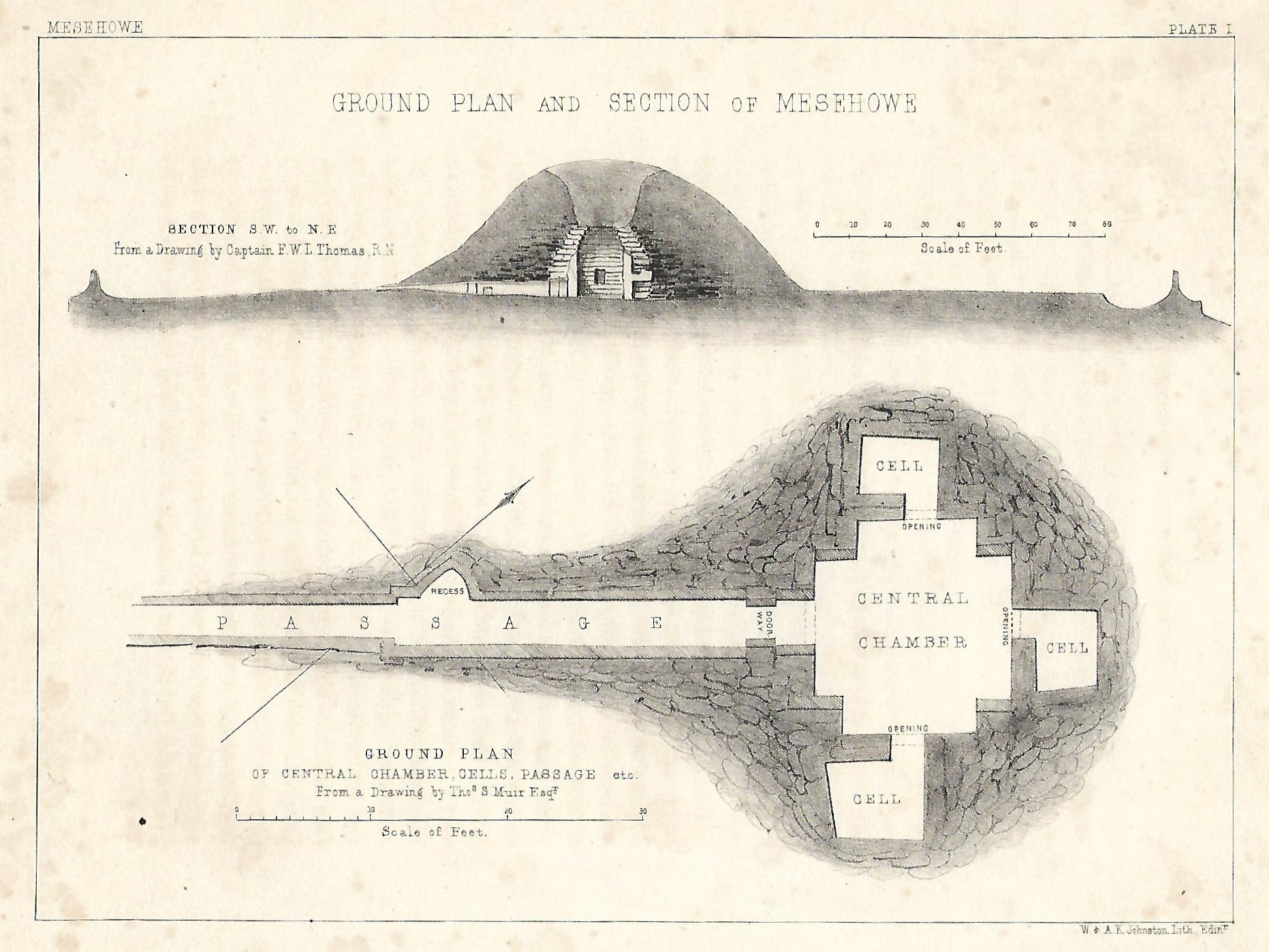
Maeshowe is a famous Neolithic tomb, with a long passage facing the midwinter sunset and a large chamber with three smaller, slightly raised chambers off it. It’s famous for having lots of Viking graffiti, but for my purposes that doesn’t interest me.

Maeshowe plans from Orkneology.com

Maeshowe is strange for at least two reasons. First, it’s much more ornate than the other burial mounds and barrows in Orkney. Second, no actual burials have been found at Maeshowe (but maybe the Vikings cleared them out).

Like Silbury Hill, nobody knows what Maeshowe was for. But if I’m running set there then I need to know as the builders will be present.

In The Silbury Revelation, Drew argues that Maeshowe isn’t a tomb but is instead a temple for worshipping the death of the old year and the birth of the new. His two main arguments for this are that no burials have been found at Maeshowe, and that it has an Earth Mother hill figure of its own. That figure is formed by two hills on Hoy and is directly opposite Maeshowe’s entrance—the midwinter sun sets directly between them.

I have no idea if that was Maeshowe’s true purpose, but I think it’s interesting enough that I’ll adopt it for my game. There are plenty of other tombs and barrows nearby if I need to somewhere to bury someone important.

My thoughts on The Silbury Revelation

I enjoyed The Silbury Revelation. Drew tells and engaging story and while he presents what seems to be a compelling argument, I don’t have the expertise to argue otherwise. I think the ideas he presents have merit, but maybe if I knew more about it I would be casting it aside in disgust. But for now it suits my purpose.

My two key takeaways from The Silbury Revelation are:

  • First, when I’m at a stone circle, I should look to see how it sits in the landscape. The stone circles are not positioned by chance, and are often precisely located (although they’re not always in their original location).
  • Second, when I’m in a bookshop I should spend more time in the local history section. You never know what you will find…

And I want to visit more stone circles…