Tuesday, 25 January 2022

Stars and Wishes

Stars and wishes have come up recently in some of the blogs I read and podcasts I listen to. Guy discusses them on his Burn After Running blog (he thinks they’re a good thing), but that’s balanced by episode 51 of the Grognard Files (where Dirk and Blythy aren’t so keen).

So what do I think?

I started using stars and wishes in my RPG sessions during 2021 and they’ve become a great way of giving feedback—both the weekly groups I run and play in now use them.

If you’ve not encountered stars and wishes before, this Gauntlet post explains them. But in essence:

  • Stars—give a star to someone and tell them what they did that was so great.
  • Wishes—what you want to see more of.

Stars


Stars are easy—they’re a way to highlight the good things that happened during the session. Strictly, you’re supposed to ‘give’ a star to someone around the table, but we don’t adhere too strictly to that, and we’ll give out multiple stars.

It’s nice to come away from a session with the highlights, so I think stars are here to stay.

Stars are a formalised way of capturing the frothing enthusiasm you can get at the end of a game—I see it often after successful freeform larps. (I don’t know whether that says more about freeforms or freeformers.) Formalising it this way encourages you to look for the good bits in all sessions though, not just the great ones.

Wishes


I find wishes harder, for several reasons.

Wishes are supposed to be constructive ways for everyone to suggest what they’d like to see more of. However, I like running horror games, and players will say things like “I wish it wasn’t me” (upon learning they’d been impregnated by a facehugger in ALIEN) and “I wish this will turn out well” (when it obviously won’t). I think they’re joking...

I’m also running a lot of published one-shot scenarios (over three or four sessions) at the moment, and there's less scope for going beyond the scenario. We’re not so good at wishing for internal things that we’d like our characters to be exploring.

And often, I find that player wishes are directed to the GM rather than other players. (I probably do that myself—so maybe I should make other players the subject of my wishes more often.)

Instead, and I guess this is similar to wishes, at the end of a session I ask the players for the plans going forward. That helps me to prepare, and helps me deliver what the players want (although there’s a limit to that in a published adventure.)

But perhaps I shouldn’t worry too much that I haven’t got wishes quite right. They’ll either come to me, or they won’t.

And for freeform larps?

I haven’t yet used stars and wishes directly in freeforms.

Wishes suffer the same problems as tabletop games—freeforms are a one-shot thing. Some freeform GMs find criticism particularly hard directly after a stressful run.

The problem with stars is giving everyone the time to “give” their star, particularly online (which is how I’ve been doing stars and wishes so far). It’s probably easier in person, as you can you’re your star in private. (Instead, in the last freeform larp I played in, I worked out what my star was and, during our post-game enthusiasm frothing, said how much I liked that.)

Summary

So I give a star to the Gauntlet for sharing the idea.

And my wish is to either get better at wishes or to embrace the fact that wishes are hard. And do them more in freeforms.

(Images from game-icons.net)

Tuesday, 18 January 2022

ALIEN stat blocks (again)

I recently wrote about revising ALIEN stat blocks. However, as much of an improvement as I think they are, I’ve realised I need to be more radical.

I’ve just finished my second session of Destroyer of Worlds as I write this. We’ve had two proper combats and there are more to come.

The most recent encounter involved the ambush I talked about last time, involving six insurgents. And having run it, I don’t think NPCs should be fully statted out. Instead, you just need four numbers—how many successes they rolled, their health, how many successes their armour absorbs, and their resistance to opposed rolls (such as manipulation).

So this is my plan.

Mooks

Your basic everyman thug. Nothing special.

  • Combat: Every other turn, they will roll one success and deal the damage according to their weapon. (Pistol/knife =1, auto rifle = 2, heavy machine gun = 3)
  • Health: 4
  • Armour: 0 successes
  • Resistance: 0 successes

The resistance figure is for opposed rolls, such as manipulation. In this case, the NPCs will not roll any successes (so the PCs need one success to succeed).

Tough guys

Tougher opponents. Still mooks, though.

  • Combat: Each turn, they will roll one success and deal the damage according to whatever weapon they have.
  • Health: 5
  • Amour: 1 success
  • Resistance: 1 success

Tres tough hombres 

Special forces and the like.

  • Combat: Each turn, they will roll two successes and deal the damage according to whatever weapon they have +1
  • Health: 6 (or 7 for androids) 
  • Amour: 1 success
  • Resistance: 2 successes

Named NPCs

For named NPCs, I will mix and match. It will depend on the NPC and how important they are to the scenario. I might even use their printed stats.

What this looks like in practice


Why am I doing this?

To make ALIEN easier to run. I find combat fiddly—there are many moving parts. I want to speed things up and roll fewer dice so I can focus on the drama.

Simplifying NPCs (which really don’t need all this extra admin) removes my mental load and lets me concentrate on running an exciting game for the players, rather than trying to remember whether I’ve included all the correct modifiers.

Not Xenomorphs

And just to make it clear, we’re only talking humans and androids here. I’m not changing the monsters—they’re fine as they are.

Later: So how did it play?

I’m writing this part of the post after our third Destroyer of Worlds session. We had the final battle of Act 1, and Act 2 is underway.

Act 1’s final battle was dramatic, to say the least. It started well, with the PCs taking out six insurgents without casualties. But then Captain Silva froze in the door of the dropship (she was about to rappel down and failed a panic roll) and moments later two RPGs hit the dropship, hitting the driver (Chaplain) and sending it spiralling into the ground. Both the Captain and Chaplain took critical damage—Silva’s skull was crushed and Chaplain’s legs were torn off (severe chassis breach…)

However, it was much easier to run (and make dramatic) without having to make so many extra rolls for the NPCs.

So definitely one to keep, especially in a game with numerous enemies and combats like Destroyer of Worlds.


Wednesday, 12 January 2022

Treasure Hunt 2021 (part 2)

This was my second treasure hunt of 2021, created quickly in the days before New Year’s Eve when we had my brother to stay.

This time I searched for new ideas, and found this excellent page on Hobby Lark which led me to this Caesar cipher code creator and this maze code creator.

You can read about my previous treasure hunts here.

Constraints

To keep things simple, the treasure was in a single location (in a basket underneath our television). To make things trickier, I used lots of codes.

The overall structure of the hunt looked like this:

  1. I gave the hunters their first code to decipher.
  2. This lead to four other clues, hidden around the house.
  3. Solving those clues led to final treasure.

The first code

The first code was a letter-replacement code. I created four letters from me to the hunters, with their code. They first had to break the code.

The four letters looked like this:


This says:

DEAR JACK

YOUR CLUE IS IN HARRY POTTER AND THE PRISONER OF AZKABAN WHICH IS OUTSIDE THE UPSTAIRS BATHROOM

LOVE UNCLE STEVE

Each  of the four letters started with ‘Dear …’ and ended ‘Love Uncle Steve’ (or ‘Love Daddy’ or ‘Love Steve’ depending on how I addressed it).

To create the code, I wrote the letter in MS Word and changed the font to a heiroglyphic font.

The clues themselves were slightly wordier than I would normally use to make them easier to decode.

The four clues—mazes 

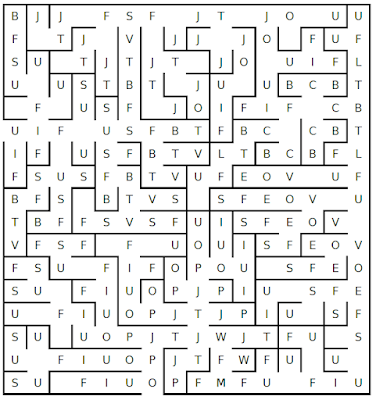
The four clues led to four maze clues, each created using this online maze code creator. As the final maze was in a Caesar cipher, the other mazes explained how to crack the cipher. (Tip for using the maze creator—it works best with a long sentence, and you may need to refresh the maze a few times to get one that isn’t too easy.)

The first maze explained the basic principles:

(The final clue is in code.)

The next two codes explained how to crack the codes.


(The first words are “THE TREASURE”)


(The final clue is a Caesar cipher with a shift = 1)

And the last code read uif usfbtvsf jt jo uif cbtlfu voefs uif ufmfwjtjpo which means the treasure is in the basket under the television (in a Caesar cipher).

And with that we were done!


Sunday, 9 January 2022

Treasure Hunt 2021 (Part 1)

This is the first of two treasure hunts I created in 2021. This one we played on Christmas Day. (You can read about previous treasure hunts here.)

Constraints

We were staying at my in-laws for Christmas, and we would have seven hunters. I wanted each hunter to find their own treasure (rather than in a single location). 

I was recycling an old treasure hunt idea that I’d not used in a long time. To make it a little harder, the hunters would have to work out which clue was theirs.

The overall structure looked like this:

  1. I gave the hunters their first clue.
  2. The hunters work out which is theirs.
  3. They then follow the trail to the final clue.
  4. The final clue was a slide-keyboard puzzle that gave them the final location of their treasure.

Which is my clue?

I used a simple number puzzle to identify the clues. So I gave each letter a number (a=1, b=2 and so on) and then added the letters in that person’s name.

So John = 10 + 15 + 8 + 14 = 47

(The hunters found this hard, so I had to explain the code on the day. In hindsight, I should have given them a clue, such as A=1.)

The clue trail - stations

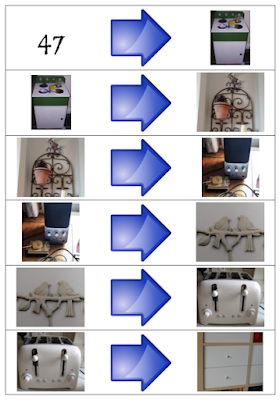
Stations is the name we give to a particular type of hunt. In Stations, clues are placed all over the house as slips of paper. Here’s a typical set of clues for stations (there will be one for each hunter).


I printed these out on a single sheet of A4, and then cut them up with a guillotine into six slips of paper. (So with seven hunters, this would end up with 42 slips.)

The first row is the one the hunter starts with. (47 = John. I could have made it easier but just putting “John” in that row.)

The other five rows are scattered randomly around the house—in halls and in rooms. (Be careful to spread them out and not put all of one hunter’s clues in one location.)

The last clue leads to the treasure. As these were photographs of things in the house, I could have put the treasure in the last location (in the drawers). But I added a final puzzle.

The final puzzle

The final puzzle was inspired by the sliding keyboard I use on my smartphone. 

So everyone received a squiggle:


I also gave them a sheet of paper with a keyboard printed out (at the correct scale):


Putting one over the other (and holding them up to the light) reveals this:


And following the clue reveals A L C O V E—this hunter's treasure was in the alcove.


Banter in Destroyer of Worlds for ALIEN

I’ve just started running Destroyer of Worlds for ALIEN, and one thing I used when I started Chariot of the Gods is banter.

I first heard about banter on 1shotadventures.com (which learned about it in MacDeath—‘Professor DungeonMaster’ talks about the idea six minutes in to the video). 

Essentially, rather than the GM providing a load of background info, the players are given 4-6 bullet points of things they have learned. They then roleplay this out and drop the information into conversation. (They need not give the information out in order—as long as it all goes out.)

(Note this is not the Banter talent, this is something completely different.)

So, this is the banter I provided for the start of Destroyer of Worlds (very minor spoilers):

Player 1

  • Ariarcus is cold. We should be just fine if we keep ourselves wrapped up.
  • Major Hatfield has confirmed we can call in an airstrike or an emergency extraction through him. If he authorizes it, of course.
  • Has anyone heard anything about the Oblivion bar or the spaceport?
  • Colonel Myers has poisoned Ariarcus’ petrol deposits with oil-eating bacteria.
  • The Oblivion bar is on the way to the spaceport. Let’s start there.

Player 2

  • Ariarcus is an oil town. I was here a year ago—1-2 metre diameter pipelines are everywhere. Don’t shoot at them—they may explode!
  • The manager of The Eye of Oblivion is a former pleasure synthetic.
  • The Conestoga-class medical frigate Monygham is berthed at the spaceport.
  • The UPP use antique combat synthetics, but they’re poorly maintained.
  • The spaceport is locked down tight.

Player 3

  • A storm front is mounting. I hope that doesn’t mean a blizzard.
  • Watch out for insurgents loyal to the UPP. Stay on your guard. 
  • The UPP are on their way. It’s only a matter of time before they invade.
  • Oil-eating bacteria was developed by Weyland Yutani. It’s a nightmare and creates a silty shit that tastes like brake dust. Too much, and you start hacking up blood.

If I had more players, I would spread the bullet points out (so each player would have fewer nuggets of information).

How did it work?

Really well. The players embraced the bullets and we shared information interactively rather than me just reading to them. It was one of the highlights of the first session.

In MacDeath, this technique is used throughout the scenario. However, I didn’t do that for Chariot of the Gods and I’m not sure I will do it for Destroyer of Worlds. But it’s now part of my GM toolbox I wouldn’t be without.


Monday, 3 January 2022

Trello for ALIEN: Destroyer of Worlds

When I run and play online RPGs, my preferred virtual tabletop is Trello. I use Discord for videochat, and a Discord dicebot (there are several, but I recommend Sebedius for Alien as it has the panic table built in).

Trello allows me to keep everything organised—and the players can also contribute (either by finding pictures or adding notes).


So this is how I set Trello up for Destroyer of Worlds. It has taken a bit of time to prepare, but I quite enjoy it and it helps me understand the game. I haven’t prepared everything yet—I’ve got most of Act 1 prepared, which is enough for me to start. Acts 2 and 3 can follow once I have a handle on the game.

Lists

Trello is organised in columns, called lists. I’ve created the following lists for Destroyer of World: PCs, Other squad members, The mission, Locations, Others, Zones for combat, Initiative, TBC, and No longer with us.

So taking those lists in order.

PCs

These are the player characters—our marine squad. When I set up the game, I put them in rank order (Captain Silva at the top, Private Hammer at the bottom). Each card had the character’s picture and their skills & weapons in them. I’ve used the same stat block I discussed before.


I will give the players full character sheets as well, but I’ve set the cards on Trello up this way so they can be easily referred to in combat.

(One downside of Trello is that if the lists get long you have to scroll down to see them. It’s not the end of the world, but I often move stuff to the top of the list to make sure key cards don’t fall off the bottom. Of course, monitor size helps here.)

Other squad members

This list is for squad members not controlled by players. After my players have chosen their characters, I will move the NPC squad members into list 2. That makes them easy for me to see and grab their key stats.

I’ve also put the squad APC in this column. (Along with some key vehicle rules.)

I will ask that the players control the NPC squad members in combat. I will have three players, and I’ll ask that they control one NPC each (rolling dice and so forth).

The mission

This list contains the mission briefing, the Ariarcus map, and the four AWOLS the PCs are hunting. In the top card I have attached a few files:

  • The general background to Destroyer of Worlds (pages 5-7 of the book).
  • The Destroyer of Worlds mission background (pages 11 and 12, plus the AWOLs, the PC squad and equipment/weapon stats)
  • A summary of the rules I found on Reddit. (There are other summaries available—this one misses the rule that you can swap initiative with another player at the start of a combat round, so it isn’t perfect.)
  • The skills list (so the players can see what stunts are available).

Locations

I’ve started this list with Fort Nebraska, The Eye of Oblivion and the spaceport. (These are the locations the PCs know about at the start of the mission.)

For each, I’ve taken a screenshot of the player-facing map and dropped it in there. As we discover new locations I’ll drop them in during play.

Others

This list is for other PCs. At the moment it just has Major Hatfield (’ve used the image for Col. Myers) and a M40E Ridgeway Heavy Tank (as I have no doubt I’ll need that at some point).

Zones for combat

This is a new way to use Trello for me, as my games rarely have much combat. I will explain the zones, and put all the combatants in those zones so I can see who is where. (More or less.)


This will be fairly abstract, but that’s okay as I usually run combat using theatre-of-the-mind rather than with miniatures. My main intent is to understand who is in the same zone (or engaged in close combat), and what the range modifiers are.

As the characters and zones are all cards in Trello, they are easy to move about.

This will be the first time I’ve tried this, and I’m looking forward to it. (As much as I ever look forward to running combats.)

Initiative

This list is purely so I can track initiative. I’ll get everyone to roll dice to determine their initiative, but once that’s established it’s just 

This also makes it easy for PCs to swap initiative, as the cards are easily moved.

TBC

The cards on this list are all NPC portraits—I’ve used some from the scenario, and others from Chariot of the Gods. I’ll use them for NPCs as I need them, both the named NPCs in Destroyer of Worlds and any others that I may need.

I could have put these on my other Trello board (as described below), but I don’t think there I’m giving anything away by showing the portraits here. I’ve not named any of them—I’ll do that as the PCs discover who they are.

No longer with us

The graveyard for dead NPCs and foes. Currently empty.

My other Trello board

It’s easy to move cards from one Trello board to another. So I’ve prepared additional cards for events I know are coming up soon. So this list contains a couple of xenomorphs that I know I will need early on, and the ambush card I talked about previously.

I’ve also turned some key information normally read out to players into a card. So for example, Dr Litvin’s prognosis (page 31) into a card. That way I can both read it out, and give it to the players so they can review it later.

(The Alien scenarios don’t do enough of this for me—I would use more handouts and less boxed text.)

That’s about it for now

I haven’t prepared the whole scenario. I’ve got enough for the first couple of sessions, and will add new cards between sessions depending on what the PCs do.


Sunday, 2 January 2022

Treasure Hunt 2020

Every year I create a treasure hunt for Christmas Day (you can read 2019’s here). This was 2020’s.

Constraints

We had three guests for Christmas, and with Mrs and Miss H, that meant I had five hunters to cater for. We decided that the treasure (Toblerone bars) would be in a single location.

My plan was for each hunter to have their own set of clues that would come together to reveal the treasure’s location.

So the overall structure looked like this:

  1. I gave the hunters all the clues. The clues were grouped into sets.
  2. The hunters worked out which set was theirs.
  3. They then solved the clues—resulting in an anagram.
  4. Solving that first anagram took the hunters to a location where they would find a letter.
  5. Those letters were a final anagram leading to the treasure.

Sets of clues

I grouped each players’ clues by dog breed: spaniel, poodle, terrier, husky, and dachshund. Each player had 6-8 separate clues (36 clues in total).

These are the clues for “spaniel.”


Other sets were smaller—depending on the experience of the hunter. (This was Megan’s so I gave her more clues than most because she will tear through them quickly.)

Whose clue is it anyway?

I used what3words in 2019, and it was too good not to use again. This time I found street and place names with the names of those playing—so, for example, fuses.reassure.fats points to Megan Drive somewhere in North Carolina, while kicks.reach.dwell points to Stevensville and appealing.jots.panther points to Down Hatherley Lane. (I could do this all day.)

(Looking back, it didn’t matter who each set belonged to. The important thing is that each set leads to an anagram.)

To solve each clue

First answer the question. So Christmas Day 3pm BBC1 [3] means that the hunter must find what is on BBC1 at 3 pm on Christmas Day. It’s The Queen, and [3] means take the third letter—e.

Similarly, Number of unopened poppies in lounge [2] refers to a painting in our lounge. There are two unopened poppies, making the letter w.

Then take those letters and rearrange them to make a word. (In Megan’s case, wellies.) This told you where another clue was.

(Or it could have lead to the treasure, if I was doing individual treasures.)

The final clue

The final clue was one of five letters: A B D E R. (So Megan found the letter D where we keep our wellington boots.)

Rearranging this anagram revealed BREAD, and the treasure was hidden in our bread bin.

Once solved, we were done, and everyone gorged on chocolate.