Tuesday, 30 August 2022

RPGaDay 15-21

So I’m still doing RPGaDay in 2022. Here’s questions 15-21.


15 - Who would you like to Gamemaster for you?

Me. Not that I think I’m a particularly wonderful GM, but I run the games I want to play. It would be great if I could also play in them.

16 - What would be your perfect game?

It’s less about the game, but more about the people. With the right group, RPGs are magical.

With the wrong group, they’re awful.

For me, though, the right group would be more focussed on telling a story and in-character banter rather than killing monsters or worrying about getting the modifiers right when rolling dice.

And plot—I do like a game with a plot.

17 - Past, Present, or Future? When is your favourite game set?

Present—I much prefer a present-day (or slightly historical setting).

I find when I’m playing fantasy (or some SF games) that I suffer from culture shock—I don’t understand the cultural norms or how society is supposed to work. (And sometimes GMs punish my ignorance, but that’s a different topic.)

I don’t get any of that with a modern-day game. I understand the world, the technology and what’s going on. Add an overlay of weirdness (vampires, secret aliens or whatever) and I’m in heaven.

So, give me Liminal, Monsterhearts, Call of Cthulhu and numerous others to D&D, Runequest, Ashen Stars or Starfinder

18 - Where is your favourite place to play?

At home—mine or someone elses. Around a table. With snacks.

Online is in second place—it’s very easy to get a game (no commute!), and I get to play with friends from across the country, but the social experience isn’t the same. 

Pubs and clubs and conventions—they’re okay, but I don’t enjoy having others around me when I play.

19 - Why has your favourite game stayed with you?

I find this really difficult.

My default go-to game is Fate Accelerated—but it’s not perfect (approaches need getting your head around) and I’m not sure it’s my favourite game. But I often find myself playing (or running) another game and thinking, “this would be so much easier if it just used Fate Accelerated.”

So maybe that does make it my favourite game?

At the moment.

Because my tastes change. For some years I would have said that Call of Cthulhu was my favourite game—I lived and breathed Cthulhu. And then I got into GURPS, at which point that was my favourite game. (And then I did freeforms and started getting very minimalist and I didn’t really have a favourite game.)

So if by “favourite” we mean “flavour of the moment”, it’s probably Fate Accelerated. Ask me again in a few years, and it may be different.

20 - How long do your games last?

A session is normally 2-2.5 hours online. In person maybe 3-4 hours. I like short campaigns, so somewhere between 8-12 sessions—enough time to explore the setting and come to a decent conclusion. 

I’ve never run or played a lengthy campaign, and I’ve no desire to—there are too many games to play.

21 - Share an intriguing detail from a game setting you enjoy.

The IISS Ship Files (Games Workshop’s 1981 book of starship deckplans for Traveller) suggests that jump drives interfere with psionics, and gave their Zhodani ship (the Tiafliet-class patrol frigate) a very distinctive elongated shape with the bridge about 80m from the jump drive. Sadly, I don’t think this idea was picked up anywhere else.

IISS Ship files - still my favourite deckplans


Monday, 22 August 2022

RPGaDay 9-14


 And here’s questions 9 to 14.

9 - What is the 2nd RPG you bought?

Traveller was my first RPG, and then the most significant RPG for me after that was Call of Cthulhu, a year or so later. But between Call of Cthulhu and Traveller, there might have been Gangbusters and Tunnels and Trolls (neither of which I played much). Or were they after Call of Cthulhu? I can’t remember.

10 - When did you start Gamemastering?

It was 1981, and my friend Rob came over to play the weird new game I had just bought (Traveller, as mentioned earlier). We rolled up characters and then tried the combat system. I can’t remember who won.

Rob then bought the Shadows/Annic Nova adventure. He ran Shadows, I ran Annic Nova (I can’t remember who went first).

We always shared being the GM or playing.

11 - If you could live in a game setting, where would it be?

Somewhere upbeat and hopeful in the future (I like to think that we somehow make it past our current troubles and reach the stars). I can’t think of a specific setting that has made me think, “I’d like to live here.”

12 - Why did you start RPGing?

I liked boardgames, I liked science fiction. The advert for Traveller sounded intriguing, and when the game arrived, I tried it out and enjoyed it.

(I then also got into hobby gaming—I bought Car Wars, Ogre, and Cosmic Encounter all around that time.)

13 - How would you change the way you started RPGing?

I wouldn’t change a thing—I like how I started roleplaying: I didn’t start by playing D&D, and I didn’t start by joining someone else’s game. I did it the hard way—figuring everything out from three little black books. I kinda like that. (I wouldn’t wish it on anyone else, but I also wouldn’t want to change it.)

14 - Roll 1d8+1, and tag that many friends and suggest a new RPG to try.

I don’t like tagging people, so I’m going to change this to RPGs I would like to run. I’ve not run any of these, but I’ve played one or two of them (just the once.)

Hillfolk: I’ve played this once, and really enjoyed it. Now I want to run it. But it’s a bit challenging to bring to the table—I find myself intimidated by it. It’s a game I really want to play, and it’s so radical I’m a little surprised that it hasn’t had a bigger impact on RPGs generally.

Urban Shadows: I backed the Kickstarter for the second edition, and I’m looking forward to giving it a try—although it’s another game I’m intimidated by.

Kingdom: I’m a huge fan of Ben Robbins’ Microscope—it’s the one game that I couldn’t wait to play after I had read the book. I’ve got Kingdom, but haven’t got it to the table yet—I really need to push that up the playing order. I might have played this, once, at Furnace.

Trophy Dark: I listen to the Fear of a Black Dragon podcast (which is generally excellent). They have mentioned Trophy Dark and Trophy Gold several times. I don’t have Trophy Dark, but I gather it’s inspired by Cthulhu Dark (which I do have) and focussed on one-shot play, so that appeals.

Good Society: The Jane Austen game. A pleasant change from flying spaceships and staking vampires.

Monsterhearts: I’ve played Monsterhearts once, but would like to run it.


Monday, 15 August 2022

RPGaDAY 2022 Q1-8

I don’t normally do RPGaDAY—it happens in August, and August is holiday month for me.


However, this year, while I was on holiday, I caught Covid and was stuck at home with little to do.

So this year I’m doing RPGaDay. I’m posting them daily on the Tavern, and here are the first eight.

1 - Who would you like to introduce to RPGs?

I don’t think there’s anyone I want to introduce RPGs to that I haven’t already.

However, there are people who I wish would play RPGs with me. (Mrs H, in particular--it would be nice to share RPGs with her. But if I did that, I’d probably have to be more into the garden/allotment than I am. So we have a happy balance - she plays boardgames, and I cut the grass, strim and compost. She has watched me run a game for friends and sat there in puzzlement while she knitted. This reminds me of when my mum overheard me roleplaying with my friends back when I was at school: “You’re just making it all up!” she accused me. Well, yes.)

I’ve already GM-ed for my daughter. Her first game was when she was 4 or 5, when I ran Faery’s Tale for her. She’s occasionally played since - she’d happily do more.

2 - What is a great introductory RPG?

I don’t worry about teaching rules when I’m introducing someone to roleplaying - I tell them to describe what they want to do, and I tell them what dice to roll and whether they succeed.

Back in the 80s, before Geek culture ruled, Call of Cthulhu was my go-to game to introduce new people to roleplaying. It’s easy to explain that this is a ghost/horror story. (Toning down the mythos and sticking to vampires, werewolves, ghosts and so on.) BRP was a nicely simple system.

To me, the setting is more important than the rules. I can handwave some tricky rules, but it’s much harder for a new player to understand an inaccessible setting. (Modern-day or recently historical are best for me.)

(And dare I mention Freeform Games? Yes, they’re larps (but that’s just TTRPG-ing standing up), but we describe them as murder mystery games. We make an okay living by introducing ordinary folk to roleplaying games without telling them that’s what they’re doing.)

3 - When were you first introduced to RPGs?

1980 for me. A cryptic advert for Traveller in Starburst #22 and #23 intrigued me, but it was another year before I actually purchased those little black books.

(I've written about this before.)

4 - Where would you host a first game?

Ideally around a table in someone’s home.

5 - Why will they like this game?

I don’t know why anyone enjoys roleplaying. We all enjoy it for different reasons—perhaps to hang out with friends, be part of a story, chew scenery, kill monsters, and escape into a fantasy world. Everyone’s different.

So I’m rephrasing this as:

How would you run an RPG session to make it likely that a new player would want to play again?

So, some principles:

  • Keep it small: no more than three or four players. That gives everyone plenty of spotlight time.
  • Keep it short: A short one-shot adventure—I wouldn’t drop a new player into a massive ongoing campaign. The ideal adventure would have some investigation and roleplaying before a fight. No longer than about three hours of play.
  • Accessible background: Make the background accessible. If you must run a fictional universe, remember that their character knows more than they do.
  • Keep the system in the background: Don’t overwhelm them with numbers and statistics. I would probably use Fate Accelerated, which I’ve taught new players many times.

After that, I hope they will enjoy sharing an adventure with their friends, and I hope their character does cool and memorable stuff they couldn’t do in another medium. And maybe then they’ll come back.

6 - How would you get more people playing RPGs?

I’d like to see more positive depictions of roleplaying in movies and television. Stranger Things was great, except the kids were geeks and nerds. It would be nice to see RPG gamers depicted as less nerdy and more ordinary.

A harder question is how to get more BAME people playing RPGs? I remember chatting with Remi at Aircon in Harrogate a few years ago, and he noted the attendees were 99% white. I hadn’t noticed—but I’m white, so it didn’t seem unusual to me. I don’t know how to fix this, although I expect positive BAME role-models in cinema and television wouldn’t hurt.

7 - System Sunday: Describe a cool part of a system you love.

I’m not sure I love Fate, but I like Fate points. They do so much:

  • They reward good roleplaying and putting characters in peril.
  • They permit players to create story elements at the table.
  • You play them after you roll the dice—so you’re unlikely to waste them.
  • They’re powerful—a +2 bonus doesn’t sound like much, but on the Fate probability curve, it’s huge.

I may not love them, but I miss them when the system I’m playing doesn’t have them.

8 - Who introduced you to RPGs?

Nobody, as explained when I answered question 3. I was patient zero – I was intrigued by a cryptic advert in Starburst for Traveller. I had no idea what I was buying…

Next time

Next time - answers to questions 9 to 16.


Tuesday, 26 July 2022

Updating Seeds of Doom

I’ve updated The Seeds of Doom with a few things I’ve enjoyed in my games lately.

The Seeds of Doom is a one-shot mystery for Monster of the Week. It’s set in a seaside town, which could be anywhere but is based on my home town of Sidmouth in Devon.  I’ve run it a couple of times before and while it’s been okay, there are a few things I can do to improve it based on recent games.


Changes to the mystery

Stealing from ALIEN: I like the random attacks that the creatures make in ALIEN, as it shakes things up. So I’ve added that to the monster attacks in The Seeds of Doom (although I’ve simplified it by given them three attacks instead of six).

Stealing from Brindlewood Bay: I like how Brindlewood Bay uses questions to help set the scene for different locations. So I’ve done that for The Seeds of Doom: ‘What can you see here that shows that the owners enjoyed gardening and were proud of their garden?’

(Yes, I could just ask those questions anyway, but I find the prompts useful and perhaps if I do it enough then it will become a habit.)

Changes to the playbooks

Monster of the Week is ideal for campaign play, but I find the playbooks are over-complicated for a one-shot. So I’ve made a few changes.

Luck: I found that luck as written didn’t work. I imagine it’s a great doom track in campaign play, but I found it didn’t work for a one-shot. So I’ve changed Luck to being a simple re-roll of the dice (rather than an automatic success) and allowed it to refresh following a refreshment scene (stolen refreshment from Lady Blackbird).

Mark luck to re-roll the dice or avoid all harm from an injury. [] You can refresh your luck by having a refreshment scene with another character.  A refreshment scene is a good time to ask questions (in character) so the other player can show off aspects of his or her PC. Refreshment scenes can be flashbacks, too.

Experience: I’ve dropped experience to three boxes from five, so there’s a chance that the PCs may get two chances to level up. I’ve also limited the experience choices to additional moves and higher stats, to keep things simple.

Amending the playbooks: I’ve made a few changes to the playbooks that I’m using:

  • Structure: I don’t understand how MotW’s playbooks are ordered. They make no sense to me, so I’ve restructured them by bringing the ‘Getting Started’ section forward in the character sheet.
  • Weapons: As I set The Seeds of Doom in England, I’ve removed some heavier weapons and firearms from the playbooks.
  • Curated moves: I’ve removed some moves that won’t be appropriate for a one-shot or The Seeds of Doom, so players don’t accidentally choose them.

I’m not using all the playbooks. For example, for The Seeds of Doom I’m not using The Chosen or The Divine as they have a big impact on the game and are better suited for longer form play.

You can see my playbook changes here.

Questions for team start

I will also use a few questions to help form the team, such as:

  • Who founded your team?
  • Where is your team’s base?
  • How are you funded?
  • Are you ‘official’ or ‘unofficial’
  • If unofficial, what influence do you have to ensure cooperation with officials?

Did it work?

Yes! I recently re-ran The Seeds of Doom and I was happy with all of the changes. We had a great refreshment scene, and the change to luck worked well.

You can download The Seeds of Doom from my Itch.io page—pay-what-you-want.

And my website contains other RPG stuff--scenarios, larps and more.


Monday, 18 July 2022

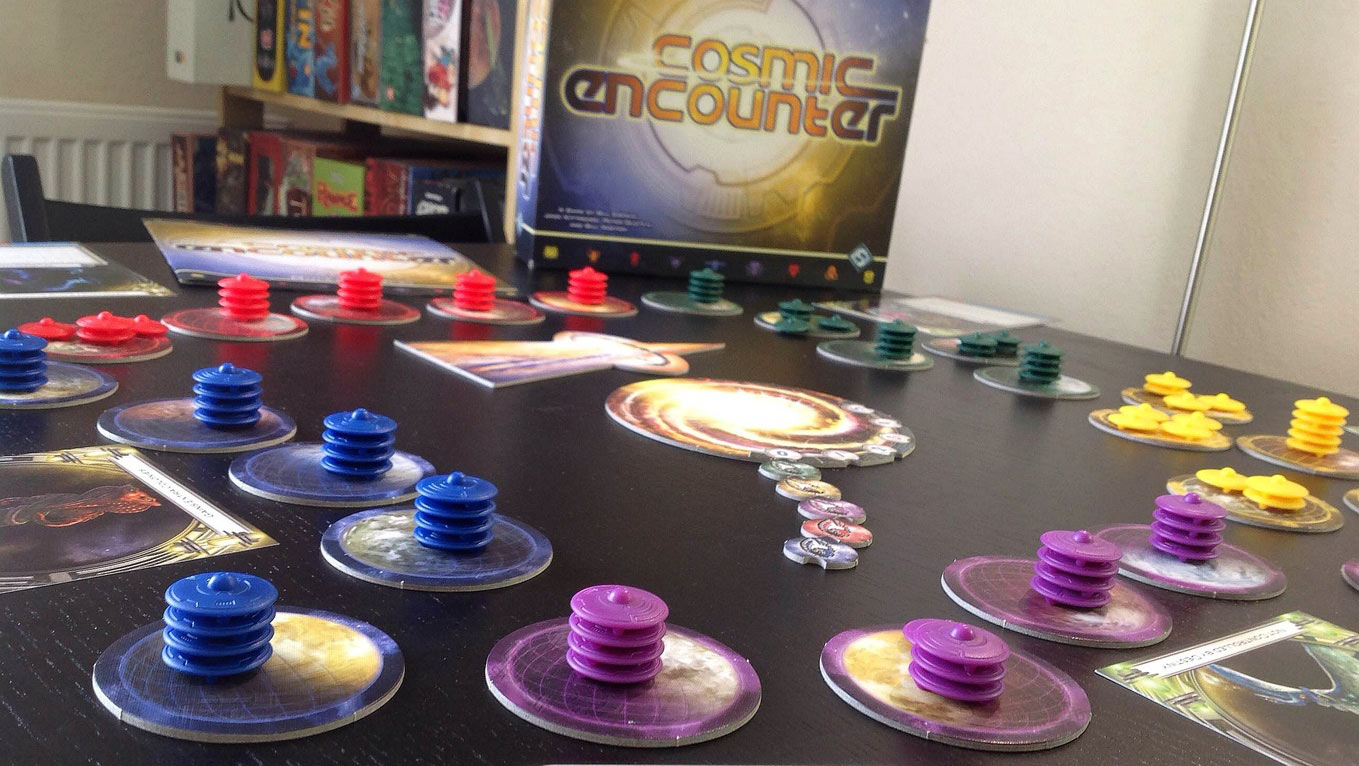
Cosmic Encounter and me

Cosmic Encounter is one of my favourite boardgames. It may even be my favourite boardgame, but I probably need to play it more than I currently do to make sure.

(This isn’t a review—you can find reviews aplenty on boardgamegeek.)


Early Cosmic

I started playing Cosmic Encounter in 1981 or so. I had just begun roleplaying (Traveller), and the advert for Cosmic Encounter in Games Workshop’s catalogue caught my eye. Once it arrived, I was hooked. We played it incessantly—both with my RPG buddies (in and around games of Traveller) and my ‘normal’ school friends.

The penultimate week of the school year was ‘project week’. We had the opportunity to do exciting things like youth hostelling or parachuting. One topic, generally reserved for those that couldn’t afford the exciting projects (or weren’t able to get into the popular projects), was boardgames. This was the early 80s and I was miles away from the nearest games shop. Boardgames meant Monopoly, Escape from Colditz, Cluedo and its friends. (Even the Spiel des Jahres was in its infancy and wasn’t something I’d learn about for a few years.) Anyway, I chose (yes, chose) boardgames for two years and brought in Cosmic Encounter for the week. I mention all this because I remember one girl who was clearly not happy to be playing boardgames; but there was one game she would play: Cosmic Encounter.

Which alien is best?

Before I started buying expansions, I tracked the success of the aliens. To my surprise, Philanthropist was the alien most likely to win. This alien lets you give a card to your opponent—which means you give away your rubbish cards and keep your good ones. It also means you draw more cards—something that would become known as ‘card advantage’. So over a decade before Magic: The Gathering popularised the term, Cosmic Encounter taught me the importance of card advantage. Since learning that, I’ve always preferred powers that let me draw cards, and shied away from those who hoard their hands.


The second most successful alien was the most obvious candidate: Virus. Virus multiplies its attack card, and is strong in challenges. But not as strong overall as Philanthropist. 

Third, I think, was Laser. Last was Clone—I’ve never liked Clone (probably because I like drawing cards). Clone only works if you’ve got an encounter card you want to keep, and it means that you’re rarely drawing new cards and so miss out on Artifacts (or Edicts as they were known then), Flares and other goodies in the deck. I wouldn’t inflict Clone on a new player either—it’s not fun enough and doesn’t sell the craziness of Cosmic Encounter at its best. (It’s okay as a second power in the right combination, which is why I haven’t thrown it out.)

My favourite power, though, is Sorcerer (you may switch cards) as I love the delightful mind tricks it creates. (Sadly I don’t play the new aliens enough to know if I have a new favourite.)


I liked the hex boards—they set Cosmic Encounter apart from the other boardgames of the time. And changing to a regular board was one of several things that Games Workshop did horribly wrong with their version. But as much as I liked the hexes, I prefer Fantasy Flight’s planet design. Definitely the best.

Expansions and other editions

It wasn’t long before I had all the Eon expansions, including the weird hexes. Despite having all the expansions, we didn’t play them much (besides the extra aliens and 5th and 6th players). Moons were too silly and slowed the game down. (I’m not a fan of expansions that slow games down for little return.) Lucre wasn’t exciting enough, and the alternate hexes weren’t that good—although we used the alternate cone and Praw a fair bit.

I bought the awful Games Workshop edition and was disappointed with the mess they made of it.

I didn’t get the Avalon Hill edition, but I bought Mayfair’s Simply Cosmic (which disappointed me as it didn’t have enough of the craziness I craved).

In the deep freeze

Then I stopped playing.

I moved away from home and didn’t get a regular boardgame group until after the renaissance started in the 90s. So while Settlers of Catan and Magic: the Gathering became popular with my roleplaying group, Cosmic Encounter remained in my cupboard, unplayed.

Since 2000 I have probably played more boardgames than ever—but, sadly, Cosmic Encounter has not been amongst them. There have, I think, been a few reasons for this:

  • Until the Fantasy Flight edition, the only copy I had that was worth playing was an ancient Eon copy full of expansions held together with sticky tape. Cosmic Encounter had to compete against newer games with their better graphic design, and Cosmic Encounter lost.
  • Gameplay has improved since Cosmic Encounter came out. When it was first released, Cosmic Encounter compared favourably to Monopoly and Cluedo. Now it must compete against Ticket to Ride, Carcassonne, Wingspan and others. Unsurprisingly, Cosmic Encounter sometimes shows its age.
  • I have learned that an hour is my preferred length for a boardgame. I normally don’t want to play a single game for much longer than that—that should be enough to give you a good, solid game and still have time to play something else later on. (Also an hour often suits real-life commitments.) Cosmic Encounter, unfortunately, often takes longer than that. Even longer if you are introducing new players. (I don’t mind setting aside longer for a good game, but an hour often works for the casual gamers I usually play with.)
  • The learning curve for Cosmic Encounter is steep, especially if you add all the craziness (which is how I like to play). However, without the craziness (and if your new players haven’t got into the spirit of it), Cosmic Encounter can be a bit pedestrian.

Three player Cosmic Encounter—with two players

But I still want to play. 

Unfortunately, Cosmic Encounter doesn’t appeal to Mrs H, but luckily Megan is happy to play. So I created a dummy player for three-player Cosmic Encounter, which we play now and again. It’s not as good as a full player, but it’s better than nothing.

The dummy player always has a mandatory power and draws encounter cards from the deck (it has no hand). I created a deck of cards for the dummy player’s decisions—how many ships to commit, asking for allies, whether to ally when invited, and whether to make a deal. Other decisions (such as where ships are taken from or which planet to attack) are usually obvious and agreed among the players. The dummy player has been known to win before now...

Favourite boardgames

Recently I thought about my favourite boardgames (which currently include Glory to Rome, Dominion, Oceans, Wingspan—and Cosmic Encounter) and noticed that I like games with variety. Games with lots of stuff that let you do different things—I like a game that forces you to make the best of what you’ve got and work for the win.


Do I like Cosmic Encounter because I like those kinds of games, or do I like those kinds of games because I like Cosmic Encounter?

House rules and variants 

Cosmic Encounter has always seemed a game that encourages house rules, and I’m no different. So these are my house rules.

If you’ve got a vacant planet in your system (ie, completely empty with no colonies), then you can colonise it for free when moving your ships (from the warp, or returning from a successful defensive alliance, or whatever). I’ve always played this way—because it’s always more fun to have the use of your alien power than not to have it.

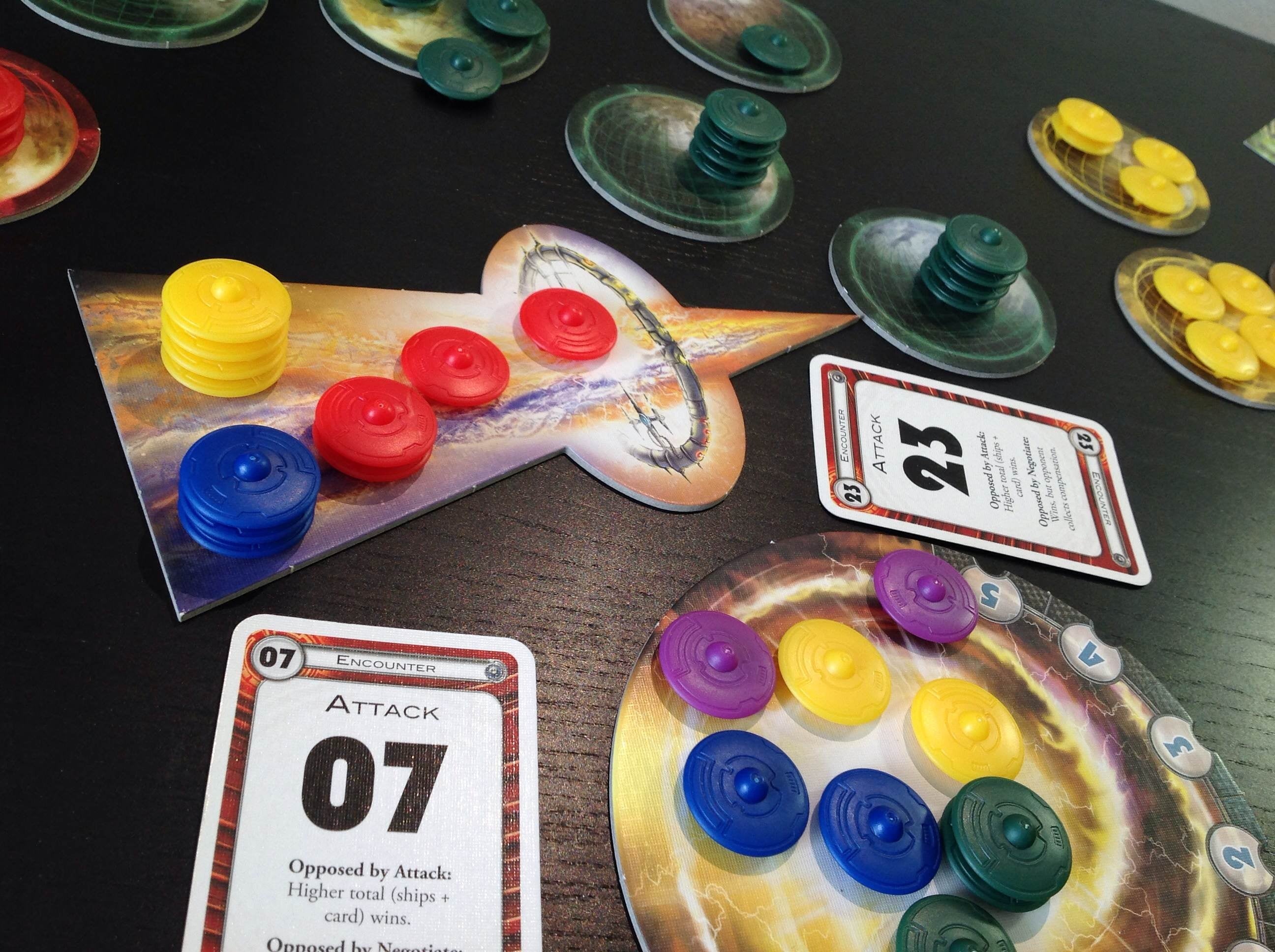
I don’t use the Fantasy Flight rules for the cone (or gate). As per the original Eon rules, defensive allies always go on the ring on the cone, while offensive allies sit with the attackers in the mouth of the cone. (Okay, that’s not really a house rule, just me refusing to move with the times.)

One thing I don’t like about the new edition is the scoring tracker. Partly that’s because it can take up so much space, especially if everyone is on the same score (although I could put the scoring tokens on top of each other). Also, I don’t always remember to move the scoring track as colonies are won and lost. Mainly, however, I remember the delight (or frustration) of winning (or losing) Cosmic Encounter because we had not paid attention, and a player already on four colonies was asked to ally with the attack. The scoring track makes it much easier to keep an eye on who is in the lead, making those delicious sneaky victories much harder.

Cosmic Encounter and the future

So I think that’s about it—Cosmic Encounter and me.

Going forward, one thing I haven’t explored is playing Cosmic Encounter online using Tabletop Simulator. Perhaps that’s something to explore.


Monday, 4 July 2022

Aiding in RPG combat

So we were playing The Troubleshooters and were in the middle of a fight. We had four PCs, but one of them had already been taken out. We faced a formidable NPC bad guy and her mooks. And it wasn’t going well for us.


Unfortunately for us, only one character was good at combat. As it wasn’t me, I decided to take a leaf from FATE’s book and help our fighter, somehow. So I asked the GM if I could distract the bad guy by picking up a trifle and throwing it at her.

Not to do damage (I already knew that would be hopeless), but to give my friend a bonus when it was his turn to attack.

Unfortunately, nothing in the rules suggested we could do such a thing. We were in combat, and my options (from the rules) were:

Move

Free actions

  • Say something
  • Pick up something
  • Drop something
  • Ready a weapon
  • Change weapon
  • Break cover
  • Fall Prone

Main actions

  • Sprint
  • Attack
  • Catch your breath
  • Reload
  • Take cover
  • Survey
  • Delaying your main action

Alas, throw trifle at someone to distract them, wasn’t on the list. Not even a generic some other action or distract enemy or help a friend, which might have allowed such nonsense.

(Quick aside. While I play and run lots of freeform larps, I have only played actual-combat boffer-larp once or twice. I don’t like sword fighting, and I’m not good at it. But I remember I was most effective when I attacked enemies that were already engaged in fighting. They couldn’t focus easily on two opponents (Darth Maul is a force-boosted exception), particularly if we attacked from opposite sides. So even though I was rubbish, by flanking I either had an unprotected side or back to attack, or I distracted my opponent for my more-skilled colleague to deliver the killing blow.)

The GM’s role?

Now, you could argue that’s what the GM is for—to mediate the player’s chaotic ideas.

But I’ve noticed that detailed rulesets tend to inhibit such improvisation. I don’t know why that should be, but I’ve seen it both with GMs ruling and with players simply rolling dice to hit. (As a player, I’ve been inhibited myself as this story about D&D shows.)

In my example above (with the trifle), the GM agreed and gave the other PC a bonus to hit. 

(It didn’t help, unfortunately—and even had he hit, the NPC would have had a dodge roll followed by rolling damage. I so much prefer FATE—I would have created an advantage which my PC could have used to not only improve his chances of succeeding but also increase the damage inflcted. Ah well.)

Aiding in combat

Putting aside the challenge of improvising while playing/running detailed rule systems for a moment (or another post), are there other games that let you help in combat?

Picking some games from my small library…

In FATE, even if you have no combat skills, you can create an advantage that someone else can invoke during the fight. You might flank them, throw sand in their eyes, distract them by throwing a trifle at them, shine a light in their eyes, upset them with insults or whatever else you can think of.

Mongoose’s Traveller has a catch-all miscellaneous action in combat. It would be nice if the examples included helping another PC, but it’s better than nothing.

ALIEN and Liminal both include rules for helping or assisting others in a task, although neither includes that in their list of combat actions.

One of the basic moves in Monster of the Week is Help Out—which gives a bonus to another PC’s move (and is exactly what I was doing with that trifle).

While Cthulhu Dark has rules for helping, it also rules that if you fight the monsters you die!

So in summary, a mixed bag.

Improvising in detailed systems

For me, much of the joy of roleplaying comes from improvising and doing all those things you couldn’t do if you were playing a computer RPG. And yet I still find myself inhibited when faced with a detailed rule system—if the rules don’t say you can do it, you can’t do it.

And yet, you can.

You just need to ask.


Monday, 27 June 2022

Social skills in RPGs

I’ve recently been playing Fate Condensed, The Troubleshooters and ALIEN and noticed something odd about social skills.

While combat skills are usually straightforward—melee and shoot (or variants thereof), social skills are ridiculously complicated. 

Examples from some RPG rulebooks I have close to hand:

RPG Combat skills Social skills
Fate Core and Fate Condensed Fight, Shoot Deceive, Empathy, Provoke, Rapport
The Troubleshooters Melee, Ranged combat Charm, Subterfuge
ALIEN Close combat, Ranged combat Manipulate, Command
Liminal Melee, Shoot Charm, Conviction, Empathy, Rhetoric, Taunt
Traveller Gun Combat, Melee Carouse, Deception, Diplomat, Leadership, Persuade
Trail of Cthulhu Firearms, Scuffling, Weapons Assess Honesty, Bargain, Cop Talk, Flattery, Interrogation, Reassurance
Call of Cthulhu Fighting, Firearms Charm, Fast Talk, Intimidate, Persuade, Psychology
Tales from the Loop None – no fighting Charm, Lead, Empathise

Traveller also has Gunnery (for ship combat) and Heavy Weapons (for artillery). And when it comes to melee, Trail of Cthulhu separates armed (Weapons) and unarmed (Scuffling) melee combat. I’m not sure why it needs to do that.

So it feels like we know what we want with combat: hitting and shooting things.

With social skills, however, we’re all over the place. And while there are a lot of similarities (several examples of Charm/Rapport), systems often have their own peculiarities, such as Traveller’s Leadership (used during combat) and Trail of Cthulhu’s Cop Talk or Reassurance.

I want to think that the skills are chosen to reflect the way the designer expects the game to be played. I suspect that’s why something like “Assess Honesty” is in Trail of Cthulhu: it’s important to know when you’re being deceived.

However.

Thinking back to recent games, the social skills I’ve most often wanted are persuade, intimidate or deceive.

You can argue that charm and provoke/taunt are different styles of persuasion. (Do they need to be separate skills? I don’t know.) And intimidation is arguably just a type of persuasion (that’s how Traveller treats it).

But it feels to me that some games specialise too far—I’m not sure what the value of Rhetoric is in Liminal. And Call of Cthulhu has both Charm and Persuade. What did playtesting show? When was Rhetoric used? Were Charm and Persuade used equally and for different things?

Because characters have a limited pool of skill points, numerous social skills makes characters less effective: skills will be spread more thinly.

I’m not sure I have an answer or a conclusion. Other than were I designing a skills-based RPG, I’d have a good long look at my skills list.

As for me, I will pay more attention to my social dice rolls, record what skills I need, and revisit this subject.