Tuesday, 26 December 2023

Treasure Hunt 2023

 This year’s Christmas treasure hunt:

Add together the fifth and sixth prime numbers. Then subtract 1.

Find the three consecutive odd numbers whose sum is 27. What is the middle number?

The first letter of the capital city of Myanmar.

Decrypt this using a caesar cypher with a shift of 3: “Wkh dqvzhu lv wkh ohwwhu g.”

What is the number of the chapter titled “The Forbidden Forest” in Harry Potter and the Philosopher’s Stone?

The ninth prime number.

The first letter of the name of the artist who painted three castles.

A bat and a ball cost £1.10 in total. The bat costs £1.00 more than the ball. How much does the ball cost, in pence?

The first letter of the name of the artist who painted a wine bottle and two glasses.

A score.


Monday, 18 December 2023

Changing my mind – Fate

Last time I talked about the change I’d make to Fate Accelerated – I’d add a seventh approach, Charming.

Vodkashok pointed out some errors in my thinking on The Tavern discussion forum (where, through the magic of Interwebs, my blog was automatically posted).


He wrote:

I'd humbly suggest falling back onto my old favourite Fate Accelerated adage - Approaches say how you do something, not what you do. So each one can be applied to anything. So, if you are trying to charm someone

Quick - rapidly bombarding the listener with words, not letting them get a word in. Literal fast talk

Forceful - power of charisma or fear, like a drill sergeant

Flashy - a staged performance, ala Donald Trump

Careful - slowly and steadily picking your words to make the most impact

Clever - long words, complex sentence structure, introduce some Latin phrasing and the occasional 'Whaar!'

Sneaky - Laying down linguistical traps, boxing someone into a corner where they cannot do anything but agree, the weasel words salesperson

He’s right, and that’s helped my Fate Accelerated thinking.

How you do it, not what you do

Vodkashok is right to remind me that approaches are how you do something, not what you do.

It seems odd that I had forgotten that, as when I teach Fate Accelerated to new players, that’s exactly what I tell them: you tell me what you’re trying to do, and I’ll tell you which approach that is.

Can you forcefully charm someone?

But I’m not sure about all of Vodkashok’s examples (they appear to be persuading someone rather than charming them), but it’s a good example of how something like persuasion works in Fate Accelerated

And “charming” might even be part of your high concept aspect, allowing you to spend a fate point to invoke it for a bonus. Or it could be a stunt.

How do you charmingly open a door?

Thinking about it further, charming doesn’t work as an approach because it’s so limited. How would you “charmingly” open a door or drive a car? You can’t. It doesn’t work.

Now, I’m not sure that every approach should be used in every situation (I probably wouldn’t let someone forcefully charm someone), but adding niche approaches probably isn’t the way to go.

So, I won’t add Charming to Fate Accelerated after all.


Monday, 11 December 2023

What would I change about my favourite RPG system?

While I participated in RPGaDAY back in August, I found the questions a bit frustrating as I would have liked them to be more reflective.

As I was going through the month, I came up with a few questions I would like to answer. This is one of them.

What would you change about your favourite RPG system?

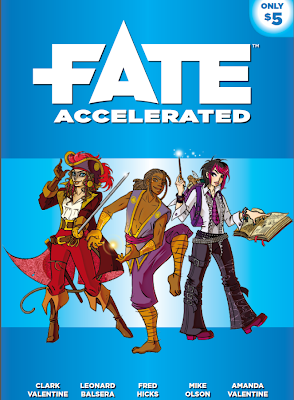
My favourite system, the one I find easiest to run and play, is Fate Accelerated.

I find Fate Accelerated absurdly simple. Characters are defined by:

  • Aspects (“Hotshot pilot” “Rugged archaeologist” “Bull in a china shop”) which are always true. (Aspects can be applied to anything.)
  • Approaches – how the character does things. Approaches come in six flavours: Forceful, Quick, Careful, Clever, Sneaky, and Flashy.
  • Stunts – special abilities that work in certain circumstances, often giving a +2 bonus to a roll.

There are no skills – if you want skills, you should use Fate Core or Fate Condensed. (But I’m not a fan of Fate’s skills list, as I mentioned in my Fate of Cthulhu writeup.)

Doing stuff

So, to do something in Fate Accelerated, a player rolls four fate dice and adds the relevant approach. If they are smashing down a door, it’s probably Forceful. If they are picking the lock, it might be Careful.

The difficulty with approaches

Sometimes, I find it tricky to work out which approach should be used. Clever and Careful often seem to have an overlap. I don’t worry too much, but if I’m struggling, I do two things:

First, I consider what the result will be (and what might happen if they fail). If the player is carefully defusing a bomb, then that suggests a methodical approach. If they fail, they’ve probably taken precautions against taking too much damage. But quickly defusing a bomb suggests a certain recklessness.

Second, it’s sometimes helpful to think of the approaches as D&D attributes. While this works for Forceful (Strength), Quick (Dexterity), and Clever (Intelligence), this doesn’t work so well for the others. (This doesn’t work for every case. If a PC was trying to intimidate an NPC, I could imagine them rolling Forceful.)

I guess I could argue that Careful might equate to Wisdom, but I suspect that the blurriness between Clever and Careful is like that between INT and WIS.

But there’s no approach in Fate Accelerated equivalent to Charisma or Constitution. That’s fine for Constitution – there’s no need for a “healthy” approach as that’s covered by stress boxes and consequences.

But Charisma? That’s the bit in Fate Accelerated I miss. My players often try to befriend or get to know NPCs, and I find the approaches let me down in Fate Accelerated. So, I’d like to see a “charming” or “charismatic” or “likeable” approach for social situations.

Just one change

So that’s the change to Fate Accelerated I’d make: a seventh approach – Charming.

Monday, 4 December 2023

Reflections on a campaign larp

So from what I could tell and what the players told me (and others afterwards), the players enjoyed my two freeforms at Consequences. Several players want to find out what’s coming next, and other players (who missed one or both episodes) want me to run them again.

Which has me in a bit of a quandary.

The big idea

So a recap.

I’m writing a series of connected freeform larps set in the same universe. The freeforms are based on the science fiction first-contact novels and movies (and other media) that I have always adored.

Some characters appear in multiple episodes. Some characters appear only once. The games are always written for 13 players (although I’ve managed when Life has interfered). The games are also designed to be independent – you need not play in the previous episodes, but I hope you’ll get more out of them if you do.

The games so far are:

The Roswell Incident: Kind of a prequel. Sets the scene and introduces some of the main themes. This is now published by Freeform Games.

All Flesh is Grass: Based on the 1965 Clifford D Simak novel of the same name.

Children of the Stars: The players grapple with another alien race. Friendly or not?

Messages from Callisto: A mission to Callisto has unsettling news.

The Stars our Destination: The next game, which I’ve started, is set on Rapa Nui (Easter Island).

So far, I have run each game twice – so I have two alternate “timelines” taking place.

Timeline 1 is is an online-only game, started in February 2022. It’s suffered from occasional technical difficulties.

Timeline 2 is a face-to-face series that started at Retcon in February 2023 and continued at Consequences in 2023.

There are a few differences between the two – aside from the differences the players have created. I have changed some character names and alien details (one alien has completely changed from my original ideas).

But I’m keen to carry on with them. The two timelines are diverging, which is both scary and exciting.

(I should also note that while I have a vague sense of where I’m heading with the overall arc, I don’t know how I’ll get there…)

Multiple runs

At a convention like Consequences, it’s common to have multiple runs of popular games. This year, The Ashlight Labyrinth and Incense and Insensibility both ran twice. 

While that’s an easy thing to do for a one-shot, that’s a little trickier for ongoing games.

One easy answer is to start each episode with a summary that basically says, “Forget what happened last time; this is the real history.” As I understand it, that’s what Tony Mitton’s Linfarn Run series does.

But I don’t want to do that. I want the players' decisions in an episode to affect later episodes. If the players decide to multilaterally disarm and dismantle the world’s nuclear stockpile, then that should be part of the history going into later episodes.

I guess I could run (say) Children of the Stars twice at the same convention. They could have a common background (let’s say Timeline 2), but I would then end up with Timeline 2A and 2B (or is that Timeline 3 and 4?).

But that’s not what I want to do. I’d rather start Timeline 3 with The Roswell Incident and start afresh.

Playing previous episodes

The other issue is whether players who join the game at episode 4 (say), would like to play an earlier episode. They already know some of what happened in those episodes (because it’s part of the background) – but would playing in an earlier episode appeal?

I don’t know.

I’d like to think that my games are enjoyable enough that they would have a good time playing even if they already knew some details. 

And freeforms are often re-run, and players often play them again. At the recent Retcons, I played in two freeforms that I had played previously – in one case, I even played the same character. It didn’t affect my enjoyment – I had either forgotten the details, or deliberately overlooked them.

So, I hope that players will enjoy playing in earlier episodes. (And if it were me, I’d be tempted to push the game in different directions.) I guess I’ll find out in due course.

2-3 monthly campaign

I guess my ideal approach for the campaign would be to run them at 2-3 monthly intervals with a stable of players.

If anyone is in the Leeds/Harrogate/York region and wants to organise such a thing, let me know!

Available for others

A final constraint is that I plan to make the games available for others to play.

So far, The Roswell Incident is available via Freeform Games as one of their murder mystery games (although the main mystery isn’t a murder…)

Next to get into shape is All Flesh is Grass, which I hope to start work on shortly. When that’s done, I’ll make it available on my itch.io page. With a fair wind, I hope to get that up in early 2024.

However, making a game where earlier games affect later games presents a few challenges. For Children of the Stars, I anticipated one big outcome and several little outcomes. (And there was another outcome I hadn’t predicted!)

So for Messages from Callisto, I prepared a set of notes for each character based on the big outcome and briefings for the little outcomes. And between the games, I hurriedly stuffed character packets accordingly.

However, as the timeline goes on, that’s likely to become more complicated.

So I will probably provide the game as MS Word documents (rather than a pdf as I might normally do), and highlight the areas that need changing. (It’s that or provide different files for each option – along with really complicated instructions for assembling character packets.)

I am already taking the highlighter approach for The Stars our Destination as I am already writing different sections of the text changes for different outcomes.

To sum up

So:

  • I want to keep the games in their own timelines. I want the in-game decisions to matter. So I’m unlikely to run them more than once at the same convention.
  • I will make them available for others to run.
  • The next game will be The Stars our Destination and is set on Rapa Nui. The title may change (but it’s unlikely). I hope to run that online in the first half of 2024 (Timeline 1), and then in person at Consequences (Timeline 2).
  • I will probably run another game at Consequences, but whether that is episode 6 or something else, at this point I have no idea.
  • I’m not sure when I’m going to start Timeline 3.

Thursday, 30 November 2023

My first Consequences

So last weekend I attended Passionate Consequences, the freeform larp convention (with some boardgames) held every year in a holiday camp near Poole.

Loads of people found it hard to believe that this was my first Consequences. Many of my larp friends attend – and many games played were ones written at Peaky. Consequences started in 2007, but as it’s on the south coast (near Poole), attending it always meant taking five days (including travel). And while I had a day job and a young family, that was more leave than I was comfortable taking.

Now I don’t have a day job, it’s easier to take leave, and so in 2023, I went to my first Consequences.

Consequences

Consequences is held at Naish holiday village, so the accommodation is mostly holiday chalets. My accommodation (a two-bed apartment, not actually a chalet) was fine – it was clean and (once we’d figured out the heating) warm. As ever in this sort of accommodation, there were never enough towel rails.

Typical accomodation / gaming lodge

The accommodation is all self-catered, and I ate a mixture of ready meals and bar meals. Unfortunately, the apartment’s oven was a little shonky. I’d bought a non-microwavable shepherd's pie but couldn’t get the oven up to temperature. So tipped the pie out of its foil tray onto a plate and used the microwave, and all was fine.

Thursday

I set off from Yorkshire at about 9, having walked the dog, and after a long but easy drive, arrived at about 3 pm. I checked in and chatted with old friends.

Horrospital

My first game was the tricky-to-pronounce Horrospital, a horror-comedy game by Tony Mitton for 25 players. Horror in freeforms is never very horrific. It is inevitably played for laughs and involves comedy vampires, werewolves, demons and the like. It’s always over the top and never very scary. Which sums up Horrospital nicely.

I played Orderly Peeler, an undercover cop. I was investigating a series of murders, and I got much of the way through solving it, but couldn’t quite get the final piece. This is partly because I was tired, but mainly because I didn’t sit down and discuss the murders properly with the character who could have filled in some gaps.

(I was tired not because of the long drive, but because the game started at 8 pm and I’m often tucked up in bed at 10 pm. I remember starting to flag at about 9:45 pm and thinking, blimey, we’ve got a way to go yet.) 

Anyway, Horrospital was very enjoyable, my favourite bit was explaining to everyone that the reason I was investigating the murders was because I was studying for an NVQ. I’m sure everyone saw through my nonsense.

Friday

I woke at 6 am (as usual) after a not-very-long night. Although I returned to the chalet early(ish), I didn’t go straight to bed as I wanted to relax and unwind first. I also needed to review my character for the morning’s game. I was originally signed up to play Sam, but a last-minute dropout meant I changed to Stevie. Who I hadn’t read. So I needed to read, absorb and take notes. Perhaps unwisely, I did that before going to bed and, as a result, got only three or four hours of sleep.

Antarctic Base 13

This was a ten-player tense SF game set at an isolated research station in the Antarctic – with strong The Thing vibes. Written by Rich Perry and Alli Mawhinney, I’ve wanted to play it for a while. I’m glad I did, as it was great.

I played Stevie, the comms operator. Which meant I had access to lots of information – and I didn’t like going outside. My favourite parts were searching the base when everyone else had gone outside and doing something in plain sight in front of other players who were so caught up in their own thing that they didn’t notice me doing it.

It’s not perfect – the character sheets need a bit of work, and a couple of bits feel creaky, but the core concept is great. 

After that, I had a short nap to wake up and lost badly at Dune Imperium, which I’d not played before. (I can see why it’s popular, but it’s a bit long for my liking.)

Children of the Stars

This was the first of the two games I was running, and I was looking forward to seeing how it would work. I had 13 players – and it went really well. I had a few pre-flight nerves because the first run (online) didn’t go well for various reasons. But this time, it went off without a hitch.

Discussions about weighty matters...

The players bought into the ongoing story. A couple had played in earlier episodes, and I had four playing in both this and Sunday’s Messages from Callisto. And I could see the decisions I’d given everyone were causing them to think.

As ever, I made copious notes and have a few changes to make – mostly clarifications rather than anything game-breaking.

Saturday

I woke with a headache on Saturday and decided to eat in the restaurant rather than battle the kitchen appliances. My headache had cleared by the time it was to play my first game.

Old Nick’s Game

Old Nick’s Game is written by Charlie Paull, Alan Paull, Roger Gammans, and Nick Hollingsworth. It’s for ten players and is set in Hell and is based (loosely) on Old Harry’s Game, a Radio 4 comedy which I know of but haven’t listened to.

I will admit to being slightly apprehensive about this game as I wasn’t sure about my character. I was playing Antonia, the mother-in-law of another character. Gender didn’t seem very important in the game, so I wasn’t worried about that, but my character didn’t believe that they were in Hell – instead, this was all a rag week stunt. But the character sheet felt muddled as a result.

As it turned out, I needn’t have worried as the game was great. It played really nicely, and I had a whale of a time pretending we weren’t in Hell. I particularly enjoyed threatening to report Satan to HR if he continued his bullying. My favourite bit was discussing my favourite fiction (which I decided was Mills & Boon romances) with Satan, and he summoned Jane Austen from the pits of Hell – and she turned out to be extremely foul-mouthed. She must have had a very good editor!

Between games

The most important thing I needed to do on Saturday was prepare the character packs for Sunday’s Messages from Callisto. So once I’d had a bite to eat, I popped back to the apartment to sort that out.

Messages from Callisto is set ten years after Children of the Stars, and decisions the players make in Children affects the background to Messages. I’d thought about this in advance and come up with options – so I had extra background and briefing sheets for each character. And now I knew what had happened in Messages, I could prepare Children.

(Would I do this again? It was a lot of work, but it was also very satisfying. So the answer is probably yes.)

Once I’d done that, I went back to the main area and got into a game of Villagers. While I was playing, I was asked if I’d fill a spare place in Better Than Life, as a player had dropped. So that was my evening sorted.

A Better Than Life Sandwich

A BTL Sandwich is a series of three short minigames featuring five characters. The scenes are all unrelated. It was written by Martin Jones for the Across the Universe weekend game, but he’s run these separately many times since.

The three minigames are all wonderful – tense, angsty and funny. The character sheets were all short, so it didn’t take much for me to catch up. It’s a great pick-up game.

The three minigames were:

  • The Judgement of Solomon: The fate of a child hangs in the balance… I played the judge – and I might have played this before. There’s no good decision here – wonderfully angsty.
  • The Gig at the End of the Universe: Inspired by The Hitchhikers Guide to the Galaxy – and at about 30 minutes, probably the right length for a Hitchhiker’s game. The light relief to the other two more angsty games. I was Zaphod Beeblebrox, man! Delightful nonsense.
  • Waiting: A dramatic game about waiting for aliens to attack. How long do you have, and what must you say before the end? Fabulously bleak.

Looking back, Better Than Life was one of my favourite games of the weekend. And it finished relatively early, which meant I was in bed by 11 am and got a good night’s sleep.

Sunday

A good night’s sleep left me refreshed for Sunday. I heard stories of people not getting to bed until 4 or 6 am. I don’t think I can do that.

Devil to Pay

Devil to Pay is a 26-player pirate freeform written by Brian Richburg and Alison Joy Schafer. It was an old-style freeform larp with long character sheets, rules, contingency envelopes, items, abilities and more. I found the long character sheet hard to read at first, but it soon made sense during play.

I played Laurens de Graaf, a Dutch privateer. To my surprise, my character survived. I was expecting to die horribly – but I won a duel and ended up with just enough loot to survive the game. It was great playing with Nickey, who was my wife and rescued our daughters before they could be killed in a pirate raid.

Messages from Callisto

Messages from Callisto follows Children of the Stars. It’s for 13 players, and I had four players who played in both games. Three played the same character. The fourth was a last-minute addition – I would have cast them as the same character had I known.

Thanks to a few typos (and some mistakes when stuffing envelopes), Messages from Callisto had a slightly creakier start than Children. But once it was going, it went well, and everyone seemed fully engaged and having deep discussions.

I have come away with a page of notes and improvements – but players told me later that they had a good time (and want to play other episodes), so that was all wonderful to hear. (I’ll probably reflect on that in a later post.)

Next year?

Next year, Consequences will move to a new venue. I suspect it will still be a long drive from Yorkshire, but I’m planning to go again.

Tuesday, 21 November 2023

Are tabletop RPGs "art"?

The old question of whether RPGS are Art (with a capital A) came up on The Tavern discussion forum recently.

I realised I wasn’t sure what I thought about that. Instinctively, I think RPGs aren’t art – but I’m also aware that this discussion has happened many times before and by people smarter than me.

So if it’s an old discussion, it was probably in ChatGPT’s learning data. So I asked the question.

Are roleplaying games "art"?

My first mistake was not specifying tabletop roleplaying games. While ChatGPT 3.5 gave me an excellent response, I realised that it was referring to video games. (And purist that I am, I’m slightly annoyed that videogames have hijacked “roleplaying”.)

So, I asked about tabletop rpgs. Here’s ChatGPT’s response – I’ve merged both answers as elements in its first answer also applied to TTRPGS.

Whether tabletop roleplaying games (TTRPGs) are considered "art" can be subjective and depends on how one defines "art." In a broad sense, many people argue that TTRPGs are a form of art. Here are some perspectives on this:

  • Narrative and storytelling: Tabletop RPGs rely heavily on narrative and storytelling. Game masters (GMs) and players collaboratively create stories, characters, and worlds, making TTRPGs a unique form of interactive storytelling. The creation of these stories can be seen as a form of artistic expression.
  • Creativity and imagination: TTRPGs require substantial creativity and imagination from both the game master and the players. The open-ended nature of tabletop games allows for limitless possibilities, encouraging participants to think creatively and contribute to the unfolding narrative. The design of game worlds, characters, and scenarios involves artistic decisions.
  • Visual and handcrafted elements: While not digital, the physical elements of tabletop RPGs can have artistic value. Hand-drawn maps, character sketches, custom miniatures, and other handmade components contribute to the overall artistic experience.
  • Emotional impact: Like other forms of art, TTRPGs can elicit emotional responses from players. The immersive nature of the experience can create a powerful connection between the player and the game, similar to the emotional impact of other art forms.
  • Rulebook design: The design and layout of TTRPG rulebooks can be considered a form of graphic design. The choice of typography, illustrations, and overall presentation can enhance the artistic appeal of the game.
  • Social and collaborative art: TTRPGs are inherently social and collaborative experiences. The interactions and dynamics between players contribute to a unique form of collective storytelling akin to a collaborative art project.
  • Cultural and Social Commentary: Some RPGs explore complex themes, social issues, and cultural commentary. This reflective aspect can be considered a form of artistic expression.

However, not everyone may view TTRPGs as art, especially if they have a more traditional or narrow definition of art. Additionally, some TTRPGs prioritise gameplay mechanics over narrative or visual elements, blurring the lines between art and entertainment.

Ultimately, whether RPGs are considered art depends on one's perspective and definition of art. Many consider the act of playing and creating within a TTRPG to be a form of artistic expression, demonstrating that the boundaries of what is considered "art" continue to expand.

I thought that was pretty good. But I wondered if ChatGPT could present the opposing arguments.

And the arguments for them not being art?

Some arguments against considering tabletop roleplaying games (TTRPGs) as art include:

  • Functional vs. artistic intent: Critics may argue that the primary intent of TTRPGs is functional rather than artistic. The rules, mechanics, and systems are designed to facilitate gameplay and create an interactive experience, emphasising functionality over traditional artistic expression.
  • Varied quality: Not all TTRPGs have the same level of narrative depth, character development, or visual appeal. Critics might contend that the wide range in quality among different games undermines the idea of TTRPGs as a cohesive art form.
  • Player-generated content: The collaborative and player-driven nature of TTRPGs could be seen as shifting the creative responsibility away from the game designer. Critics might argue that the artistry lies more with the players' contributions than with the inherent design of the game itself.
  • Commercial considerations: Some argue that the commercial nature of TTRPGs, where profitability is a significant factor, can dilute the purity of artistic intent. Games may be developed with market trends and sales in mind, potentially compromising artistic vision.
  • Lack of tangible artefacts: Unlike traditional visual arts or literature, TTRPGs don't always produce tangible artefacts that can be readily displayed or collected as art. This lack of a physical, tangible product may contribute to scepticism regarding their classification as art.

These arguments are not universally accepted, and opinions on whether TTRPGs are considered art can vary widely. Additionally, the evolving landscape of art and the broader acceptance of interactive and participatory forms of media challenge traditional distinctions between art and other forms of cultural expression.

But what do I think?

I found ChatGPT’s explanation helpful in helping me realise where I stand on the whole “Are RPGs art?” discussion.

So, for me, while RPGs have artistic elements (most obviously the artwork), I don’t regard the playing of RPGs as art. But I’m happy if you do.

(Note: the image above was the result when I typed Are tabletop roleplaying games “art” into the Artflow AI art generator. I think it’s orcs playing D&D.)

Monday, 20 November 2023

Currently reading

My current reading pile has gotten out of hand. Normally, I may have two or three books on the go – an actual physical book, a book on my Kindle that I read at night, and maybe an audiobook or a book on my phone. 

Thanks to poor book management by myself, I seem to be in the middle of ten books right now.

Here they are, in no particular order.

The Integral Trees by Larry Niven

I picked this up at the wonderful Aardvark Books secondhand bookstore in Herefordshire. It has a pretty good SF section, and while I remember Larry Niven’s The Integral Trees coming out in 1983, I didn’t read it then. It cost me £2.50, 55p more than the 1985 cover price.

Unfortunately, it isn’t as good as I hoped. While the world is exciting and different (and the reason to read it), the story is about the descendants of a crashed human spaceship and feels a bit derivative. (Maybe it wasn’t derivative in 1983 – but I can think of other books with similar premises from about that time.)

I won’t seek out its sequel, The Smoke Ring, but I’ll probably pick it up if I come across it.

How to be a Liberal by Ian Dunt

I enjoyed Dunt’s Brexit – What the Hell Happens Now? (which accurately predicted much of the chaos we’ve experienced) and I’ve enjoyed his journalism. But How to be a Liberal is, so far, a history of liberalism, starting with Descartes in 1619.

And I’m finding it hard going - I picked this up in Wetherby’s Oxfam months ago, and yet I’m not even 100 pages in. So I’ve put it on the back burner. I haven’t abandoned it (yet), but I’m clearing other books before returning to it.

The Land of the Green Man by Carolyne Larrington

This is a tour of British folklore, covering pretty much everything. I bought this because I wanted to learn more about British folklore – and particularly how I might apply it to my Liminal games. (I usually just make stuff up, but Liminal’s USP is that it covers British folklore, so I thought I’d do some reading.)

However, I’m starting to regret not taking any notes…

Stories of Your Life and Others by Ted Chiang

Chiang’s Stories of Your Life is the short story that became Arrival. It’s been on my to-read list for a while, so when I saw it in a secondhand bookshop in Berwick, I bought it.

However, I don’t enjoy short stories. I find them too choppy – I want to wrap myself in a story, and short stories are over too quickly. They also have a different feel to novels – they’re “cleverer”, and that’s not always what I want. So, I’m slowly working my way through them. My favourite story so far is Understand, a story about a man whose hormone-K therapy makes him superintelligent – but not quite intelligent enough…

I’ve got one story to go, and I’m not quite sure what is stopping me from reading that story and moving Stories of Your Life and Others off my current reading list. (All those other books, probably.)

Discovering Scarfolk by Richard Littler

A birthday present and delightfully wrong on so many levels. Scarfolk is the fictional 1970s county in England’s Northwest – I can’t do it justice here, so I suggest you visit the Scarfolk blog. To my surprise, Discovering Scarfolk has a narrative and concerns itself with the disappearance of two children. Or at least, that’s the story so far.

The Book Your Dog Wishes You Would Read by Louise Glazebrook

All about dog behaviour and communication – our dog, Monty, is now seven years old, so I probably could have done with this a few years ago. It’s an easy read, and I’m already nearly halfway through, so I expect I will finish this fairly quickly.

Cursed Objects by J W Ocker

I’ve had Cursed Objects for ages – I think it was a 2022 Xmas present. It’s a collection of over fifty essays about cursed objects (the clue is in the title). There are loads of ideas in here for RPG investigations, but I probably should have made notes.

This is taking a long time to read because it lives in the summerhouse, and I only read a chapter or so on a sunny afternoon. Now that we’re in November, sunny afternoons are few and far between… I’m not expecting to finish this before next year. 

The Ember Blade by Chris Wooding

I’m finding The Ember Blade hard going, which is a surprise as I normally find Chris Wooding very readable – his Tales of the Ketty Jay are wonderful (start with Retribution Falls), as is The Haunting of Alaizabel Cray.

However, this is slow. It’s a fantasy setting, with an occupying empire and plucky underdogs (I wonder who we’re rooting for?), but it’s taking its time in getting going, and I’m not finding the two heroes particularly likeable. (And as a result, I’m finding it much too easy to put it down.)

Ministry for the Future by Kim Stanley Robinson

Every now and again, I find I’ve got some spare time, but I don’t have my Kindle (or another book) to hand. That’s when I turn to the Kindle app on my phone, and because I had some time on holiday recently (probably waiting for the family somewhere), I have started Ministry for the Future.

The book starts in the middle of an awful heatwave in India that results in millions of deaths. I’ve only just started Ministry for the Future, but it looks like that’s the event that kicks everything off. I expect when I finish The Ember Blade, I’ll start reading this one on my Kindle.

Unruly by David Mitchell

I’m listening to Unruly: A History of England’s Kings and Queens with Mrs H. We like to listen to audiobooks on long car journeys, and we started Unruly on our way back from Herefordshire recently. It’s engaging and often funny, as expected from David Mitchell.

Thanks to concentrating on the traffic, I’ve lost track of exactly where we are, but I know we haven’t reached the Battle of Hastings yet. But I don’t think it’s far off. However, I’m not sure when we’ll next listen to it – we’ve not got another long car journey planned for a couple of months.

MR James: The Complete Ghost Stories Collection

During December, I like to listen to MR James’ ghost stories – I have several of his best-known stories on Audible, read by the likes of Derek Jacobi and David Suchet. Last year, I bought this collection, read by Jonathan Keeble, which fills in the gaps.

I didn’t complete it last year – maybe I will this December. But I’m in no rush.

(By the way, if you don't get on with reading MR James' ghost stories, and I find them hard to read, I do recommend listening to them. They're much better that way.)

And the pile I haven’t started yet

So that’s what I’m currently reading. Part of the problem is that the books aren’t that compelling – so not ploughing through them. I’m likely to score most of them two or three out of five.

And here’s the list of books I have waiting for me. I will try not to start these until I’ve made at least a dent in the above:

  • Art of Ron Cobb by Jacob Johnson (I love Ron Cobb’s art – and there’s plenty of text as well)
  • A Gamut of Games by Sid Sackson (a collection of 30+ games)
  • The Armchair General by John Buckley (a sort-of choose-your-own-adventure where you’re trying to win WW2)
  • Gothic Ghost Stories by Trevor Bell (something for those dark December evenings)
  • Lessons in Chemistry by Bonnie Garmus (currently being read by Mrs H)
  • The Last Devil to Die by Richard Osman (I’m not allowed to read this before Mrs H reads it, which is probably a good thing)
  • Forgotten Castles of Wales and the Marches by Paul R Davis (I love castles, and saw this in Ludlow)