Tuesday, 27 February 2024

Good Society at the table

Two years ago, I wrote a review of Good Society based on a read-through of the rules. 

Now, finally, I have played it. Here’s how it went.

The players

We have four players:

  • Thomas playing Samuel FitzgGeorge (old money)
  • Terry, playing hedonist Louisa Trotter
  • Jon, playing meddler Elspeth Blackstone.
  • Me, playing the socialite, Captain George Wetherby (I’m aiming for a Wickham/Willoughby sort – I’ve called him Wetherby because Jane Austen’s rakes often have surnames beginning with W).

Thomas is also facilitating. I’m not running it because I wanted a break after As the Sun Forever Sets, and Thomas was happy to bring Good Society to the table.

We also have a range of minor characters (known as connections) – for example, I’m also playing Louisa’s friend Hettie Bower.

Online with Trello

We’re playing online using Trello as our virtual tabletop and Discord for video chat. We have a weekly two-hour slot, but we don’t always play every week (because life sometimes gets in the way). 

That doesn’t mean two solid hours of playing, however, as we’re often slow in getting going as we start with some social chat and then have to remember what happened last time. (This is especially true if we’ve had a break of a couple of weeks.) So, on average, I guess our sessions are about 1 hour and 45 minutes of playing time.

Backstory (session 1)

In our first session, we set up our game and created our major and minor characters. 

As this is our first game, we’re keeping things simple and playing the Farce playset, which is light-hearted and suited for beginners.

Create major characters

These are the PCs – the stars of the show.

Set up the playset: Normally this would consist of choosing desire and relationship cards from a deck, but Thomas had done his homework and had put everything we needed on a Trello board.

Choose desires: We then each chose our character’s desire. I picked “A large income is the best recipe for happiness I have ever heard of” – my character wanted money! This then came with a relationship – a rival! Picking this desire also gave me my role (Socialite) and I chose the Military background.

Form relationships: We formed relationships by giving our relationship card to another player. I suggested that Thomas (who was playing the New Arrival) might want to be my rival, and he agreed.

Flesh out the major characters: Now is the time to collaboratively fill in the blanks and work out how the characters actually know each other and what has happened in the past. And while we did that, we filled out the rest of the character sheet.

Introductions: Finally, the characters are introduced. (And in our case, add appropriate illustrations to the Trello board.)

Part of our Trello board

Create connections

Connections are supporting characters – and we created two each. You can either use the deck of connections or use the potential connections on your character sheet. We did the latter. I created my father, Fitzwilliam Wetherby and Lydia Bennett, who has a huge crush on George.

Complete connection sheet: Fill out their name, their relationship with the major character, what they think of that character and so on.

Select a connection to control: Then choose a connection to control – ideally one that’s not linked too closely to your major character (because talking to yourself is awkward). I picked Hettie Bower, Louisa’s best friend.

And as that had taken up our entire evening, we left our first scene until the next session.

Playing the game

The game is played over a series of cycles, each of which is broken into phases.

  • Novel
  • Reputation
  • Rumour and Scandal
  • Epistolary
  • Novel
  • Rumour and Scandal
  • Epistolary
  • Upkeep

Cycle 1 (sessions 2-4)

Novel chapter: We started with an “event scene” (one where everyone is present) at a ball at Templeton Grange, held to celebrate Simon FitzGeorge’s return home. That gave everyone a chance to start to get to know their characters and interact with others.

Reputation phase: With the dance over, we checked whether our reputation had changed. There are mechanical ways this happens – and my reputation hadn’t changed.

Rumour and scandal phase: We then each had two actions where we could either create or spread a rumour (or create two rumours or spread two rumours). The rumours could be about anything, and in this cycle, we created rumours that were mostly true. In the following cycle, we started creating rather more fantastic rumours designed to help us achieve our goals.

Spread rumours get resolve tokens that can be spent to affect the game (although we took a while to understand how this worked). Rumours that weren’t spread eventually faded and dropped out of the game.

Epistolary phase: Letter writing! We each wrote two letters – mostly to other characters or sometimes to new ones. I wrote a letter to my father (a connection played by Terry) asking for money, and another letter to Elspeth (played by Jon), my old flame.

It’s fun writing the letters (they don’t need to be actually written out – you can just describe what they say), and I think the limit of two per player is to stop this phase from getting out of hand.

Novel chapter: And back to roleplaying. While our first chapter was an “event” (everyone present in one scene), this time, we had a “visitation” chapter. This consisted of individual scenes of the characters calling on one another to further their goals.

As Cpt George Wetherby, I struggled to work out how I would get money. The traditional way would have been to marry into it, but my old flame’s ardour had cooled and I wasn’t sure how best to proceed.

Reputation phase: Another reputation phase.

Upkeep phase: We ended our first cycle with an upkeep phase. First, everyone spends monologue tokens – which are used to get a character to speak their inner thoughts. Nobody had used a monologue token at this point, so we spent those. Then all the resolve and monologue tokens reset, at which point we realised that nobody had used a resolve token either.

(We aren’t using inner conflicts, which are also progressed in this phase.)

Cycle 2 (sessions 5-7)

I resolved to engage more with the mechanics in this cycle.

Novel chapter: Another event scene – this time a picnic. I was keen to try out the mechanics and burned through both my resolve and monologue tokens.

I arrived at the picnic with Lydia Bennett on my arm and spent a resolve token to make Elspeth (my old flame, played by Jon) jealous. There’s some negotiation with resolve tokens (in case you’re proposing something the other player objects to), but in this case (and perhaps because it was our first resolve token of the game), Jon accepted it.

I then spent my monologue token to hear Samuel FitzGeorge’s inner thoughts. He was concerned about the upcoming local elections, where he was the Tory candidate. I then struck up a conversation with Samuel, where he expressed his concern about the upcoming election. I then bided my time and, in a later scene, spent my last resolve token to get Samuel to accept my help in preparing for the election (and hopefully skim some cash for myself).

While this is going on, the others are also progressing their characters’ schemes – although some with more success than others.

Reputation, rumour and scandal: More of the same – my reputation is still unaffected.

Epistolary phase: My first letter was to Samuel from George, with various ideas for the upcoming campaign. My second letter was from my connection (Hettie) to a friend in London, seeking information about Samuel’s political rival.

Novel chapter: Another chapter of lots of little scenes with characters visiting each other. We also had a montage of Samuel and George campaigning for votes. During this phase, I figured out how to use rumours.

Samuel was showing an interest in courting my sister, Lilibeth. However, there was a rumour that “Samuel and Louisa spent some time alone in the Orangerie during the ball.” So I mischievously warned Lilibeth that I suspected Samuel and Louisa had an “understanding” (were secretly engaged) and spent the rumour’s resolve token attached to affect the story.

This immediately created chaos and several new scenes:

  • Lilibeth has heard the rumour and tries to get Samuel to confess it, but Samuel does not know what is going on, and Lilibeth storms off.
  • Lilibeth calls on Elsbeth and confesses her situation with Samuel, Elsbeth advises her to ask Joanna (Louisa’s sister) about it, as surely she should know.
  • Hettie asks Louisa about Samuel’s proposal. Louisa denies it, and Hettie suggests Louisa should be more circumspect when keeping company with men. Hettie asks Louisa to make sure Samuel doesn’t think he’s proposed to her.

That ended our session – and I thought the chapter. Unfortunately, we continued the chapter in the next session, and I felt the scenes were less directed and full of padding.

Reputation phase: Check to see if our characters have done anything to affect their reputation. I may be playing George a little too safely, as I haven’t earned any reputation tags. However, Jon’s character has three positive reputation tags, and so he chooses to have Joanna as Elspeth’s protégé. (This is like Emma Woodhouse taking Harriet Smith under her wing in Emma.) This has lots of story potential and makes me wish I was finding it easier to earn reputation, good or bad.

Epistolary and upkeep: We ended with more letters and an upkeep phase where resolve and monologue tokens were refreshed. We also agreed that, as things seemed to be heading towards some kind of conclusion, the next cycle would be the last.

Cycle 3 (sessions 8-9)

Our last cycle, and things started getting crazy. In a good way.

Novel chapter: We start the third cycle at the election hustings, where my father finds out that I’ve been skimming from Samuel’s campaign funds. Later on we have a stand-up row, and he disowns me.  However, I spend a resolve token to impress Joanna (who has just come into an inheritance – something that was only revealed last cycle), and end up challenging George McDonald to a duel to defend Joanna and Louisa’s honour. (Yikes! A duel!)

At a post-hustings soiree, I kiss Joanna – and she seeks advice from Elspeth on what to do. Elspeth confronts me and I confess my fondness for Elspeth, but we fall out badly. Unseen by either of us, Lydia overhears… We ended the scene before the duel – and decided to refer to it during the epistolatory phase. (I have no resolve tokens left and told my fellow players that I was happy for my fate to be in their hands – to be decided in the next session.)

This was a superb session – lots of fast, punchy scenes and drama. Brilliant.

Reputation, rumour and scandals: My reputation took a hit this time! I showed strong emotion (a negative criteria for me) but I also stood up for Louisa and Joanna (positive criteria). Not enough, yet, for it to affect play though. (Technically, this being the last cycle, we should have skipped this phase. But we missed that rule until the end.)

Epistolary phase: More letters. Samuel spent a resolve token to have me wounded in the duel because my opponent cheated and shot early. (As well as wounding me, this let him achieve his political goals.) So that was the topic of several letters. Samuel was most surprised to receive one from Elspeth suggesting that he should propose to her!

Final novel chapter: My character arc was more or less complete – all I needed to do was propose to dear, sweet (and now very rich) Joanna. I was still out of resolve tokens, but the other players didn’t interfere. Instead, the chapter was mostly about Samuel’s dilemma. He had been courting Lilibeth (my character’s sister) but the letter from Elspeth had put his head in a spin. He decides to let fate decide, by racing two of his favourite horses bearing their ribbons. However, Elspeth spends a resolve token to turn his head in her favour, and we end the chapter with Samuel proposing to Elspeth. 

So a happy, Jane Austen-y ending!

Final epistolary phase: Set some years later, this functions as an epilogue to the game. Samuel and Elspeth are together and spend lots of time in London. Louisa continues to weave her webs of deceit, and George and Joanna are living in America celebrating the birth of their fourth child.

And after all that, what do I think?

We had a slow start to Good Society, mainly because it’s a different style of game to how we normally play. It’s collaborative and, at the same time player-v-player; play is directed generally towards other players rather than the GM/facilitator. That’s how I like to play, but for others, it was more of a shock, and it took us a while to get going.

I’m sure we’d find it easier with more practice. (We said the same about Fiasco.)

Players: I suspect Good Society sings when everyone is familiar with the Jane Austen tropes and stories. Unfortunately, only two of us were familiar with the stories – and while that wasn’t essential to have a good game (and we had a good game), I suspect things would have been smoother had everyone been on the same page. I would like to try Good Society with a different group.

(The fact we are all blokes, mostly beardy and towards the end of middle age, may have hindered our embrace of the romantic side of the game.)

Characters: During character creation, we should have been more specific about our character’s background. For example, Terry told us that his character (Louisa) and Jon’s (Elspeth) were former friends, until Louisa’s cruel actions ended the relationship abruptly. However, we didn’t initially drill down to find out exactly what those cruel actions were – the specifics would have helped the game. 

Scenes: Sometimes, we found scenes a little troublesome. They weren’t always clear, or they dragged on a little. Scenes are common in a lot of indie games – but rarely do they have good advice for setting scenes, and Good Society is no exception.

As we are so used to traditional RPGs, some advice on scene setting would have helped. I found my scenes were most satisfying when I kept the following in mind:

  • Where is the scene set?
  • When is the scene in the timeline?
  • Who is present?
  • What do you want?

However, we didn’t always do this (I wasn’t facilitating, and I didn’t want to step on Thomas’s toes). Consequently, I found some scenes saggy and dragged on.

Who calls? Who gets to call the next scene isn’t clear. I noted that in a couple of novel chapters, it seemed as if a couple of the players hadn’t called scenes. Their characters had been in plenty, so it seemed as if they were having a lot of spotlight time, but they’d not called scenes themselves and so weren’t necessarily progressing their desires. I wonder if having a randomised turn order (like I’ve been doing in Hillfolk) would have helped.

More care with names: We had too many similar names in our cast: George Wetherby, George McDonald, Samuel FitzGeorge, and Fitzwilliam Wetherby. The two Georges were a particular challenge, particularly in the ongoing game log, as occasionally it wasn’t clear which George was being referred to.

The system: the system isn’t particularly clunky, but it’s a bit fiddly and took us a while to get our heads around. Once I understood how resolve tokens and rumours and reputation worked, things were much simpler – but I’m not sure everyone did, as we had plenty of unspent resolve tokens at the end of the earlier cycles.

Would I play again?

Yes, definitely. Ideally with a group of players more familiar with the setting and tropes.

Monday, 19 February 2024

All Flesh is Grass - on Itch.io

All Flesh is Grass is now available to download for free on Itch.io.

All Flesh is Grass? What’s that?

All Flesh is Grass is a short freeform-larp for 13 players set in 1965 Wisconsin. It takes around two hours to play. 

It is August 1965. Yesterday, the residents of Millville in Grant County, Wisconsin (pop. 164) woke to discover a mysterious barrier around their village. Through trial and error, they found that the barrier lets no life pass through it – only inanimate objects.

Yesterday evening, a short story about the barrier appeared on page 3 of the Fennimore Herald.

Today, at lunchtime, Senator Wilson and representatives of the federal government meet with the mayor of Millville in a large tent erected across the barrier on the road to Bridgeport.

The barrier itself is invisible but stretchy. Trying to walk through it is like trying to walk while being pulled back by elastic bands. Eventually, the force is too great and throws you back.

That sounds vaguely familiar


All Flesh is Grass
is based on the 1965 science fiction first-contact novel of the same name by Clifford D Simak. There are a few differences, but if you’ve read the novel, you’ll know what’s going on.

That doesn’t mean you know what to do about it, of course…

Didn’t you write another alien larp recently?

Yes, I’m writing a series of first-contact freeform larps, all in the same universe and featuring some of the same characters.

The first was The Roswell Incident, and that has been published by Freeform Games.

Coming up after All Flesh is Grass is Children of the Stars (set in 1983), Messages from Callisto (1993) and The Stars our Destination (1999) – and more planned, but at this point are little more than twinkles in my eye.

Sounds great! Who do the players play?

The players play either villagers or members of the government who are here to help.

Millville folk

  • Morris: Retired carpet sales rep and Millville’s head council member
  • Constable Martin: A police constable
  • Carter: A real-estate/insurance business owner
  • Sherwood: A gadget manufacturer
  • Preston: Local reporter and council member
  • Flanagan: Retired school principal and council member

Out-of-towners

  • Senator Wilson: Senator for Wisconsin
  • General Billings: US Army general.
  • Shaw: Aide to the senator
  • Dr Blake: Government scientist
  • Captain Yip: USAF officer
  • Agent Franz: FBI agent
  • Jamie Flanagan: Chicago doctor

One player gets to play two characters – Jamie Flanagan and Captain Yip.

Huh? Why make give two characters to one player?

This occurred during the writing process and was an accident. 

When I started the project, I was talking about my ideas with a friend who suggested I should write the games for the same number of players. I thought this was a good idea, and as The Roswell Incident was for 13 players, so was All Flesh is Grass (and all the games since).

As I started writing, my original plan was that all the characters would be played by one player, and The Voice (the mysterious character not in the list above) would be an NPC or played by me. But as I wrote, I realised it would be better if The Voice were played by a player.

Ahah – that means you have 14 characters and 13 players!

Exactly.

I looked at merging characters, but I realised that two characters could easily be played by one person. I’ve played two characters in the same freeform before, and it has been a lot of fun. (It’s also a design space I think we can do more with.)

So I decided to keep all 14 characters and have one player take two.

I’ve run the game twice so far, and in each run, the players adapted to the situation without batting an eyelid. Feedback suggested that my approach worked well – and so I didn’t feel the need to change anything.

How did you decide who gets to play the split character?

I made it clear in the signup and casting forms that one player would play two characters (and which ones they would play), helping the players decide whether they wanted to play two characters or not. More on that here.

Sounds great! Where can I get it?

You can get All Flesh is Grass over on Itch.io.


Friday, 9 February 2024

West End Lullaby

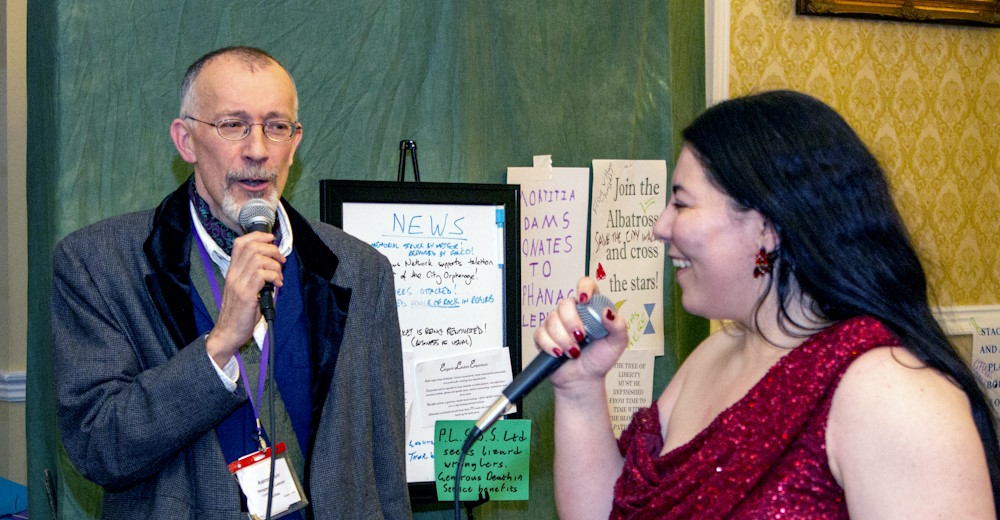
Earlier in February, I played in West End Lullaby, a weekend freeform for 77 players and is based on musicals such as Chess, Fiddler on the Roof, Cats, School of Rock, Our House, Bugsy Malone, Matilda, Les Miserables, Return to the Forbidden Planet, Starlight Express, Sister Act and many others.

I played Aaron Burr (from Hamilton), who has a side-order of Sam from Mama Mia! Essentially, Burr is a lawyer who is also one of the three fathers in Mama Mia!

This is rather long, so TLDR: It was great, I had a wonderful time. When can we do it again?

This and other photos of the game are by TsiJon Photography.

West End Lullaby was written by Matt Freeman, Hanbury Hampden-Turner, Ray Hodson, and Daniel Taylor (with additional material by Rei England, Simon Clark, and Kate Ashford). James Goodman and Mike Nudd helped as GMs. 

This will be my third musical freeform. Will I sing? The picture above suggests I did...

Oh yes, and an obligatory spoiler warning. I will talk about some plots – I’ll try not to give too much away!

Pre-game character summary

West End Lullaby had the best pre-game character summary I’ve seen. In addition to telling me who the character was, the GMs gave me what they thought my game would probably look like (so lawyerly stuff to begin with, easing more into politics and potentially a rivalry with Hamilton – and maybe a duel).

(In freeforming/larping circles, this is often called a casting “hint”. “Hint” never seemed the right term – this was a summary, not a clue or indirect indication.)

The GMs also provided costuming advice: “Characters come from across several hundred years of time, so other characters will be wearing anything from 18th-century formalwear to post-apocalypse glam rock. In keeping with the ‘musicals’ theme, conveying the emotional feel of the character is the most important thing.”

So I took the easy route and wore a frock coat I already had. (While I love the effect that costumes produce, I find costuming very stressful. My perfect costume would be for someone to say, “Here, Steve, wear this.”)

Character sheet

The full 20-page character sheet was issued later than some would have liked. I know that stressed some people out, but personally, that works fine for me. I’m used to reading character sheets at the last minute, so two weeks was still plenty.

There are often typos in character sheets, and these were no exception. None were awful; the worst was the omission of a key piece of information that could have been much worse for my game had I not realised. (As it was, I accidentally blabbed it to someone early on, but they were an ally anyway. And then I let the GMs know so they can correct it for the future.)

Rules

The rules arrived a few days after the character. I gave them a quick skim, knowing that I’d read them in more detail during the game when they would make more sense. The rules were mostly standard, but there were nice points I particularly liked:

Play to lift: Styles of Play covered playing to win and playing to lose (both fine) but emphasised playing to lift. Try to support other people’s visions of their character, letting them, in turn, support you. Try to roleplay in a way that encourages the players around you by accepting their view of their character. That’s probably a freeform (if not roleplaying) metarule. I know many people do that instinctively, but it was nice to see it in the rules.

Pickpocketing: Pickpocketing is divisive as it can ruin your game when someone steals that vital item you’ve been spending all game hunting for. West End Lullaby solved the problem by letting the victim decide what had been pickpocketed. So you could lose something trivial or just make something up. (And it was easy to get an item – just go to the market and buy something. I bought books and CDs and flowers.) That also meant the GMs weren’t involved – it could be handled entirely by the players.

Evidence: I liked the idea that all criminals left evidence cards with their names on them. (That includes pickpockets.) Arresting a suspect for a crime involved gathering enough evidence cards (severe crimes needed more evidence).

The evidence cards didn’t have to come from the same crime – it was all damning evidence. This might have been a bit strange, but from what I can see, worked out well in practice.

(One of many memorable moments was frustrating Inspector Javert (Alex) in arresting Dandy Dan (Nathan) for murder when I used my ability to point out inconsistencies with the evidence (which meant they needed more). I suspect Javert didn’t make the same mistake twice.)

Relationships: The relationship rules covered romance and were the “heart tasks” that many games have used. West End Lullaby brought interesting tweaks, though. 

  • You could write your own tasks to suit how your game is going. I love that flexibility.
  • The same approach (and often the same tasks) was used for other relationships – close friends, rivalries, etc.
  • You didn’t have to give tasks out – you could just track them and decide for yourself whether you fell in love or decided someone was a good friend (or rival). (I suggested this in an old post – maybe the GMs thought it was a good idea.)
  • Relationships weren’t exclusive – you could give your heart to more than one person (although it would have been nice to have different heart abilities for the different types of relationships.

As with most romance rules, you have a target number, and when that number is reached, you give someone your heart (which means sharing your game with them – and they get a neat ability).

So how was my game?

But enough of the rules, how was the game?

In short, awesome. And tiring.

Aaron Burr, sir?

It was lovely being so well known in song. Many people started their conversation with me with “Aaron Burr, sir?” I never stopped enjoying it (although, ironically, I don’t really like the song).

Important lawyerly business with Dandy Dan

As a respected lawyer, I got involved in lots of stuff. Some examples.

  • I served papers on Bill Snibson (Simon)
  • One character (Tony) asked me to certify them as legally dead. In the next session, someone else (sorry, I forget who) approached me and started to explain the other side of the story. For a moment, I thought there was a conflict of interest until I realised that I could simply give them a copy of the death certificate.
  • I successfully defended Paula Gill (Victoria) from a breach of contract lawsuit. The contract may have been very one-sided, but it had been signed by all the parties and had been legally fulfilled, and the judge agreed with me. (Unfortunately, Hamilton (Jon) was supposed to be on the other side but was unfortunately held up and missed it – I was annoyed for Jon, but there were so many timetabled events we couldn’t wait too long.)
  • I wrote a couple of wills, including Jean Valjean’s (Ezzy).
  • Stacee Jaxx (Graham) and Penny Vandergelder (Elyssia) approached me to assign the ownership of the Stacee Jaxx name to Penny. For that, I needed Graham to sign their character’s real name. They were unsure about that. “We have to trust someone,” said Penny. So Stacy told me. I looked up and shrugged – I had no idea who [name redacted] was.
  • Helping Gomez Addams (Rich) with his financial planning.

I also trained a new lawyer, Sarah Wyre (Kat), to whom I would direct players when I couldn’t help them (sometimes due to a conflict of interest, often because I was busy). Sarah said she was grateful that I sent her extra work, but also could I stop because she was getting so busy.

The Room Where It Happens

If the GMs had a planned arc for Aaron Burr, it was for him to become more influential by becoming a city councillor and maybe even Mayor. 

Becoming a city councillor turned out to be fairly easy. Between the Friday night and Saturday morning sessions, I re-read the character book and the rules. (I find everything makes more sense once I’ve started playing.) And I discovered there were two spare places on the council – these hadn’t been explicitly stated in the rules (or my character sheet), and I felt like I’d done my own legal legwork.

Not all council meetings were this dull...
(With Maria and Sir John Tremayne (Chris) and Horace and "Fat Sam" Stacetto (Mike) in the background.)

So I started the Saturday morning session by asking my friend Jean Valjean (Ezzy) to propose me to the council. I also sounded out Mayor Falco (Nick) and other councillors. To my surprise, Maria, Duchess of Dene (Lisa), wasn’t against my selection – despite my betrayal of her love 20 years earlier. And so I joined the city council – followed by Hamilton, who took the other vacancy.

I decided not to run for mayor. I had so much on that I didn’t need to be any busier, and when I saw that the wonderful Mrs Blitzstein (Janet) was standing, I correctly guessed that she would win.

One thing that didn’t happen was a rivalry with Hamilton. We barely saw each other for much of the game. I had a chat with Jon (who played Hamilton) before the game, and we agreed that we’d see how the relationship/rivalry played out. But I was so busy I didn’t have time or energy to put anything into the rivalry, and I don’t think he did either. And in our game, there wasn’t anything to be rivals over. (Maybe if I was a fan of the musical, things may have been different.)

Mamma Mia!

The other half of my game was all about the romance. Aaron Burr played one of the three dads from Mamma Mia! As per the musical, Sophie (Natalie) had invited me and the other potential dads to her wedding. And unfortunately, her mother Donna (Sarah), had never forgiven me for a terrible misunderstanding all those years ago. But Aaron had never forgotten Donna and wanted to mend the broken relationship. But did she want him?

While Sarah (who played Donna) had played in some big larps in Europe, West End Lullaby was her first weekend freeform. One week beforehand, she gamely stepped in when the original player dropped out. On short notice, Sarah did a fantastic job.

As I didn’t know Sarah, it was hard to judge how to play mending the broken relationship. I took it slowly – but I never really knew what Donna was thinking. Even when I finally proposed on Sunday morning, I still didn’t know if she would say yes or not. (She did!)

Sarah told me she was taken by surprise by my proposal. I suggested that had she played in one of these games before, she would have seen the arc from a mile off and known it was coming.

The romance mechanic: Curiously, if we stuck to the mechanics, it was almost impossible for Donna to win Aaron’s heart. First, his heart score seemed high (8), and second, the suggested relationship tasks weren’t very Donna-friendly (debate politics, ask me to be your second in a duel, enlist my help in a difficult court case, etc). So I created lots of new ones: Be Donna, accept my gift, dance with me, and so on.

Aaron Burr's romance tasks...

(I find that romance mechanics are often better thought of as guidelines rather than strict rules.)

The three dads

As for the other two dads, one kept a low profile. When I found out who they were and we spoke, they wished me luck with Donna. The other was the charming and wonderfully over-the-top Count Fosco (Paul). He had his own romantic plot but delighted in flirting with Donna in front of me.

As for who the actual father was – Sophie tore the DNA test results up at her wedding, so we never found out.

Actually a double wedding - Sophie bullied myself and Donna into getting married as well.
(The Mother Superior (Ingrid) marries Sophy to Bugsy Malone (Ewan), and me to Donna, while Dennis Dupree (Haven) looks on.)

Other highlights

New faces: While it was lovely to see old friends, it was also lovely to meet new faces. Four of my close contacts (Donna, Sarah Wyre, the Duchess of Dene and Jean Valjean) were played by people who hadn’t played a weekend freeform before, and I didn’t know any of them. I hope they enjoyed themselves and that we’ll see them again.

Singing "You're the One That I Want" with Donna

Singing: I sang “You’re the One That I Want” (from Grease) with Donna, which was nerve-wracking and exhilarating. Friends came up to me afterwards, surprised that I’d sung. (We sang that late on Saturday night. Afterwards, I wished I had sung Abba’s “SOS” to Donna on Friday evening. But I wasn’t feeling confident enough then.)

The war case: I helped Dolly Levi (Alison) with her investigation into General Stanley’s war record. Well, I say I helped – she did most of the work and told me how it was going. But I enjoyed being part of the investigation.

The Casey Street Market negotiations: I was heavily involved in the Casey Street Market negotiations, which involved Mayor Falco (Nick), Patty Klineman (Clare), William Pressman (Ben), Horace Vandergelder (Kevin) and the stall holders themselves. The end result may not have satisfied the developers, but it felt right.

The Battle of the Bands: I spent a large part of Saturday evening watching the music contest – it was so good, everyone threw themselves into it.

I’ve only scratched the surface; there was so much more I wasn’t involved with. Mad science, space and rockets, superheroes, time travel, crazy fire newts, chess tournaments, and so much more. It would be an easy game to play again – so maybe in a few years, when the GMs have forgotten how stressful it can be, they will run it again.

A final thank you

So, as I hope you can tell, I really enjoyed West End Lullaby. I had a wonderful, exhilarating time. It was great seeing old friends and making new ones.

So thank you to the writers and GMs and players and everyone who made it so wonderful. Let’s do it all again soon!


Monday, 5 February 2024

Traveller: Cargo and freight

This is my fifth and, for now, final post musing about some of Traveller’s quirks.

Last time, I worked out that if Rethe/Regina imports all its food, then it needs 4.8 million displacement tons of red kibble every week, shipped from nearby Inthe. (This is standard Adam Smith free market economics - focus on what you're good to buy what you're not so good at. So Rethe, being a densely-populated world, produces something (although it's not clear what) and buys in food and other things.)

Assuming that's what it does, I’m going to think about logistics. (Well, some of them – I don’t work in logistics, so of course I’ve overlooked something.)

The problem

We must transport 4.8 million tonnes of red kibble from Inthe to Rethe, every week.

It’s a two-parsec jump, so we could use 200-ton Far Traders. Except that, as I have already calculated, we’d need about 75,000 of them. Every week.

We’re going to need a bigger boat.

How about the 200,000-ton Galika Megula, the largest freighter in Mongoose’s High Guard? Well, with a cargo of over 136,000 tons, Rethe still needs 56 of them, every week.

So let’s go even bigger.

Lego container ship on Flickr

Container shipping

I’m reading The Box: How the Shipping Container Made the World Smaller and the World Economy Bigger by Marc Levinson and a few things struck me.

  • One, the shipping container is relatively new, and I’m not surprised that the paradigm of ruthlessly efficient freight isn’t part of Traveller’s DNA. 
  • Traveller’s vision of merchant shipping has a 1950s vibe about it, with non-standard freight sizes, loading and unloading on site. It looks nothing like today’s container shipping. (As I’ve been reminded, a core foundation for Traveller is EC Tubb’s Dumarest saga. That was first published in the 1960s, when container shipping was just getting started. I don’t know whether Traveller’s trading rules reflect the Dumarest saga, but if they do, I suspect it’s because EC Tubb was writing about the merchant shipping world he knew about. He may not have known of the coming freight revolution.)
  • Container shipping is much more efficient than its predecessor. It means that merchant ships spend much more time at sea earning money (rather than sitting at the docks being loaded and unloaded), drastically cutting the cost of freight.

Traveller’s ships really don’t carry much cargo - not compared to what a world like Rethe needs. While Traveller’s ships are ideal for adventuring, they’re not terribly practical if you need to feed a world.

Instead, we need ruthless efficiency!

Feeding Rethe

As I’ve said, Rethe needs to import 4.8 million tonnes of red kibble every single week. It needs to be efficient and reliable.

Here’s my idea of how it would work.

Build a fleet of truly massive merchant ships, each able to transport 1.2 million displacement tons of cargo. So four a week would solve our shipping problem. (Of course, four a week probably still means a fleet of about twenty ships, allowing for return journeys, stopover time and maintenance.)

To speed up cargo delivery, the cargo holds are constructed as six huge demountable pods. The pods are streamlined, and massive tractors transport them between the starport (or wherever they are loaded) and the cargo ships. 

The pods are huge: 205,000 tons. If they were boxes, they’d be about 300 x 100 x 100 m in size. (For comparison, a Lightning Class Cruiser is only 60,000 tons.)

The spine of the ship (little more than a massive jump drive – and over a kilometre long) is not streamlined. It just travels back and forth between Rethe and Inthe. A round trip looks like this:

Arrive at Inthe

Travel to the highport. Detach cargo pods from Rethe containing whatever it is that Rethe exports. Attach cargo pods filled to the brim with red kibble. While cargo is unloaded and loaded, refuel and refresh crew and supplies as necessary. Travel to jump point and jump.

Arrive at Rethe

Travel to the highport. Detach cargo pods from Inthe containing the red kibble. Attach cargo pods filled to the brim with exports. While cargo is unloaded and loaded, refuel and refresh crew and supplies as necessary. Travel to jump point and jump.

Rinse and repeat. Endlessly.

(I’m assuming that Rethe has highports. I know that with a Class E starport, it shouldn’t have highports. I question the canon in this post.)

Let’s build a megafreighter!

So here’s the Titan-class megafreighter. I’ve designed this using High Guard and a spreadsheet. I may have made mistakes, but hopefully not big ones. 

We’ll start with the cargo pods.

205,000 ton demountable, streamlined cargo pod

  • Breakaway components: 4,100 tons
  • Cargo space: 200,900 tons.
  • Cost: 10,455 Mcr

I imagine these attached to the Titan’s spine in two groups of three pods, the pods in each group spaced equally around the Titan’s spindly hull.

1,830,000 ton Titan-class megafreighter

The total tonnage is made up of:

  • A 1,830,000-ton dispersed breakaway hull. (TL 12)
  • Six 205,000-ton cargo pods
  • Manoeuvre-1 (18,300 tons)
  • Jump-2 (91,505 tons)
  • Power plant (61,000 tons, generating 915,000 power units at TL12)
  • Fuel: 494,100 tons (for four weeks of operation and one jump-2)
  • Bridge (500 tons – this is an overestimate)
  • Computer/20
  • Sensors (civilian – 1 ton)
  • Crew 2051 (one captain, one pilot, one astrogator, 1690 engineers, 198 mechanics, 99 administrators, 26 sensor operators, 16 medics, 98 officers). That’s a lot of crew – I’m going to come back to that.
  • Staterooms: 2051 (8204 tons)
  • Other cargo 11,790 tons (this is spare tonnage – could be used for living areas for the crew).

And it costs a fortune – I didn’t price it out, but it’s not cheap.

Crew

But over two thousand crew? That seems … a lot.

If your assumption about starships is that they are masters of their own destiny, travelling from system to system in whichever direction their owner’s whimsy takes them, then having a huge crew to deal with any issues makes sense.

But if you are just going backwards and forwards between two systems? Do you really need nearly 1900 mechanics and engineers, nearly 100 administrators, 26 sensor operators, and 100 managers (officers)?

That seems overkill. And expensive.

As far as the engineers and mechanics go, how much can go wrong that can’t wait a few days? I would imagine that 90% of issues wouldn’t be a problem during jump and can wait until the ship has arrived and the local engineering team can fix it. (Or, if it’s a longer job but can be completed in jump, then the ship jumps while the work is underway.)

I haven’t changed the crew requirements for the Titan, but I know the company bean counters will want to make everything as efficient as possible, and I’m sure they’ll be checking that everybody is adding value. If the Titan is as reliable as I like to think, I expect the headcount will be reduced.

Variants

The Titan is a big ship. Is there any way of making it more efficient?

M-Drives: Removing the M-Drives saves 18,300 tons in the drives themselves, with a proportionate saving elsewhere (crew, power and jump requirements and so on). Is that an option, assuming the operators use tugs at each end? If you operate the same jump route for decades, how accurate are your exit and entry points?

(As for jump masking, I imagine positioning the tugs (and maybe other facilities) to allow for jump masking – much as today’s mariners account for the tides.)

Drop tanks: Using drop tanks saves over 360,000 tons (giving savings elsewhere, such as crew and so on). However, drop tanks are expensive and often don’t survive the experience. Given the potential savings, I would expect part of the R&D budget to revisit the question of drop tanks. (I’ve wondered about this in a previous post.)

Modular fuel tanks: I imagine it takes a fair bit of time to refuel a ship with nearly half a million tons of liquid hydrogen. Even if drop tanks aren’t an option, I can imagine using modular fuel tanks that can be filled up in advance and attached along with the cargo pods to minimise the time between jumps.

Move operations to Paya: As I noted before, Paya/Aramis would be a better source of red kibble than Inthe, as it’s closer. Requiring only a one-parsec jump, the Titan is significantly smaller – not just saving over 240,000 tons in fuel, but also making the rest of the ship smaller as well. With four ships arriving every week, that’s a weekly saving of 480 million credits (around 25 trillion credits a year). It wouldn’t be long before moving operations to Paya would pay off.

And everything else…

And all this is just for importing the red kibble. Alongside this, there will need to be vast amounts of infrastructure, including:

  • Enormous fuel processing stations
  • Fleets of cargo pod tugs to get the kibble in and out of orbit
  • Massive distribution systems to get the kibble to hungry mouths
  • Water processing to ensure that kibble can be rehydrated
  • Maintenance and spacedocks
  • Accommodation for all the workers
  • Loading and unloading of other goods – there’s more to life than just red kibble
  • Passengers – arrivals and departures
  • Administration and paperwork
  • System defences to protect against piracy

I haven’t considered any of these – just thinking about importing millions of tons of red kibble has been quite an exercise.

But this is the kind of far future I like: vast megafreighters, billions living in space cities, and a vibrant interstellar economy.

That’s it for now

And that’s it for now.

I’m sure I’ll have some other grumbles about Traveller, but it’s time to leave the Third Imperium in peace for a while.

Monday, 29 January 2024

Traveller: Feeding Rethe

This is the fourth part in a short series mulling over various quirks of Traveller’s Third Imperium background. Part one considered how hazardous low berths are, part two wondered about jump drive fuel tanks, and part three considered Rethe, a Mars-sized desert world where 26 billion people live.

This time, how to feed everyone on Rethe.

Rethe

A quick recap from last time. Rethe (E430AA8 8 Poor. Non-agricultural. Desert World.) is the most populous world in the Regina subsector. (I noted last time that Rethe had grown - apparently that was following the T5 Second Survey, which increased “the size of worlds with thin or better atmospheres to match the physics that small worlds can't hold atmospheres”. So I’ll stick to canon from here on.) There’s barely any air (very thin – respirators needed) and no water.

Yet somehow, 26 billion people (mostly humans) live there.

How do we feed Rethe?

How many calories do we need? (I’m just going to concentrate on calories (kcals), in this post. I’m not going to complicate it by thinking about individual nutrients or factors such as processing.)

On average, humans need about 2,200 kcals a day. Men need slightly more, women slightly less, but we’ll use 2,200.

26 billion people, therefore, need 57 trillion kcals each day. Which is 400 trillion kcals a week, or 21 quadrillion kcals a year.

Where is all that energy coming from?

Homegrown

So let’s assume that everything is grown on Rethe (or in-system somewhere), all 21 quadrillion kcals. How much land is needed?

According to Our World in Data, the most efficient use of land is to grow maize. 0.65m2 of maize will create 1000 kcals. (I’m pretty sure that’s an annual yield and is based on an average of numerous real-life studies, so it includes an allowance for variation in yields due to the soil, weather, nutrients and so on. There may be other foods that are more efficient - I haven't made an exhaustive search, but maize provides a sense of the scale of the challenge.)

So a single km2 of maize generates about 1.5 billion kcals, which is a lot. But not enough, not by a long shot. To feed Rethe, we need 13.5 million km2.

That’s roughly the surface area of China and India combined.

Or imagine the sheer grandeur and majesty of the orbital hydroponic farms. They’re huuuge!

Endless fields of maize

And that’s just the area of maize. It doesn’t allow for space for planting, watering, weeding, packaging and harvesting. It assumes the soil is rich Earth-like.

It also assumes that the 26 billion people of Rethe are happy with a maize-only diet. If they wanted a more varied diet (maybe some spuds to go with their corn on the cob), then that would take up more room. (Although given Traveller is an SF game, I assume other delicious plants are available in the Third Imperium that take up no more room than maize.)

Given that Rethe is a desert world with a very thin atmosphere (maybe like the Tibetan plateau, but drier) at TL 8, perhaps we’d better import the food.

Imported food

So let’s import some food: red kibble.

Delicious red kibble

For the sake of this exercise, let’s assume red kibble is a dehydrated nutritious (if not delicious) foodstuff with an energy density of 1200 kcals per 100g. To compare, 100g of salted peanuts contain about 600 kcals, so I’m probably being generous. But it’s the far future, so let’s go with it.

So 1 kg of red kibble contains 12,000 kcals.

We now need to turn that into a volume. We’ll assume that 1 kg of red kibble occupies 2 litres – or 1 cubic metre weighs 500kg. (To compare, according to this website, 1 litre of peanuts weighs 0.62kg, so I don’t think I’m far out, given this is fictional anyway.)

The volume of each displacement ton is 14 m3, which is 7,000 kg of red kibble. That means each ton contains 84 million kcals. (I’m ignoring packaging.)

How many Far Traders?

A Far Trader has a 63-ton cargo bay, which, if filled with red kibble, can provide 5.3 billion kcals.

However, feeding Rethe for just a week requires 400 trillion kcals, and you would need a fleet of over 75,000 Far Traders. Arriving every week.

Another way of looking at it is that Rethe needs 4.8 million displacement tons of red kibble every week, without fail, not to starve.

But let’s put aside the logistics of delivering nearly five million displacement tons of red kibble every week and think about where it’s coming from.

Sourcing red kibble: local systems

Luckily, within two parsecs of Rethe we have three potential food suppliers: Paya, Focaline, and Inthe. (And all the systems have gas giants, which is fortunate as we need a lot of fuel.)

Paya A655241-9

Paya is the closest and has an A-class starport. It looks the most promising – it’s a reasonable-sized world with 50% hydrographics. The wiki describes it as “a garden world.”

However, Paya has fewer than 1000 people living on it (600, according to the wiki).

I’d like to think that Paya has vast robotic farms churning out red kibble, but as it's not classified as an agricultural world (too few inhabitants), I guess that’s not the case. Perhaps the soil isn’t great.

Focaline EA88544-7

According to the wiki, “Focaline is an agricultural world with an ideal environment for producing food from plants, animals, or other forms.”

There’s just one problem – it only has an E-class starport. Even if it could make five million displacement tons of red kibble every week, it can’t get them easily into orbit.

Inthe B575776-9

Inthe is “an agricultural world with a tainted atmosphere but still a near-ideal environment for producing foodstuffs.” So that’s just what we need. Phew!

It has a decent starport and is big and fertile enough (and not too populated – tens of millions) to provide all the red kibble Rethe needs.

The influence of nearby worlds

This shows one downside of Traveller’s planetary creation system: it’s completely random, with no recognition of nearby worlds. Of course, a world’s physical characteristics should be independent of its neighbours – but in the Third Imperium, I would expect the social characteristics (population, government, law level, tech level, starport type) of nearby worlds to influence others.

In Focaline’s case, if it was a wonderful source of red kibble, then I would expect Rethe to invest in a good starport and have shipped millions of workers over (making barely a dent in Rethe’s population but boosting Focaline’s massively) to make sure the red kibble flows uninterrupted.

But as Focaline only has an E-class starport, then perhaps it’s not fertile after all.

(And the same could be said for Paya. If it’s that great at growing things, why doesn’t someone invest in automated farms and a workforce? There's a ready market one parsec away!)

But at least we have a source for our red kibble: Inthe.

In "reality", I would expect Rethe to import food from all three worlds (and elsewhere). But let's go with Inthe for now.

Next time

Next time, I think about cargo and how to ship all that red kibble, and I might even build a megafreighter.

Update: other sources of food 

I posted this link to Reddit and Facebook and it has provoked some lively and interesting discussion. So I thought I’d capture my responses here.

Soylent Green

A few people have talked about eating the dead. Assuming the cultural implications are easily overcome, there is a bigger problem - corpses don't provide enough kcals.

According to Wikipedia roughly 150,000 people currently die each day here on Earth. Rethe has a population 3x Earth's, so that's 450,000 people every day (or about 170 million people a year). Searching around, the most generous reports are that there are about 150,000 kcals in a human body (my search history is... odd). That means cannibalisation only provides 66 billion kcals a day - and Rethe needs 57 trillion! So way less than 1% of the total calories needed.

Underground hydroponic farms

What about underground farms? This place grows salad crops, which famously aren't energy dense. But it's the far future, so let's make some assumptions that a good, calorie-dense crop can be farmed using underground hydroponics.

Let's assume it's twice as effective as maize, grown on Earth, and 1000 kcals needs only 0.325m2 per year.

This shrinks the area needed to "only" 7 million km2.

But wait, we can stack the units! Let's say we stack them in 10 units high. That gives us 700,000 km2. How big is that? Well, that's a little more than the surface area of France.

Except that we probably need to add 50% onto the area to allow for access for maintenance, cropping and so on. That gives us a little over 1 million km2 - so we have to add Germany as well.

So that's indoor farms with hydroponic beds stacked 10 rows high, the size of Germany and France combined. (Obviously, it's not one farm, but hundreds of thousands of them.)

But what about water?

So far I’ve assumed that water is available on Rethe – either in ice or available via comets. How much water do these underground hydroponic farms need?

This article here suggests that a hydroponics system requires 5-7 litres per day per m2. Let's be generous and assume our miracle food only requires 4 litres per day per m2.

I imagine Rethe is good at recycling its water and recovers 90%. How much more does it need?

With 7 million km2 needing water, this means a daily requirement of 4 x 7,000,000 (km2) x 1,000,000 (m2 in a km2) x 50% (recycled) or 2.8 trillion m3 of water per day. Which is a cube of water 1.4 km on each side - every day. (And this is on top of the water needed for drinking/washing/cleaning/sewage/industry and everything else.) On a desert world.

It's that last bit that I struggle with. A desert world. While I imagine Rethe does grow some food, I would imagine much of it is imported.

Next time: Next time, I look at how to import enough food to feed Rethe.

Update August 2024

Over on Unchartered Territories (here and here), Thomas Pueyo considers vertical farming in detail – and it looks like vertical farming is what Rethe needs. (The limitations that hold back vertical farming here on Earth don’t apply to Rethe – Rethe doesn’t have the luxury of a surfeit of good arable land for crops. And power isn’t an issue, assuming cheap fusion power.)

According to the article, vertical farming promises up to 200x improvements in land area compared to regular farming. 200x sounds rather like marketing hyperbole, but it’s the far future, so let’s go with it. That means we ‘only’ need about 67,500 km2 of vertical farms, which is a little smaller than Scotland. This is still huge, but much more manageable.

Also, over on my post where I talk about Biospheres, Father Fletch pointed me to this discussion about food on Freelance Traveller.

Monday, 22 January 2024

Traveller: Rethe and the perils of random world generation

This is my third post on some of Traveller’s illogicalities. Don’t get me wrong, I love the Traveller background (the Third Imperium) – it was my first RPG, as I’ve said before. But that doesn’t mean it’s perfect.

Earlier posts covered low berths and starship fuel tanks.

World creation

Traveller has a procedure for creating worlds. Roll dice, work through the steps and out pops a world at the end of the process.

This can produce weird results – but if you’re doing this yourself, you can either tweak the results so they make more sense or justify those results.

However, the Traveller canon has several books full of systems, most famously the Spinward Marches (Supplement 3), where most of the original Traveller adventures were set. I imagine a computer was used to create the hundreds of systems in the Spinward Marches – and as a result, some worlds are a little crazy.

Such as Rethe, in the Regina subsector.

Rethe

Rethe on the wonderful Traveller Map

According to page 150 of The Traveller Book, Rethe has a population of 26 billion, the highest in the Regina subsector.

According to the Traveller wiki, that’s now either 30 billion (if you hover over the UWP) or is “over one billion” and “in the last 25 years has grown by well over six billion” (according to the text, at time of writing). I’ll stick with The Traveller Book for the rest of this post.

Reth’s UWP (Universal World Profile) is E230AA8 8 Poor. Non-agricultural. Desert World.

Let’s break that down:

  • Starport E (Frontier installation – a patch of bedrock with no facilities.)
  • Size 2 (3,200 km in diameter, roughly – about the size of the moon. But see below.)
  • Atmosphere 3 (Very thin, needing a respirator.)
  • Hydrographics 0 (No freestanding water – like the moon. Maybe some ice.)
  • Population A (Tens of billions – 26 billion, according to The Traveller Book.)
  • Government A (A charismatic dictator.)
  • Law level 8 (Guns and long-bladed weapons are controlled – a bit like the UK.)
  • Tech level 8 (Laser carbines and air rafts – according to The Traveller Book, this equates to 1980-1989 on Earth!)
  • Poor: Any world with an atmosphere of 2-5 and hydrographics 3- is automatically poor. I’m not sure this makes sense.
  • Non-agricultural: Worlds with an atmosphere 3-, hydrographics 3- and population 6+ are non-agricultural.
  • Desert world: Hydrographics 0 and atmosphere 2+. (Mongoose's Core Rulebook describes Desert worlds as "barely habitable".)

How big?

According to the Traveller map and the wiki, Rethe is size 4 or 6,400km in diameter. That makes it slightly smaller than Mars – according to the wiki, Mars and Rethe have the same physical characteristics (430).

I’m not sure why it changed, and it doesn’t change my argument about Rethe’s inhospitality, but I’m sticking with The Traveller Book for the rest of this post.

But what does all this mean?

So, let’s talk about the obvious outlier – a population of 26 billion people. On the moon (or Mars). At tech level 8 and with no starport to speak of.

Really?

Imagine 26 billion people living on the moon. Thanks to the very thin atmosphere, they must live indoors – in massive cities/archologies or orbital settlements. (The wiki mentions orbital habitats.)

But what’s it like? Is Rethe futuristic and grand, like Coruscant in Star Wars? Or is it shabby, overcrowded and awful, like Ceres in The Expanse?

Why Rethe?

Why are there 26 billion people on Rethe? What makes it so attractive?

According to the Regina subsector page on the Traveller wiki, Rethe’s population is mostly human. (It doesn’t explicitly say that, but you can work it out from the numbers in the sophont population table.) And humans didn’t evolve on Rethe – they went there.

(And it’s more plausible to say that there are 26 billion people in the Rethe system, but Rethe itself is the most important world, and most people are there.)

It seems likely that Rethe is rich in lanthanum, Zuchai crystals, unobtanium, anti-matter, dark matter, or other exotic minerals. (Being rich in heavy metals would help it retain its thin atmosphere rather than being airless like our moon.) Something that has drawn billions of people to Rethe to seek their fortune (either by mining or servicing the mining industry, or by servicing those servicing the mining industry).

Rethe needs to export something valuable – because it must import food and other essential resources. (I imagine it can find ice, and therefore water, in the system somewhere.)

If it doesn’t import anything, it starves. And if it doesn’t export anything, it can’t pay for its imports, so it starves. So, assuming that the population of Rethe isn’t starving, it must be doing brisk trade with nearby worlds.

The Traveller wiki notes that “Since it was colonized, the world has been a backwater, with the population producing just enough to support the cost of life support.” That doesn’t sound like a rich, prosperous world – but “just enough to support the cost of life support” for 26 billion people means that Rethe is producing an awful lot of something.

E class starport?

But how can Rethe trade when it only has a class E starport?

Maybe if Rethe was in a lightly populated part of space, then you justify not having a starport. There could be a garden world somewhere in the system and lots of in-system trade, but no actual starport. (Although why Rethe is the main world and not this lovely garden world then needs further justification.)

But Rethe isn’t remote – it’s on a branch of the Spinward Main, a long chain of systems just one parsec from each other.

Giving Rethe a Class E starport is like imagining New York without ports, stations, airports or roads – and only a single-track highway to get there. It’s hard to imagine – it doesn’t make sense.

So Rethe needs an enormous starport (or starports) filled with bulk carriers. They bring in supplies and take out whatever it is that Rethe exports. It must be Class B at least – and probably Class A.

(The Traveller Wiki suggests that Rethe originally had a Class B starport, but for unspecified reasons, it was downgraded.)

And tech level 8?

How can Rethe be only tech level 8? The Traveller Book hasn’t dated well (it tells us that TL8 is the technology of the 1980s), but Mongoose Traveller says that at TL 8, “permanent space habitats become possible”. Possible.

Rethe needs better than “possible,” given it has 26 billion people living in what are effectively permanent space habitats. (It might have an atmosphere, but it’s not breathable. And there’s no water - and that means no food.) At TL10, “orbital habitats and factories become commonplace”, which suggests that Rethe needs to be TL10 at least.

But perhaps there has been a war. That would explain the Class E starport and the (relatively) low tech level. But a war also suggests a huge humanitarian crisis that the subsector (if not the sector) should be mobilising to fix. But such a war or crisis isn't mentioned anywhere (The Traveller Book's library data for Rethe just mentions an annual festival.)

Canonically, I think the date of The Traveller Book is 1105. The Traveller wiki entry for Rethe says that it is Milieu 1116, which covers the period from 1100 to 1117. Seventeen years is a long time for 26 billion people on a desert world not to have a decent starport, and according to the wiki, Rethe is still  TL 8 Class E (although rebuilding back to Class B).

But that’s one of the challenges of canon – having the background (particularly one as vast as the Third Imperium) evolve. Peculiarities such as Rethe are almost inevitable.

How likely is Rethe anyway?

I recreated the rolls that made Rethe from The Traveller Book. The rolls were:

  • Starport (2D): 10 or 11, for an E class starport
  • Size (2D-2): 4, for size 2
  • Atmosphere (2D-7+size): 8, for atmosphere 3
  • Hydrographics (2D-7+atmosphere): 2, 3 or 4 for hydrographics 0
  • Population (2D-2): 12 for A
  • Government (2D-7+population): 7 for government A
  • Law level (2D-7+government): 6 for law level 9
  • Tech level (1D +1 (for size 2) +1 (for atmosphere 3) +4 (for population A)): 2 to get tech level 8.

With only a few extreme rolls, it’s not surprising that a world like Rethe appears somewhere – probably more than once.

Rethe is a little less likely with Mongoose’s core rules because the starport roll comes after the law level roll and is modified by population (+2 for a population of 10+). An E-class starport is still possible, but you’d have to roll 2. But a roll of 10 or 11 (as per the original roll for a starport) would have given Rethe an A-class starport.

And an A-class starport gives Rethe an extra +6 modifier on the tech level roll (and +1 for 0% hydrographics, which isn’t in The Traveller Book). So that’s a total DM of +13, which gives us TL 15 if we take the original result of 2.

So, a Class A starport and TL 15. It’s more like Coruscant, and the only question is why Regina is the sector capital rather than Rethe.

What I’d change

I’m not doing this to poke fun at Traveller – I’m just pointing out some illogicalities that can arise when you randomly create systems using a formula. Rethe isn’t particularly unusual – some of the rolls were at the extreme ends of the bell curve (but even then, only one 12), but if you roll up a lot of worlds, it will happen sooner or later.

So if I were to change anything, I would ensure high populations on worlds that can’t support themselves were at least TL 10 with a good starport. Or maybe a common-sense check before committing the system to the canon.

Next time

Next time, I look at how to feed Rethe.

Monday, 15 January 2024

Traveller: Why do starships have internal fuel tanks?

Last time, I mused over the lethality of Traveller’s low berths. This time, I’m grumbling about starship fuel tanks.

Jump drives

Back in 1981, when I first read Traveller’s little black books, I didn’t fully understand how jump drives worked. I imagined they were like the hyperdrives in Star Wars – and were used throughout to keep the ship in jump space.

Except they don’t work like that.

I realised something was amiss with my concept when I got my hands on Supplement 7: Traders and Gunboats and, in particular, the Gazelle class Close Escort.

The Gazelle class Close Escort

The Gazelle then: From Traders and Gunboats

The Gazelle included a new feature: drop tanks.

“The L-Hyd Tanks: The close escort carries a large fraction of its fuel in droppable tanks mounted longitudinally. With the tanks attached, the ship is capable of jump 4 and 4-G acceleration. When the tanks are dropped, the ship burns the fuel and can achieve jump. Once the tanks are dropped, they must be replaced at a starport or naval base; until they are replaced, the ship is capable of 5-G acceleration, but only jump-2 (due to lack of sufficient fuel capacity).”

This crashed up against my assumptions, and it took me a while to work out what this actually meant: jump drives spent all their fuel before entering jump. And then they could drop their tanks, which is important because, in Traveller, a ship’s volume (measured in, er, tonnage – more on that below) determines how far it can jump.

This was the first time I had seen this. It wasn’t in my little black books, and it wasn’t in The Traveller Book.

It’s not even particularly clear in Mongoose’s latest rules.

The Gazelle now: From High Guard (2022 update)

Core Book 2022 Update

While providing a much clearer explanation of what’s going on during jump, Mongoose’s Core Rulebook Update 2022 doesn’t clearly say that jump drive fuel is consumed to create the jump bubble before entering jumpspace.

And the amount of fuel spent creating the bubble is 10% of the ship’s tonnage x the distance jumped, in parsecs. (While this is implied, I don’t think I’ve seen it in the core rules, although I may have missed it. It’s covered in the Traveller wiki.)

Why is this important?

Because in a world where tonnage is money, why would you ever have internal fuel tanks for your jump drive? Once you enter the jump bubble, those tanks are empty…

In fact, for most ships, the J-drive fuel tanks are empty for most of its life. You normally only need to fill them when you’re about to make a jump – otherwise, it is best to keep them empty.

The cost of an empty fuel tank

So, if we look at a humble 200-ton (or rather, 2,800 m3 volume) Free Trader, its jump-1 drive requires 20 tons of fuel. If a Free Trader had droppable fuel tanks, those 20 tons could be turned into cargo space which would be potentially an extra Cr 20,000 every trip (assuming it was filled with standard cargo).

Why wouldn’t you do that?

Now, drop tanks may only work in civilized places – perhaps only at class A and B starports or where there is a steady trade. I can imagine renting standard drop tanks much in the way you’d rent a skip today. (So that will eat into that Cr 20,000.)

And you might want internal fuel tanks if you didn’t know whether you would be able to refuel at the other end. However, most Traveller ships don’t have the fuel capacity for more than one jump, and the assumption is that fuel is pretty easy to get.

Are there other options?

Alternative fuel tanks

High Guard gives us more options for fuel tanks:

Collapsible fuel tanks: A huge bladder that sits in the cargo space and can be filled (and emptied) with fuel as needed. It's a good idea, but there’s no time to use the cargo space productively between forming the jump bubble and entering jumpspace.

Collapsible fuel tank from High Guard

Drop tanks: As fitted on the Gazelle Close Escort, above. However, they bring a penalty to the jump drive roll, and the tanks themselves have a less than 50% chance of surviving the experience. (I find it odd that they aren’t more reliable – I imagine Toyota kaizen-ing the hell out of these and making them safe and reliable and cornering the market as a result.)

Fuel/Cargo container: Allows fuel to be stored in unused parts of a ship.

Mountable tanks: Fixed tanks that convert cargo space into fuel tanks, and as far as I can see, have no benefit over a collapsible fuel tank. (Well, they take up less space than a fuel bladder, but you’ve lost the use of your cargo space.)

None of these are ideal – they either use up precious cargo space or aren’t particularly reliable.

My solution: collapsible external fuel tanks

Collapsible external fuel tanks

Why not fit those fuel bladders on the outside of a ship? That way, when the fuel is used up, the bladder collapses and preserves the ship’s precious volume. And it can be reused time and time again.

Collapsible external tanks will affect a ship’s streamlining – although I can imagine blisters on the hull that conceal the tank (but at a cost – maybe 2% of the fuel tank tonnage) and protect the ship’s streamlining.

Implications

The real problem with this is that it invalidates almost all the Traveller ship design assumptions since 1977. Ships should have more cargo space and less fuel space. You might still want internal fuel tanks for some situations, particularly if you need an armoured hull, but most ships would have external fuel bladders.

Footnote: Traveller tonnage

Traveller tonnage is a bit weird. Ships are measured in displacement tonnage, which is actually a measure of volume (equivalent to the volume of liquid hydrogen displaced, measured in tons – so one displacement ton is 14 m2).

I can see how this works for jump drives – the J-drive needs to create a jump bubble big enough to take the ship. So volume is important.

But for manoeuvre drives? I would have thought that a ship’s mass was more important than its volume for an M-drive. So, is a ship more agile with its fuel tanks empty? Apparently not – but maybe that was one calculation too many. (Interestingly, M-drives use power from the power plant but no actual fuel themselves.)

Next

Next time I look at the most populated world in the Regina subsector: Rethe.